
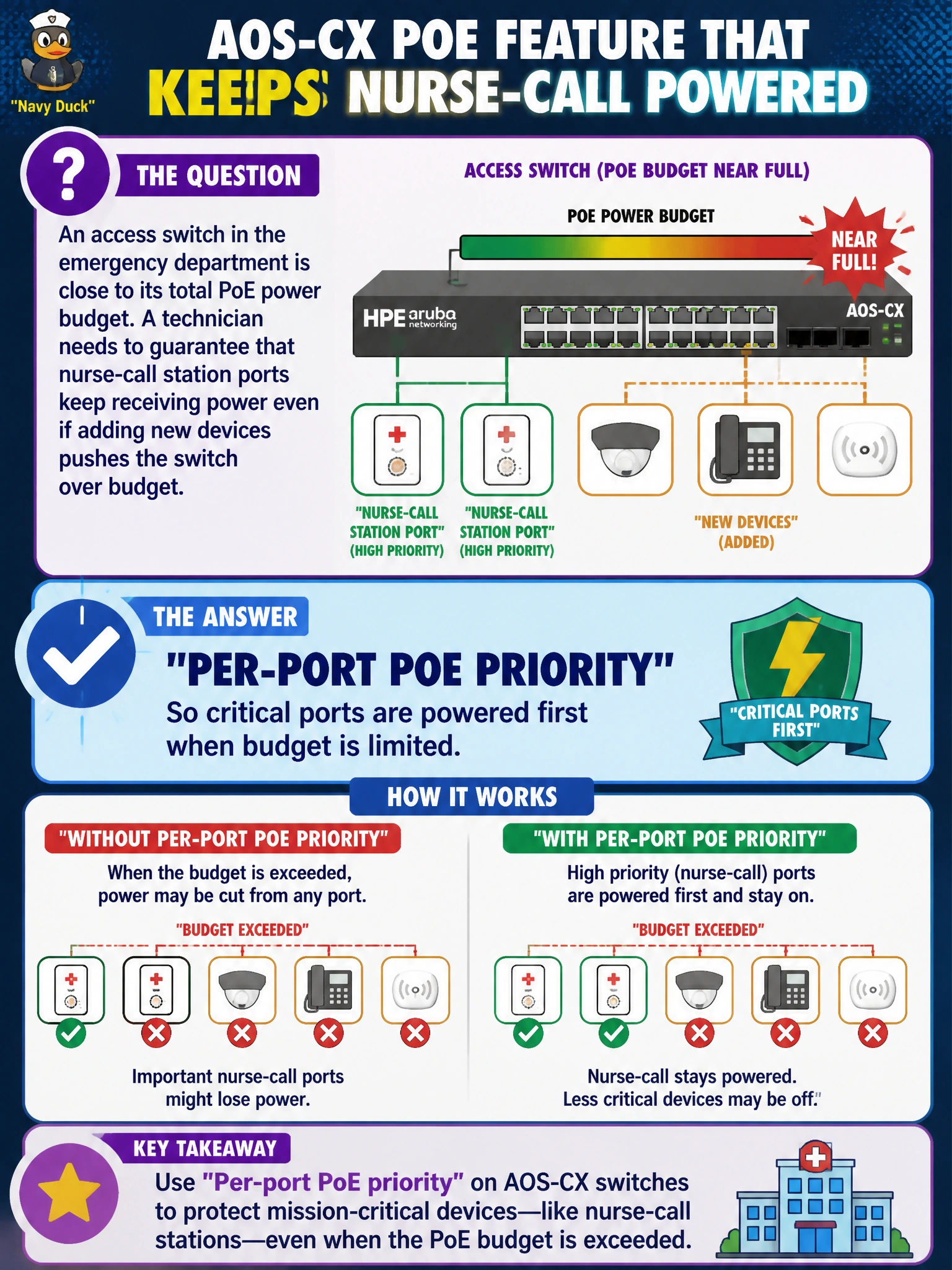
An access switch in the emergency department is close to its total PoE power budget. A technician needs to guarantee that nurse-call station ports keep receiving power even if adding new devices pushes the switch over budget. What AOS-CX PoE feature addresses this?
Select an answer to reveal the explanation.
Short Explanation
When there isn't enough power budget to go around, priority is what decides who gets served first. Marking the nurse-call ports as high priority tells the switch to protect their power even if it means denying power to a lower-priority port added later.
Full Explanation
PoE priority lets an administrator mark specific ports as higher priority so that when the switch's total PoE power budget is constrained, it preserves power to those critical ports first and denies or drops power to lower-priority ports instead, which directly protects nurse-call stations if the budget is exceeded. VSX active-gateway is a Layer 3 feature that lets a VSX pair share a virtual gateway IP and MAC for routing redundancy — it has no relationship to PoE power budgeting or allocation and would not affect which ports get powered. Changing a port's native VLAN ID affects how untagged Layer 2 frames are classified on a trunk; it has no bearing whatsoever on the switch's electrical power budget or PoE negotiation. Enabling jumbo frames changes the maximum frame size the switch will forward for larger payloads, a data-plane setting entirely unrelated to how PoE power is sourced or allocated, and it does not reduce a device's actual power draw. Caveat: PoE priority only helps once the budget is actually exceeded; it does not increase the switch's total power capacity, so a persistently tight budget may still require a hardware or power-supply upgrade. Operational check: after setting priorities, simulate or observe a budget-constrained event and confirm the nurse-call ports remain powered while lower-priority ports are the ones affected.