
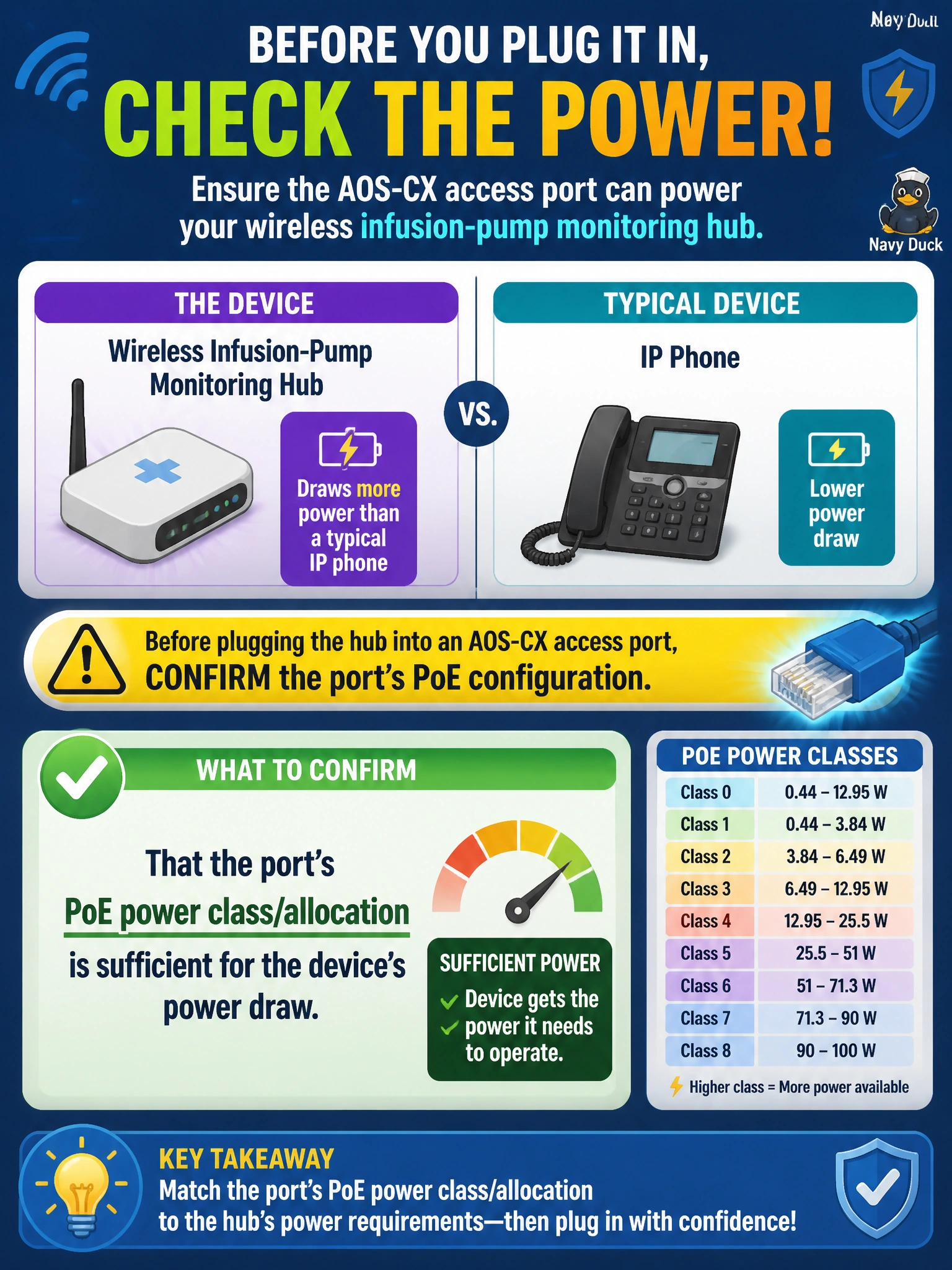
A new wireless infusion-pump monitoring hub in the ICU draws more power than a typical IP phone. Before plugging it into an AOS-CX access port, what should the technician confirm about that port's PoE configuration?
Select an answer to reveal the explanation.
Short Explanation
Not every powered port hands out the same amount of juice — some devices need more than a basic phone or access point. Checking that the port's PoE allocation actually covers the pump hub's power class avoids a device that powers on, then browns out or refuses to negotiate full functionality.
Full Explanation
PoE ports on AOS-CX negotiate a power class or allocation with the connected device, and confirming that allocation is sufficient for a higher-draw device like an infusion-pump monitoring hub prevents the device from being under-powered or from exceeding what the port or the switch's overall PoE budget can supply. Trunk mode is a VLAN-tagging concept and has no relationship to how much electrical power a port can deliver — mixing the two ideas conflates data-plane VLAN handling with the physical power-sourcing function of PoE. LACP concerns bundling data links into a logical aggregate and plays no role in power negotiation between a switch port and a powered device; a standalone access port delivers PoE just as well as one that is part of a LAG. Spanning tree manages loop prevention and topology convergence; disabling it does not speed up or otherwise affect PoE power delivery, and disabling it for this reason would remove loop protection for no actual benefit. Caveat: a high-draw device can also exceed the switch's total PoE power budget even if the individual port supports it, so budget headroom across the whole switch matters too, not just the one port. Operational check: after connecting the device, verify the port shows the expected PoE class and delivered wattage rather than assuming a green link light means full power was granted.