
An outpatient annex is being built with two AOS-CX aggregation switches configured as a VSX pair to avoid a single point of failure. In normal, healthy operation, how do the two VSX switches behave from the perspective of connected devices?
Select an answer to reveal the explanation.
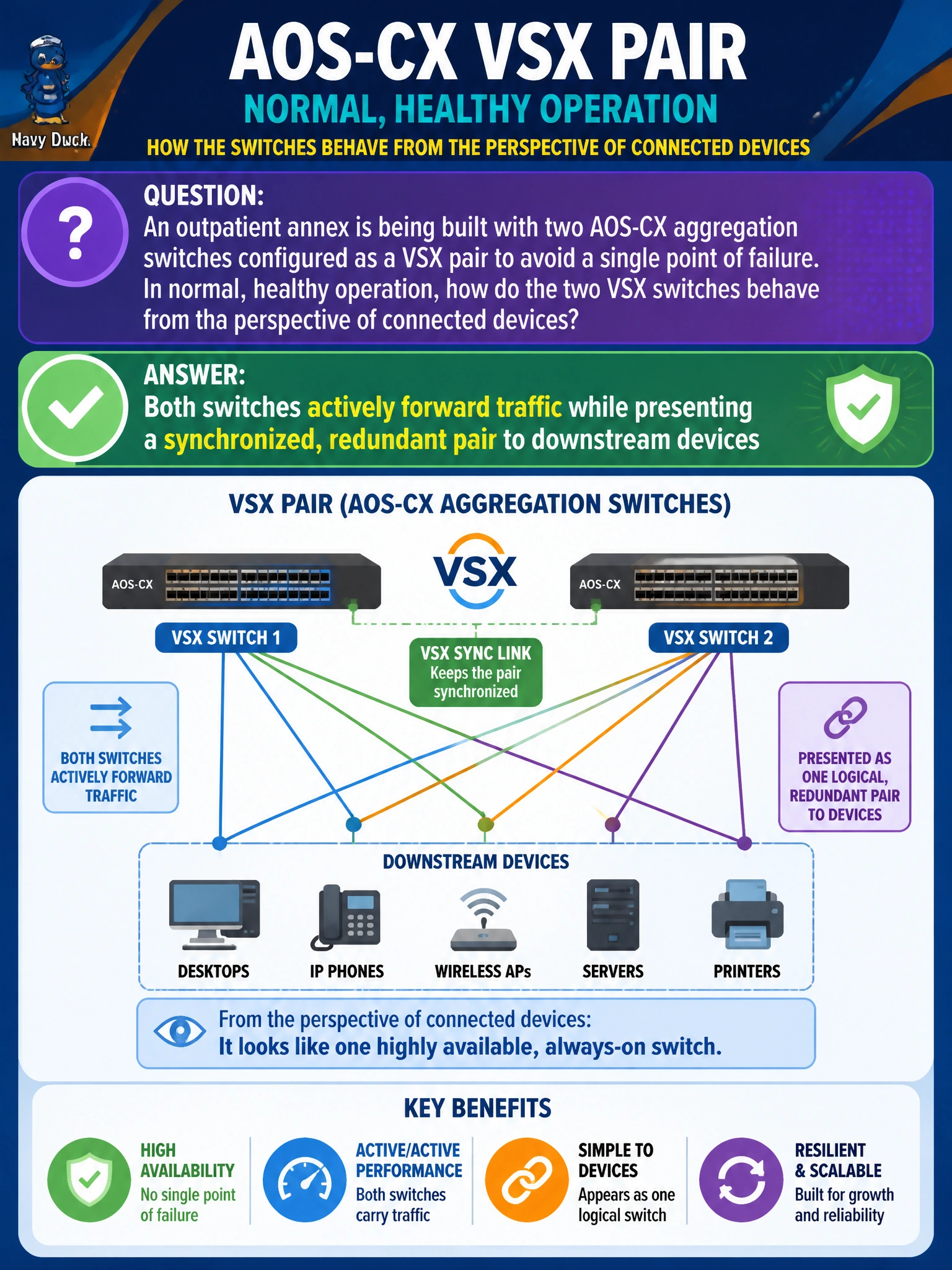
Short Explanation
VSX isn't a spare sitting on the bench — both switches are on and pulling their weight at the same time. Downstream devices see a consistent, synchronized pair, so if one switch goes down the other keeps forwarding without anyone rewiring anything.
Full Explanation
VSX keeps two separate physical switches with independent management planes but synchronizes their control-plane state and forwarding tables so both actively forward traffic simultaneously, giving devices dual-homed to the pair active-active resiliency without a failover delay. Describing one switch as powered off and booting only on failure describes a cold-standby model, which is not how VSX operates and would introduce an unacceptable outage window during failover. Saying only one switch forwards while the other idles describes an active-passive design, which wastes half the available bandwidth and is specifically what VSX improves on compared to older active-standby technologies. Claiming the two switches merge into a single control plane with one management IP describes VSF stacking behavior, not VSX — VSX deliberately keeps each switch's control plane and management IP independent, which is precisely why a control-plane bug in one switch does not take down the other. Caveat: because each VSX switch keeps its own management IP, monitoring tools need to poll both members individually to get a complete picture of the pair's health. Operational check: verify VSX status on both switches shows a synchronized and active state before considering the pair fully deployed.