
A technician is forming a link aggregation group between an access switch and the aggregation switch and wants both ends to actively negotiate the bundle rather than assume it is already formed. Which LACP configuration achieves this?
Select an answer to reveal the explanation.
Short Explanation
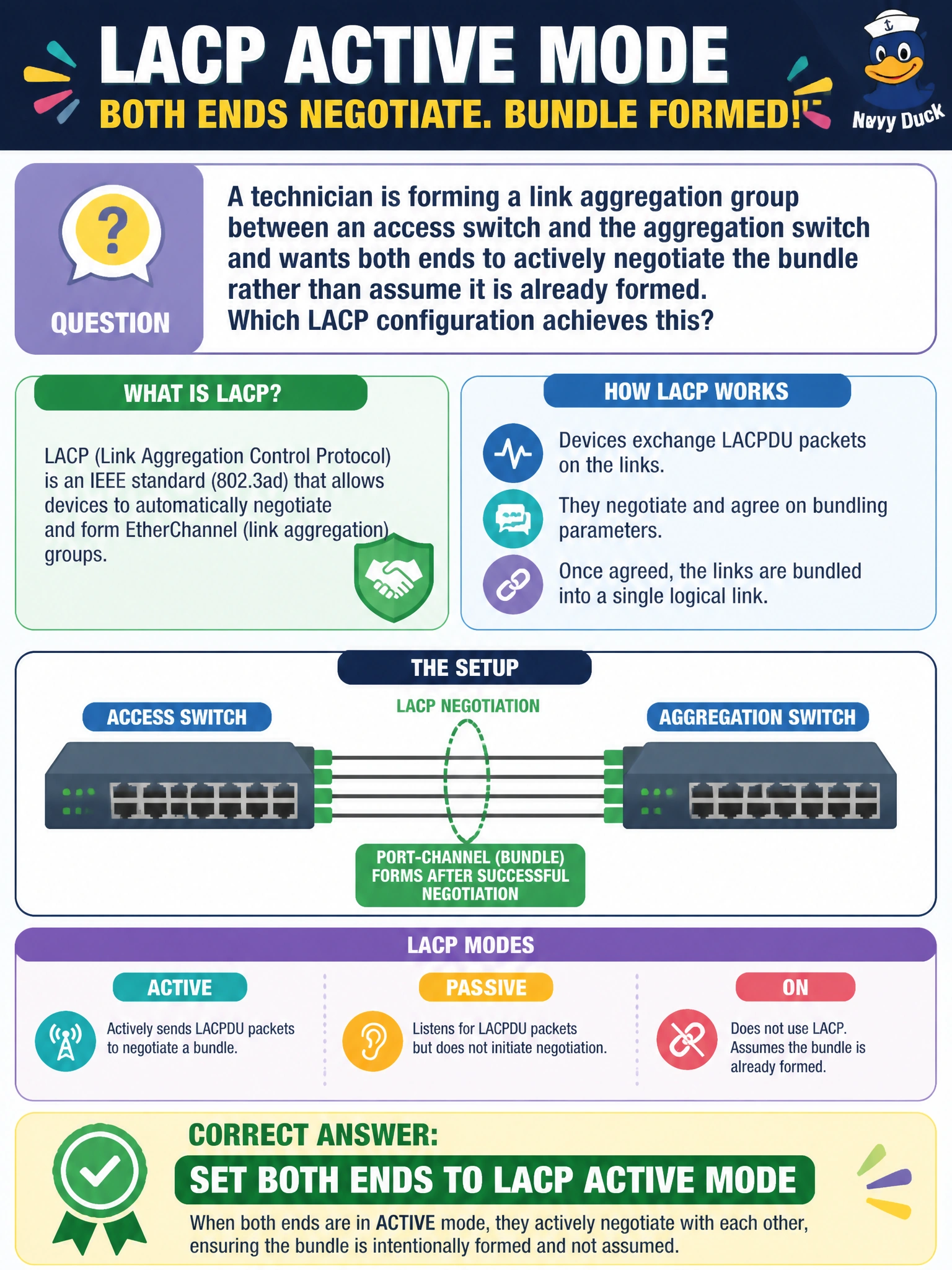
Active mode means the switch speaks up first instead of waiting to be asked. Setting LACP to active on both ends means each side sends LACP packets right away, so the bundle negotiates and comes up on its own without extra coordination.
Full Explanation
LACP active mode causes a switch to initiate negotiation by sending LACP packets regardless of what the other side does, and setting both ends to active guarantees negotiation happens even if there is any doubt about the peer's configuration — at least one side must be active for a LAG to form at all. Passive mode on both ends fails entirely: a passive port only responds to LACP packets and never sends the first one, so if neither side initiates, the two switches sit silent and no aggregate ever forms. Leaving one end unconfigured does not create a valid negotiation partner — LACP needs an explicit mode on both member interfaces, and an unconfigured interface will not participate in the protocol at all. Disabling LACP and using a static aggregate removes negotiation and monitoring entirely, which means neither switch verifies that the other end is even correctly bundled — a miswired cable or mismatched member set can silently create a forwarding loop or a broken link with no protocol-level warning. Caveat: active-active is the most robust choice precisely because it does not depend on remembering which side was configured first. Operational check: verify LACP state on both switches shows the bundle as up and 'bundled,' not merely 'individual,' after applying the configuration.