
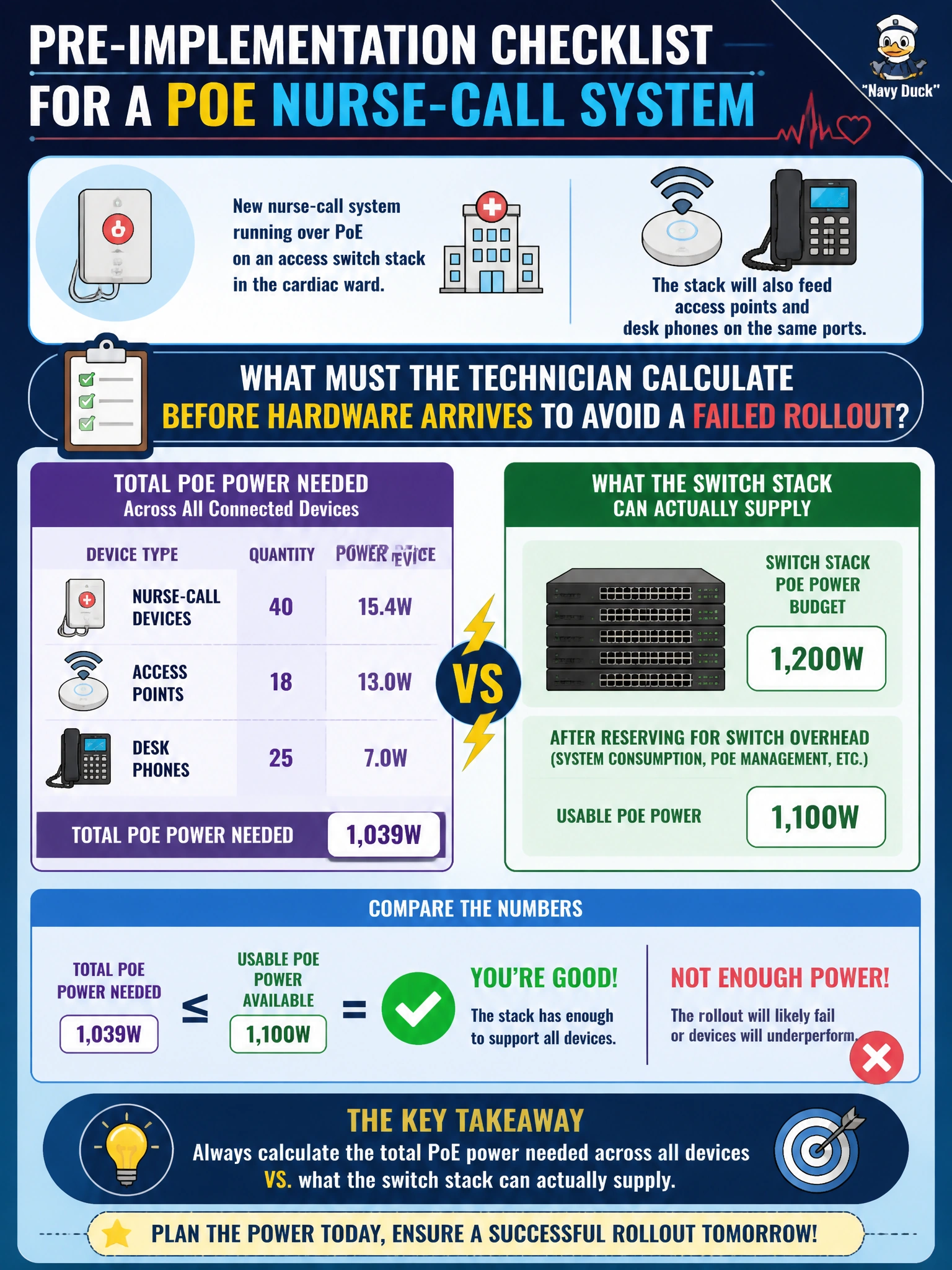
A junior technician is planning the pre-implementation checklist for a new nurse-call system that will run over PoE on an access switch stack in the cardiac ward. The stack will also feed access points and desk phones on the same ports. What must the technician calculate before hardware arrives to avoid a failed rollout?
Select an answer to reveal the explanation.
Short Explanation
Every PoE device draws real watts, and a switch only has so many to hand out. Add up the nurse-call phones, the APs, and the desk phones, then check that against the stack's total PoE budget before it ships — otherwise the last few devices in the ward simply won't power up.
Full Explanation
Power over Ethernet is a shared, finite resource on a switch or stack, so the pre-implementation planning step has to sum the power draw of every device slated for those ports, including worst-case draw for phones, access points, and the nurse-call hardware, and compare that total against the switch stack's rated PoE budget. Underestimating this is one of the most common causes of a rollout that looks complete on paper but leaves devices unpowered once everything is plugged in, which is especially unacceptable for a nurse-call system on a cardiac ward. VLAN scale is a logical segmentation limit that has nothing to do with electrical power delivery and is rarely a binding constraint on a modern access stack. Spanning-tree diameter concerns loop-prevention topology depth, not power, and is unrelated to whether devices can draw current from their ports. A DNS suffix search order affects name resolution on a server and has no relationship to switch port power at all. Before hardware arrives, the technician should total the wattage from each device's PoE class or nameplate rating and confirm headroom remains for future growth.