
Before approving any production apply, finance wants each HCP Terraform run on AWS, Azure and Google Cloud resources to show the estimated monthly cost and how much the change raises or lowers it. What provides this?
Select an answer to reveal the explanation.
Short Explanation
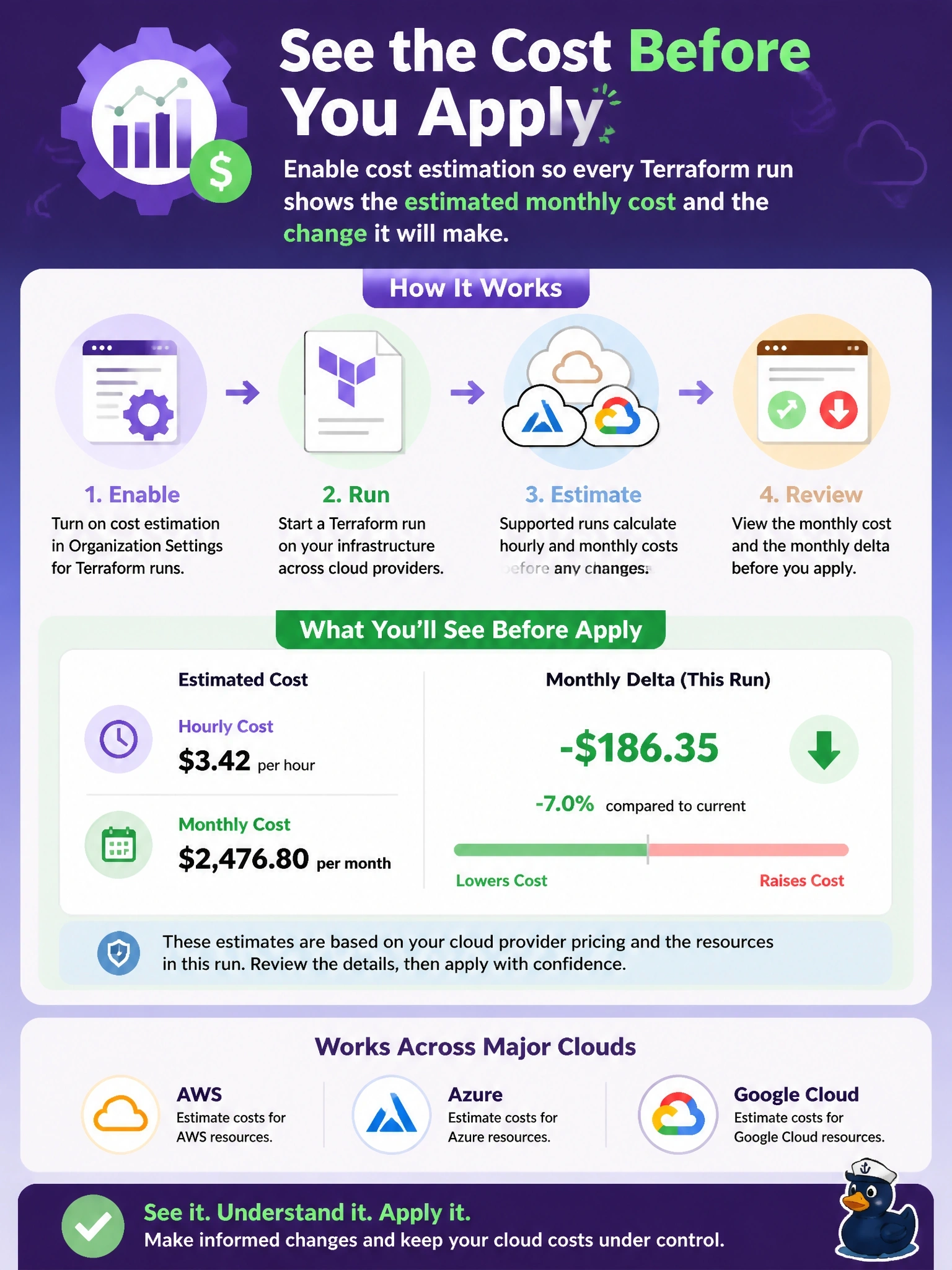
Cost estimation is the price tag stuck on the plan: you see the monthly cost and the change before you hit apply. The Usage page and HCP billing are about what you pay HashiCorp, not what AWS will bill you.
Full Explanation
HCP Terraform cost estimation is disabled by default and is turned on organization-wide under Settings, Cost Estimation. Once enabled, every run gets an extra phase between plan and apply that shows an hourly and monthly cost for each estimable resource, the total, and the monthly delta, with an itemised list and a list of resources that could not be estimated. Supported resources come from the major AWS, Azure and Google Cloud providers, and usage-based or unpriced resources are listed as unestimated. Because the estimate appears before apply, approvers can use it in their decision, and Sentinel policies can read it through the tfrun import. The Usage page reports managed resource counts and plan limits for billing HCP Terraform itself; it shows no cloud prices. The explorer queries workspaces, modules, providers and Terraform versions across the organization and does not compute cloud costs. The HCP portal shows what HashiCorp charges for managed resources, not what the cloud provider will charge for them. Exam caveat: cost estimation is not performed for runs that use resource targeting, and the estimate is only an estimate. Operational check: enable the setting, queue a plan that adds an instance in a test workspace, and confirm the cost estimation phase shows a positive monthly delta.