
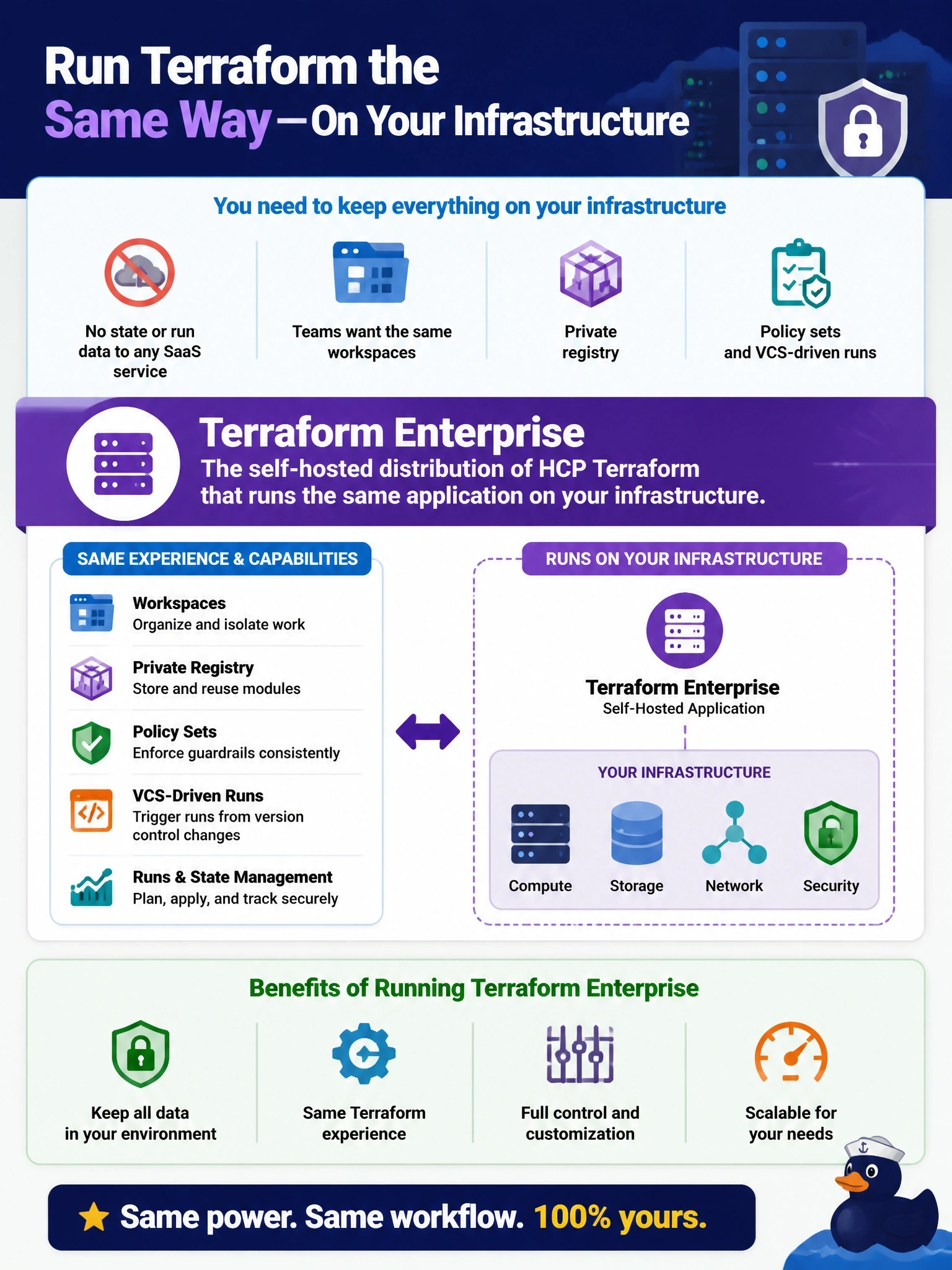
A regulated customer cannot send state or run data to any SaaS service, but its teams want the same workspaces, private registry, policy sets and VCS-driven runs that HCP Terraform provides. Which offering should the customer use?
Select an answer to reveal the explanation.
Short Explanation
Same restaurant menu, but cooked in your own kitchen: Terraform Enterprise is HCP Terraform installed on your infrastructure. Agent and local modes move where Terraform runs, but the state and control plane still live in the SaaS.
Full Explanation
Terraform Enterprise is HashiCorp's self-hosted distribution of HCP Terraform. The two are different distributions of the same application, so workspaces, projects, the private registry, policy sets, VCS-driven runs and the API work the same way, and HCP Terraform documentation applies to Terraform Enterprise unless it states otherwise. Because the customer operates the instance, state and run data stay on its own infrastructure, and it adds enterprise capabilities such as audit logging and SAML single sign-on. Agent execution mode moves where plans and applies execute, but HCP Terraform still orchestrates the run, stores state and holds run data, so the SaaS restriction is not met. Local execution mode is worse for this requirement: state is still stored in HCP Terraform, and remote runs, VCS integration and policy enforcement are lost. A CLI and S3 backend design keeps data in-house but discards the managed workflows the teams asked for, leaving them to rebuild a registry, policy enforcement and run orchestration by hand. Exam caveat: some features differ between the two distributions, for example data retention policies are exclusive to Terraform Enterprise, so check feature notes when planning a migration. Operational check: after installation, connect a VCS provider, create a workspace, and confirm a merge queues a run whose state is stored only in the customer's own storage.