
A prod workspace has cost estimation enabled and a Sentinel policy set attached. A run finished planning, showed an estimate, and is now paused without applying, and the run page shows the state Policy Override. Which statement correctly describes the run's progress?
Select an answer to reveal the explanation.
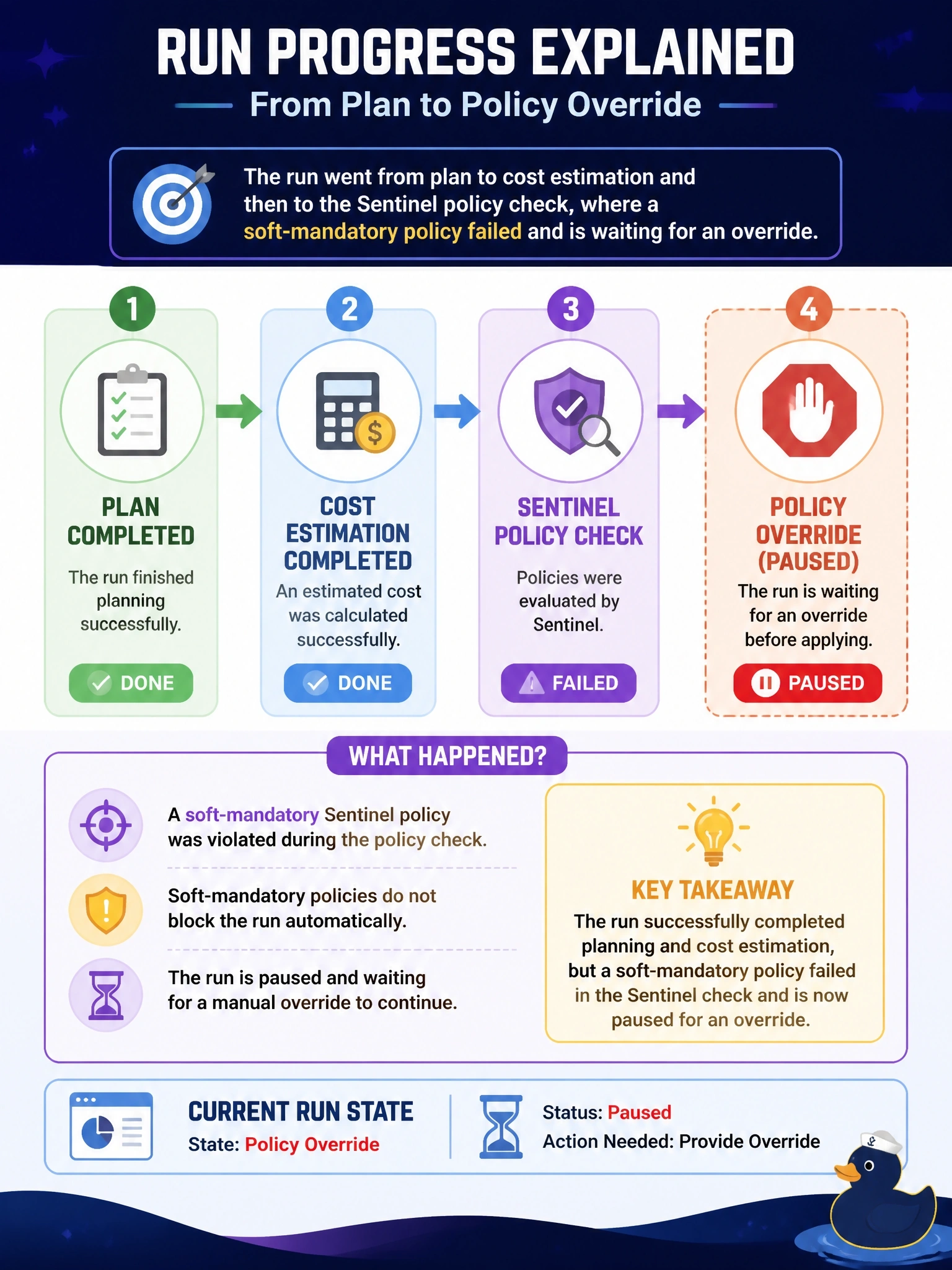
Short Explanation
Think of an airport: check-in (plan), the price tag at the counter (cost estimate), then security (policy check), and only then boarding (apply). Policy Override means a soft-mandatory rule flagged you and someone with override rights has to wave you through.
Full Explanation
HCP Terraform moves a run through ordered stages: pending, plan, cost estimation, policy check, apply and completion, with optional run task phases around plan and apply. Cost estimation runs only when it is enabled and uses the plan data, so it always follows a successful plan. The Sentinel policy check then evaluates the plan, and because the cost estimate already exists, policies can read cost data through the tfrun import. Policy Override is the state for a soft-mandatory failure: the run pauses until a user with permission to manage policy overrides approves it or a user with apply permission discards it. An order in which apply precedes cost estimation is wrong because estimation is a pre-apply phase meant to inform the decision to apply. Cost estimation cannot come before plan because it needs the planned resource changes. A hard-mandatory failure in this classic policy check flow ends the run in the Plan Errored state rather than pausing for an override. Cost estimation does not replace or skip the policy check, and a run waiting on a run task shows a pre-plan, post-plan or pre-apply running state instead. Exam caveat: OPA policy evaluations run after plan and before cost estimation, and a policy set can be configured to allow overrides of mandatory failures. Operational check: open the run, expand the policy check section, and read which policy failed and its enforcement level.