
A program manager orchestrates an onboarding workflow where a triage agent should run a prebuilt data-redaction skill before summarizing support tickets containing PII. The skill already exists with defined inputs for ticket text and retention rules. How should the team call the skill from the agent and workflow for reliable execution?
Select an answer to reveal the explanation.
Short Explanation
You want room service by name, not by hint. Invoking the skill explicitly with inputs guarantees redaction runs every single time.
Full Explanation
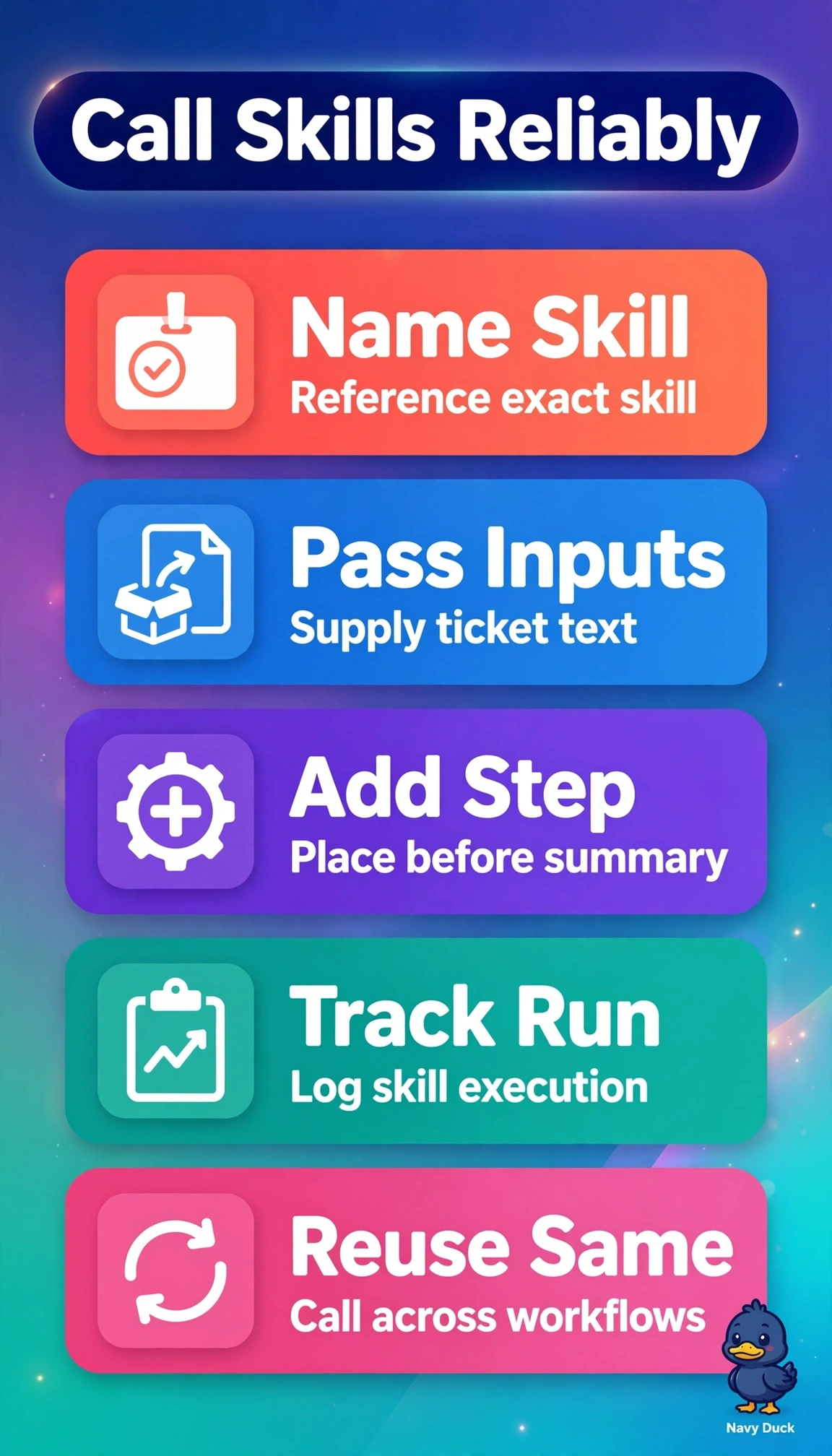
The correct approach succeeds because it unites precise addressing, complete parameters, correct sequencing, and observability: referencing the prebuilt skill by name prevents misselection, providing ticket text plus retention rules fulfills its defined contract so no default handling can under-redact, placing the call in both agent prompt and workflow step gives the triage agent clear invocation logic while letting the orchestrator enforce before-summarization order with context carried forward, and explicit tracked execution proves redaction occurred before sensitive data reaches the summarizer. Dynamic runtime discovery fails on addressing despite preserving inputs and timing, because letting the agent locate a suitable skill invites variance and hallucination that undermines deterministic reliability required for PII compliance. Workflow-only centralization fails on agency despite correct naming, inputs and timing, because omitting the prompt instruction leaves the triage agent unaware of its role, risking skipped invocation or summarization of raw text due to disconnected context. Implicit background execution without tracking fails on observability despite correct naming, inputs and placement, because silent automatic running provides no verifiable proof of completion or auditable record that governance demands before summarization. An exam caveat is to not mistake efficient patterns like auto-discovery, orchestrator-only control, or silent helpers for correctness when the scenario explicitly requires named, fully parameterized, and traceable invocation. For a practical check, inspect the execution trace to confirm the named skill succeeded with both inputs logged before summarization began and that only its redacted output fed the summarizer.