
A product manager builds a custom Copilot agent that drafts competitive release notes, must cite current competitor pricing pages, and must avoid stale training data when answering analysts. Which agent configuration should the manager use to create a custom agent by adding web search to instructions or prompts?
Select an answer to reveal the explanation.
Short Explanation
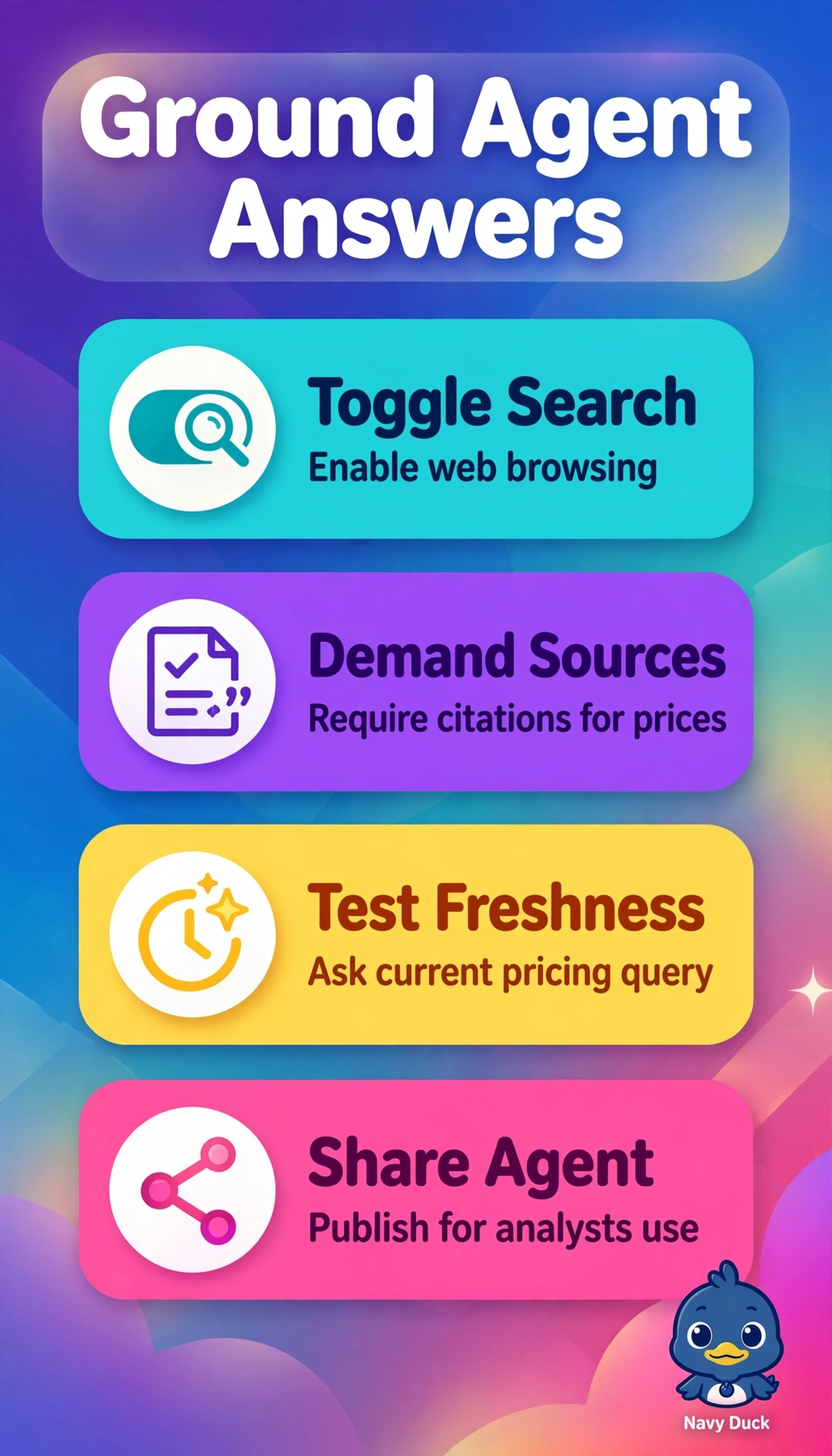
Fresh pricing only comes from the live web. Turning on browsing with citation rules gives you a newspaper instead of last year's memory.
Full Explanation
The correct configuration pairs live web search in instructions with an explicit requirement to cite current sources for pricing claims, which directly satisfies both analyst needs for verifiable competitor pricing and protection against stale pretraining knowledge by forcing retrieval at answer time. The paraphrased-summary approach fails on verifiability because live retrieval without mandated source links leaves pricing assertions uncheckable and noncompliant with the must-cite requirement, even though grounding in live data is otherwise sound practice for readability. The SharePoint-grounded approach fails on source scope because citations to approved internal libraries validate first-party content but cannot substitute for current external competitor pages, leaving competitive pricing ungrounded despite strong governance. The scheduled-update approach fails on currency because periodic knowledge refreshes still rely on static snapshots that lag market changes, whereas the scenario demands live web retrieval to avoid stale training data when answering analysts. Exam caveat: distinguish internal grounding for approved product truth from web search for external market truth, as questions often test selecting the correct grounding source rather than general best practice. Practical check: in testing, ask for a competitor price change from the past week and verify the response returns a live page link with date rather than a paraphrase or internal document.