
A retail PM must choose between assigning a GitHub issue to Copilot cloud agent versus building a custom agent for refund triage that uses internal policies. Stakeholders confuse the two options. Which distinction should clarify Copilot cloud agents from custom agents?
Select an answer to reveal the explanation.
Short Explanation
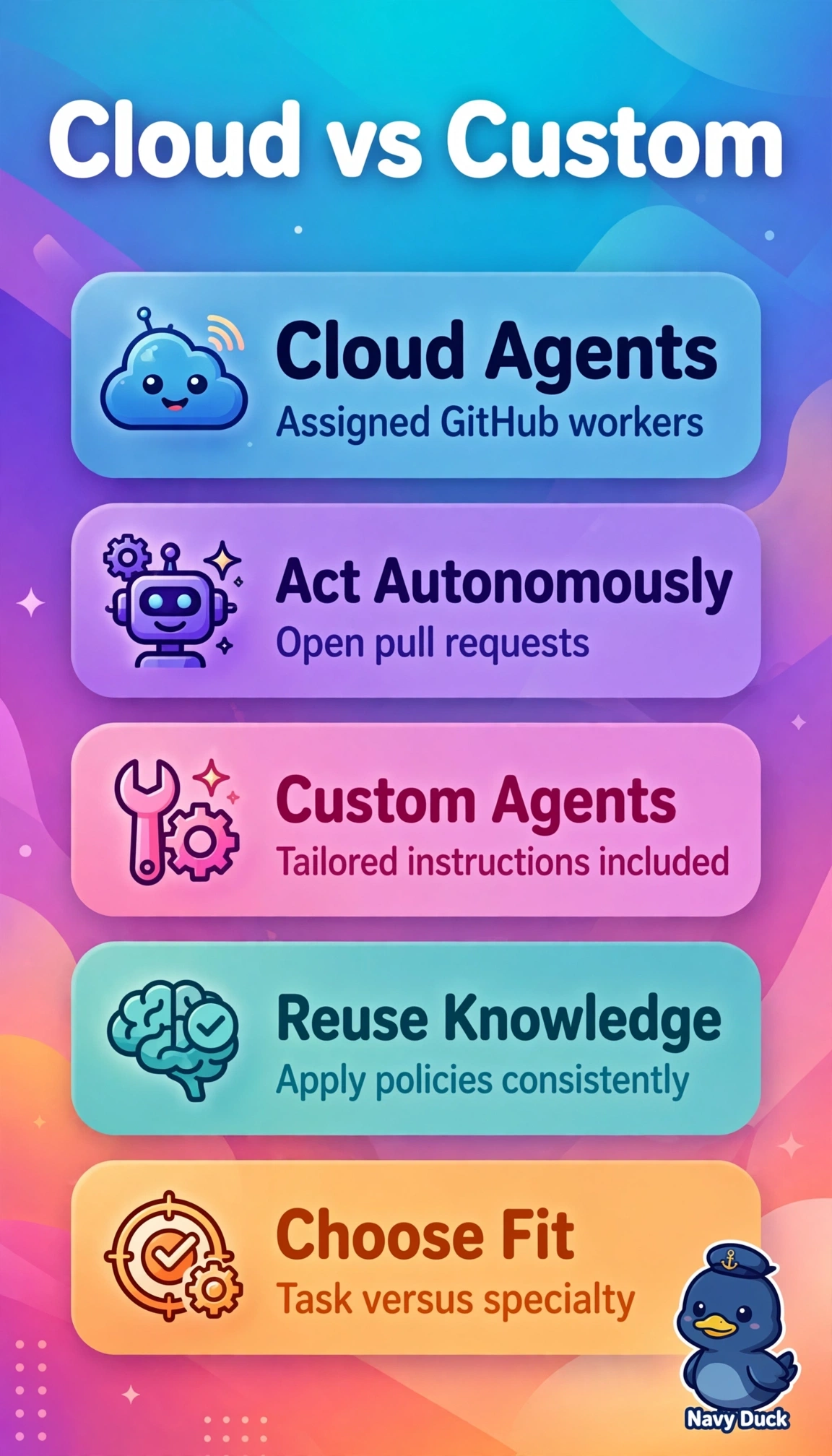
One is a temp helper, the other is your trained specialist, and that role split matters. Cloud agents act on tasks while custom agents carry your playbook.
Full Explanation
The correct distinction holds because Copilot cloud agents are delegated GitHub work items that execute autonomously in cloud context with repository access to progress issues toward pull requests, whereas custom agents are purpose-built assistants whose value comes from embedded tailored instructions, here internal refund policies and triage workflow logic. The live-IDE description fails by concept because real-time IDE assistance describes Copilot completion and chat behavior, not asynchronous autonomous execution assigned from GitHub. The marketing-guidelines description fails by concept because although it correctly captures tailored embedding, it misplaces the domain to marketing rather than the stated refund triage responsibility, so it does not resolve the stakeholder confusion about refund handling. The reversed-ownership description fails by concept because it inverts accountability by attributing autonomous GitHub execution to the custom agent and refund policy embedding to the cloud agent, contradicting the defined responsibilities in the scenario. Exam caveat is to separate delivery mode from knowledge content, since cloud versus custom is not generic versus powerful but delegated GitHub execution versus domain-tailored behavior with policy grounding. Practical check is to trace where work starts, GitHub issue assignment with agent logs versus custom system instructions, and to inspect the custom agent prompt for cited internal refund policy steps and triage actions before deciding to assign versus build.