
A hiring manager pilots an agent to screen engineering applications in GitHub Issues, summarize portfolios, schedule interviews, and send rejection messages for 300 applicants. False rejections create legal and fairness risks, while scheduling is low risk. Which human review design identifies critical decision points where human judgment is required?
Select an answer to reveal the explanation.
Short Explanation
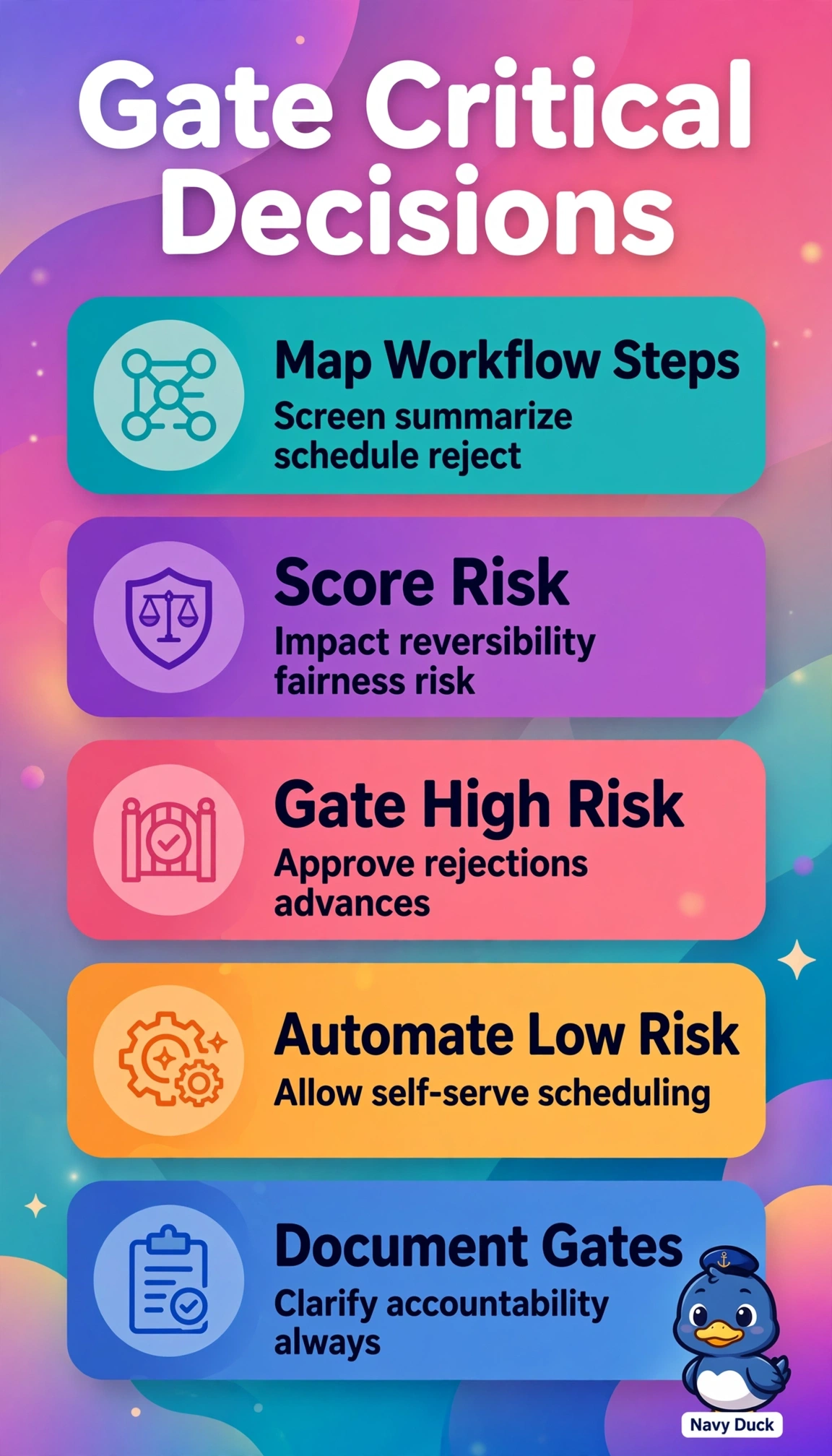
You’re deciding where to place crossing guards, not paving everything. Decision-point mapping puts people over rejections, automation over calendars.
Full Explanation
The correct design applies risk-proportionate oversight by inserting mandatory human judgment at irreversible, externally consequential decision points while automating reversible logistics, which directly addresses the stated legal and fairness exposure from false rejections and flawed advancement for 300 applicants while preserving efficiency where error cost is low. One plausible design requires review only for rejections while auto-advancing candidates, which correctly controls the rejection risk but fails selective gating by leaving advancement unguarded, allowing biased or unqualified progression to consume interview resources and embed early screening errors. Another plausible design requires review only for advancement while auto-sending rejections, which correctly protects interview quality but inverts the primary risk profile because an unreviewed rejection is final, applicant-facing, difficult to remediate, and carries the explicitly highlighted legal liability. A third plausible design requires review for rejections, advancement, and scheduling, which is common for conservative pilots and appears thorough, but it fails calibration by treating low-risk reversible scheduling as critical, creating bottlenecks without reducing material risk and missing the requirement to differentiate routine automation from judgment-required steps. On the exam, do not equate more human involvement with better safety; match review intensity to reversibility, external visibility, and stated legal impact rather than applying uniform oversight. As a practical check, map each agent action to harm if wrong and ease of undo, then require an explicit approval gate only where error is hard to reverse or legally consequential and allow logged automation with sampling audit elsewhere.