
A product operations lead wants a repository agent to triage new issues by labeling, assigning priority, and requesting missing details. Runs are inconsistent. Which approach best creates effective agentic workflow instructions?
Select an answer to reveal the explanation.
Short Explanation
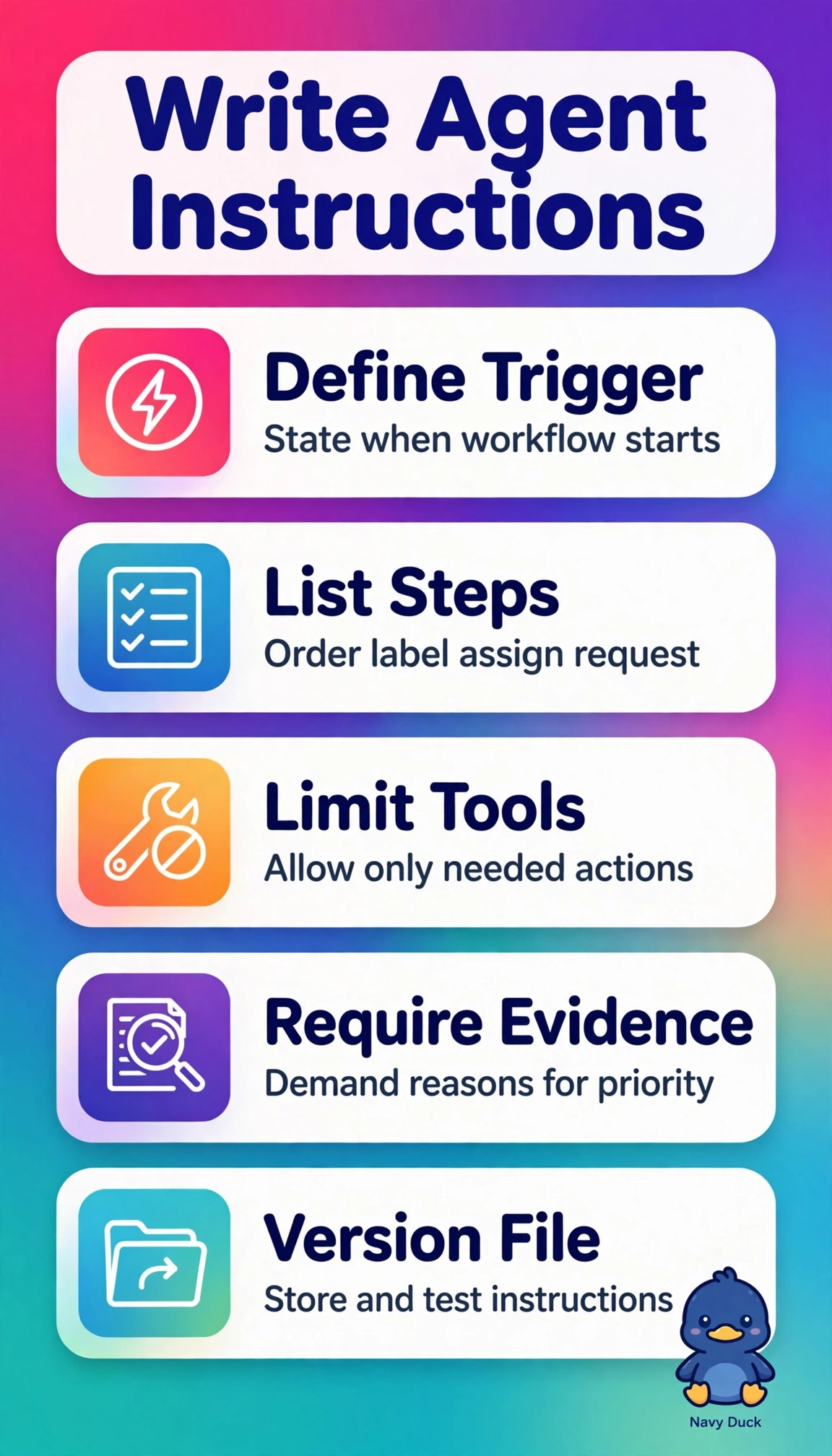
You'll get steadier triage when you've got a tight checklist that says when to jump in, what you can touch, and what proof you need. It's like giving your agent a recipe instead of just saying 'cook something tasty' with boundaries that keep every run on beat.
Full Explanation
The correct approach succeeds because agentic triage inconsistency stems from underspecified autonomy, and scoped step-by-step instructions resolve it by binding when the agent should act, what it may do, and what proof it must record before labeling, prioritizing, or asking for detail. Documenting triage best practices with examples and rubrics is widely used for human alignment but fails as an agentic control because principles alone do not create deterministic execution and leave invocation and boundaries to model inference. Configuring repository automation rules is a sound pattern for predictable labeling but fails the need for judgment-driven work because fixed if-then rules cannot request missing details contextually or justify priority with cited evidence. Supplying structured prompt templates improves phrasing for labeling and follow-ups but fails as workflow instructions because reusable prompts lack lifecycle control of triggers, permissions, and completion criteria across runs. An exam caveat is to distinguish content help from control help: any choice that improves knowledge without constraining triggers, scope, and evidence will not fix inconsistency. A practical check is to inspect a run log and verify each triage action links to its triggering event, authorized action, and cited issue evidence.