
A business analyst with no coding background must summarize 80 lengthy vendor contracts for risk themes, then later help engineers brainstorm edge cases for an API retry logic change. Both tasks will use Copilot Chat in the browser. Which principle should the analyst apply to choose an appropriate model for each business purpose or task?
Select an answer to reveal the explanation.
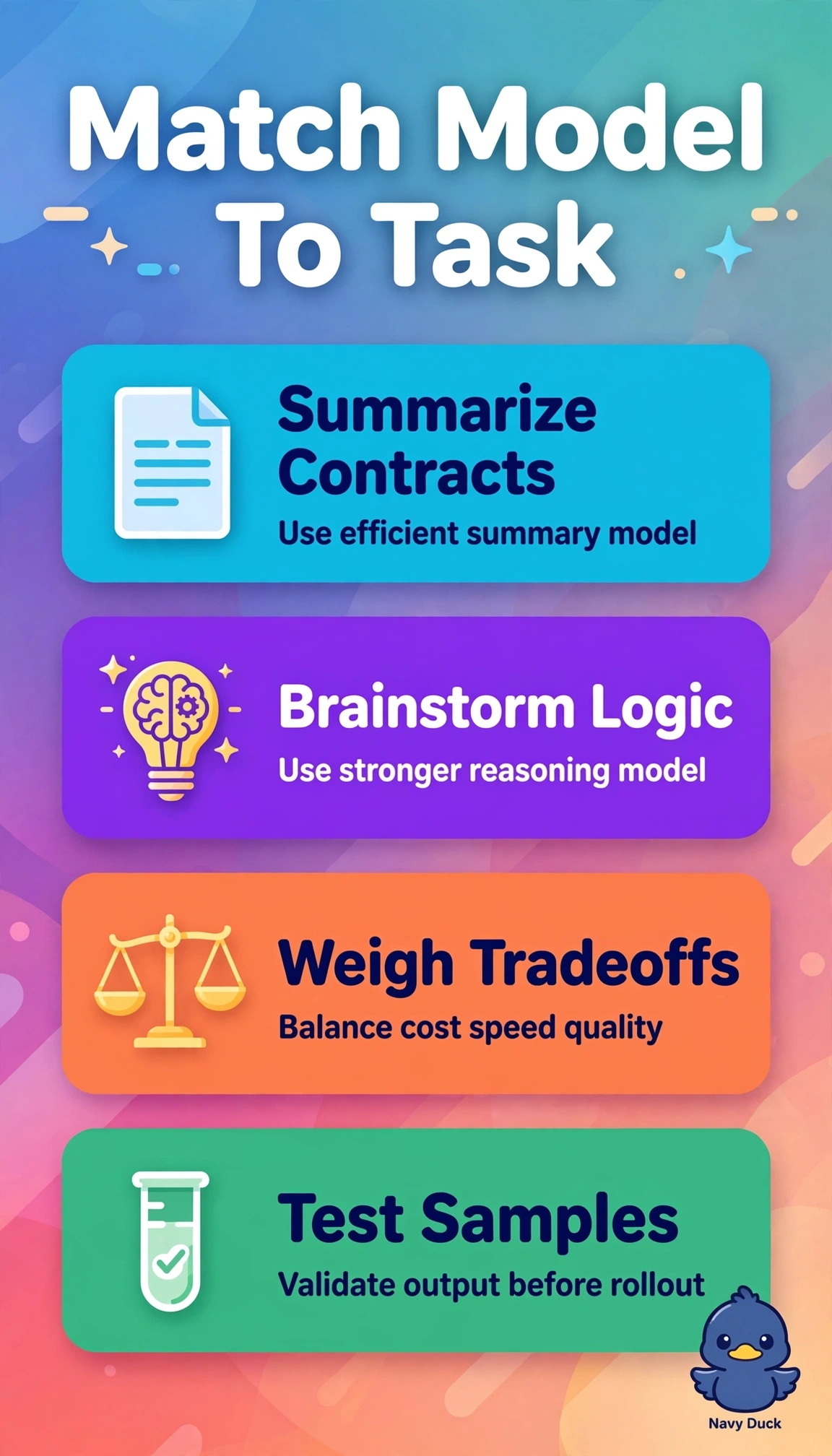
Short Explanation
You wouldn’t hire a detective to file paperwork, right? Fit matters more than horsepower when you pick models. Save deep reasoning for tricky logic and use efficient models for summaries.
Full Explanation
The correct principle is fit model capability to business purpose: 80 lengthy contracts need cost-efficient summarization with strong long-context handling to extract risk themes at scale, while brainstorming retry edge cases needs stronger reasoning to explore timeouts, idempotency, backoff, ordering, and partial failures. Using a stronger reasoning model for contract themes as well as API work provides analytical depth but violates efficiency, since it spends higher cost and latency on high-volume summarization where compression matters more than complex inference. Reusing the cost-efficient summarizer for API edge cases preserves budget predictability but underpowers the second task, because summarization optimizes for condensing input rather than conditional reasoning, so uncommon but critical retry paths would likely be missed. Integrating a code-specialized model via API is a standard engineering pattern for precise logic analysis, yet it fails the stated human constraint that the analyst has no coding background and must work in Copilot Chat in the browser, adding integration burden the scenario excludes. As an exam caveat, do not choose uniformity, maximum accuracy everywhere, or lowest cost everywhere over differentiated task fit, since questions often reward matching cost, reasoning depth, and accessibility to each purpose. As a practical check, verify which summarization and reasoning models are exposed in Copilot Chat, then pilot each on sample contracts and a sample retry prompt to compare theme recall, edge-case coverage, latency, and cost before scaling.