
A product manager asks Copilot to summarize 25 customer interviews for executives who skim. Results arrive as long paragraphs with mixed themes that executives ignore. Which instruction best specifies the structure of the response such as table format or maximum length?
Select an answer to reveal the explanation.
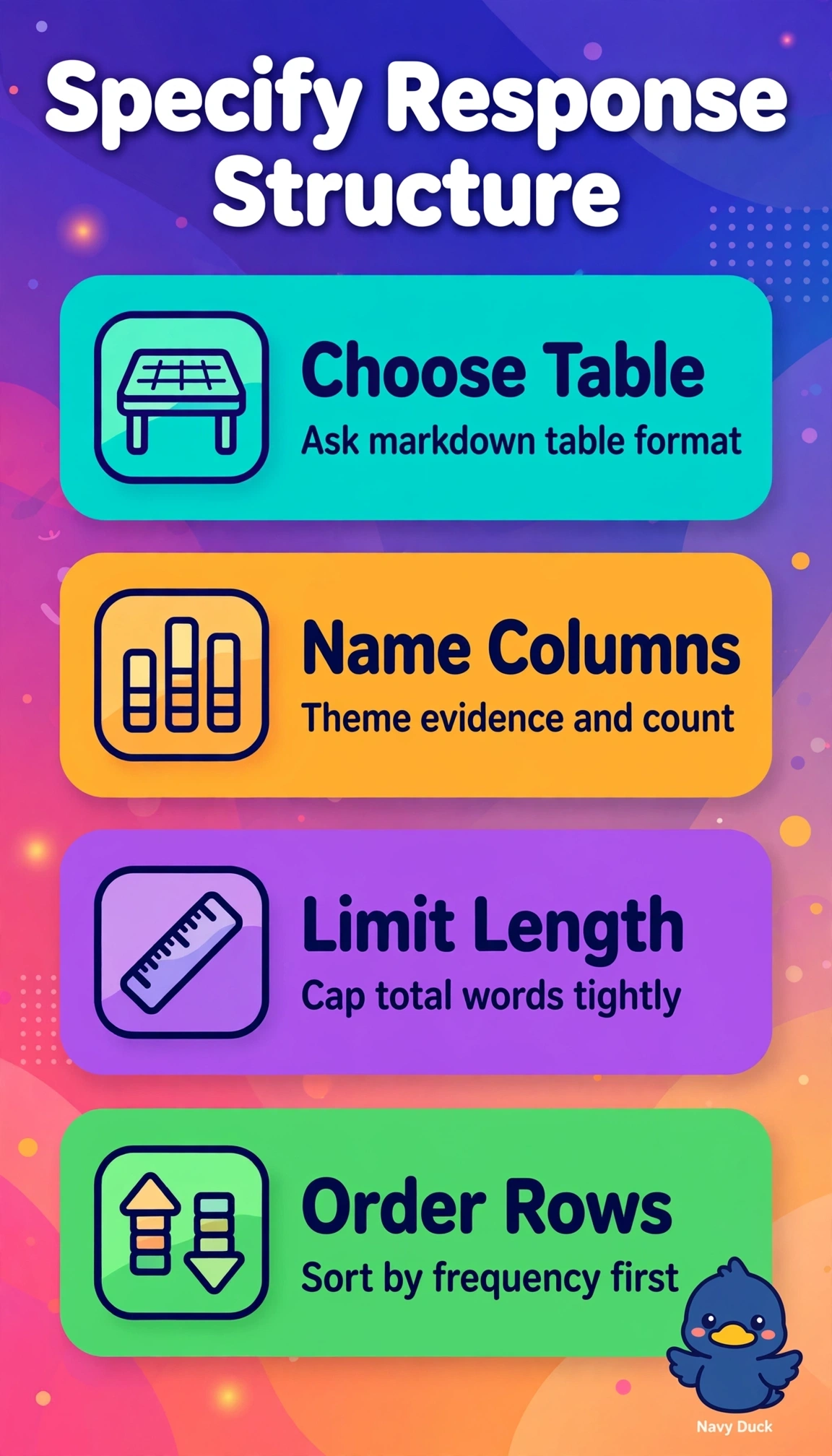
Short Explanation
Walls of text lose busy readers fast. You're handing Copilot a tight visual table blueprint with limits, like giving a suitcase size before packing.
Full Explanation
The correct instruction works because executives who skim need both a scannable layout and a hard brevity constraint to overcome long paragraphs with mixed themes, and a table with theme, evidence, and count columns limited to 180 words total delivers both by forcing thematic grouping, traceability to interview data, frequency signal across 25 interviews, and total length control. The table without a word limit fails on constraint specification because columns alone improve organization but do not prevent verbose cells that executives will still ignore, so the length problem persists despite better structure. Concise bullet points limited to 180 words fail on structure precision because bullets control length and group ideas but lack enforced columns for side-by-side comparison of theme versus supporting evidence versus prevalence, which is essential for executive triage of qualitative data. A table with owner and due date columns limited to 180 words fails on content-task fit because that schema is designed for action tracking and accountability rather than interview synthesis, replacing evidence and count with workflow fields and losing analytic value. An exam caveat is that plausible formatting instructions are not interchangeable when the stem names both format and maximum length, so select the response that satisfies both dimensions plus appropriate synthesis fields rather than settling for only one. As a practical check before sending, verify the output is actually a three-column table, that every theme row has concrete evidence and a count, and that the total response stays within the word budget without hiding overflow in overly dense cells.