
A business analyst uses Copilot to draft regional quarterly summaries from sales workbooks with tabs for each region and month. Copilot mixes regions and invents quarters when the prompt says summarize performance. Which prompt change best defines the data to be acted on and input variables for reliable outputs?
Select an answer to reveal the explanation.
Short Explanation
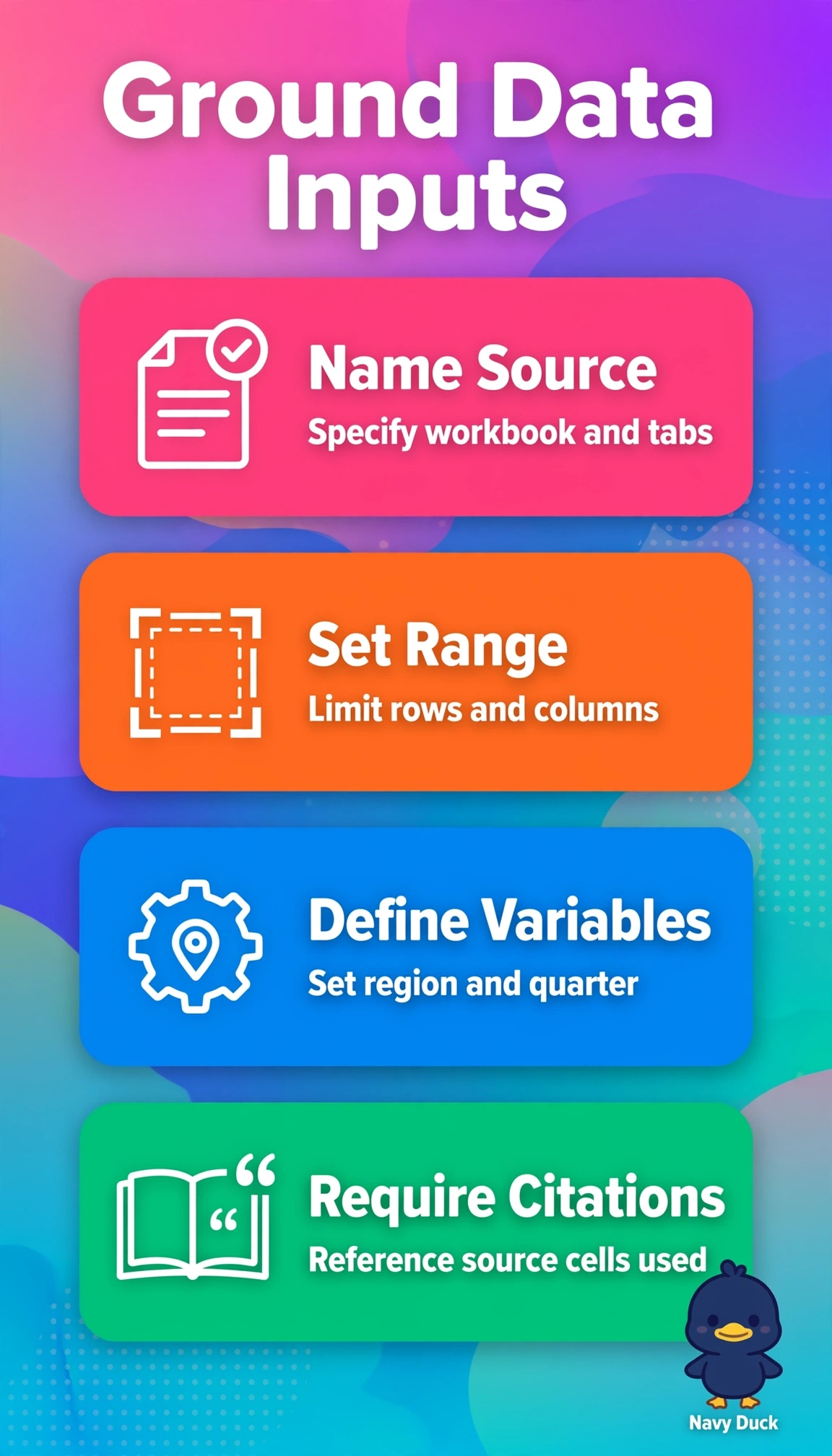
When you leave the source and scope vague, Copilot can mix data or invent time periods. Name the workbook and tabs, and define the inputs—region and quarter—so it knows exactly what to use.
Full Explanation
Naming the workbook and the tabs to use, while explicitly defining region and quarter as input variables, grounds Copilot in the intended source and scopes the data it should use. This addresses both problems: mixing regions and inventing quarters. Asking Copilot to find relevant sales data and summarize overall trends leaves the source, tabs, region, and time period open to interpretation, so it may retrieve unrelated data or combine regions. Asking for a polished executive summary with leadership recommendations changes the presentation and adds a recommendation request, but does not define the data or inputs; the original errors can remain. Pasting last quarter’s summary and asking Copilot to update the numbers may carry forward stale figures or assumptions, and it does not specify which workbook tabs or how to determine the current quarter. For an exam, distinguish source grounding, tab-level scope, and explicit input variables: reliable outputs require all three, not just a better summary request. As a practical check, verify that the prompt names the workbook and exact tabs and gives an explicit mapping for region and quarter, including which months make up that quarter, before accepting the draft.