
A regional operations manager oversees product launches across 60 retail stores using email threads and spreadsheets, causing missed deadlines and unclear ownership. Leadership requires trackable milestones, clear handoffs between merchandising and staffing teams, and measurable completion criteria. Each stage must declare what it receives and what it hands to the next team so an agent can pick it up without meetings. Which task decomposition pattern should the manager use to structure processes and tasks for automation?
Select an answer to reveal the explanation.
Short Explanation
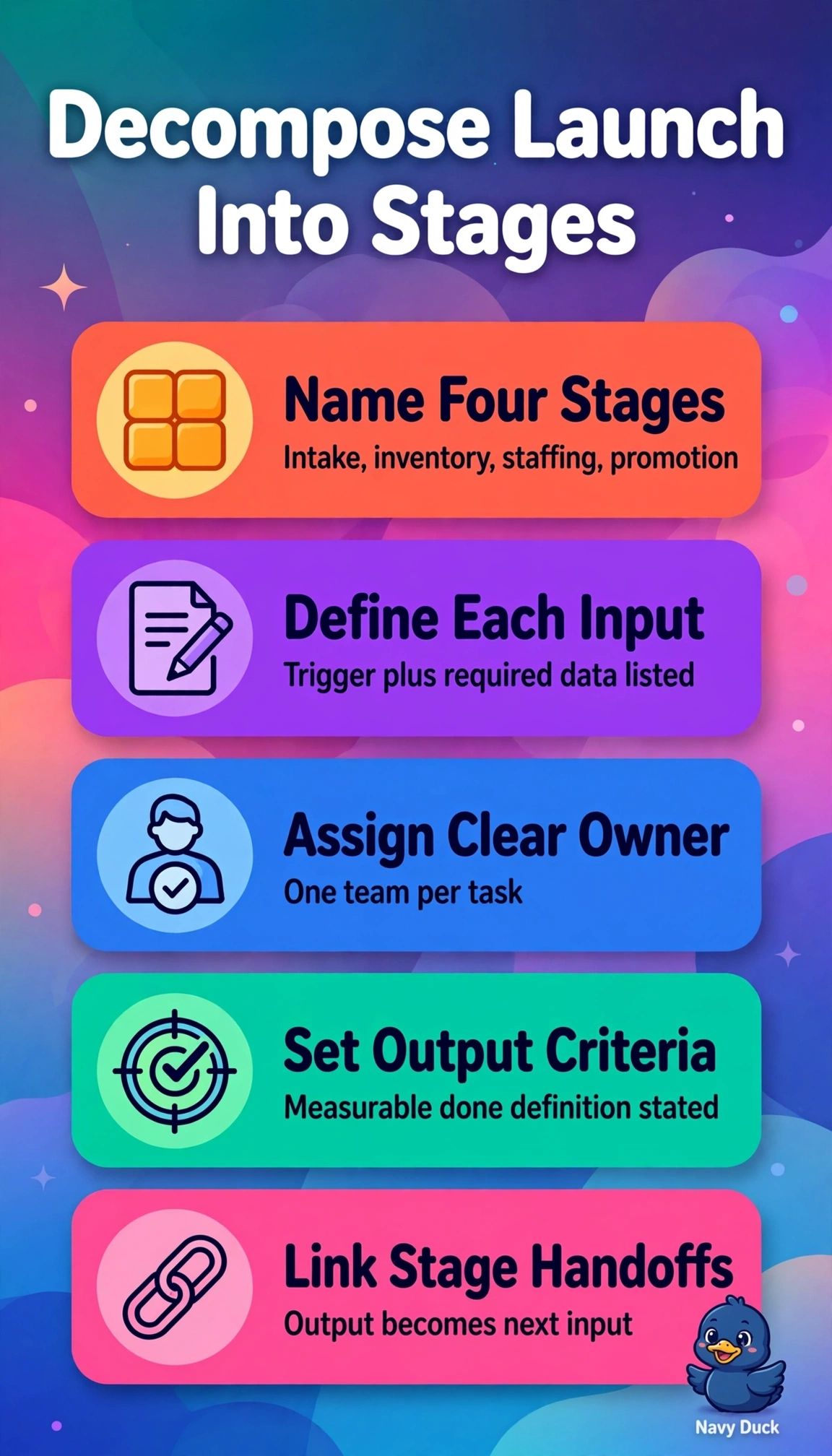
You’re turning a tangled launch into an assembly line where every station knows its job. Breaking work into stages with clear inputs and owners makes handoffs trackable and ready for agents.
Full Explanation
The correct pattern succeeds because dividing the launch into intake, inventory, staffing, and promotion stages with explicit inputs, owners, and outputs creates natural checkpoints for trackable milestones, enforces clear handoffs where merchandising output becomes staffing input, and makes completion measurable rather than anecdotal, which directly fixes missed deadlines and unclear ownership across 60 stores and provides a stable structure for automation. The continuous-flow alternative is a legitimate Lean pull approach for steady operations, but by replacing staged milestones with uninterrupted flow it removes the trackability leadership explicitly required for launches. The milestone-and-owner structure with measurable criteria reflects solid work-breakdown practice, yet without defined handoff contracts it leaves the critical merchandising-to-staffing transfer implicit and recreates the current email-driven ambiguity. The staged approach with milestones, owners, and handoff meetings captures good stage-gate governance, but substituting collaborative meetings for measurable outputs leaves completion criteria subjective and unauditable at scale. On the exam, do not select a generally good practice that drops even one stated requirement, as the stem deliberately tests completeness over familiarity. As a practical check, verify each stage could be automated by asking what system trigger starts it, who owns it, what artifact is handed off, and what measurable condition closes it.