
A technical project manager asked Copilot in agent mode to refactor a reporting dashboard, but after several accepted edits the layout broke and velocity charts disappeared, requiring a quick return to the last working state. Which use of reverting changes by using checkpoints restores stability fastest?
Select an answer to reveal the explanation.
Short Explanation
Checkpoints are your time machine when a refactor goes sideways. Rolling back to the last good save restores calm fast, making checkpoints your safety net for bold experiments.
Full Explanation
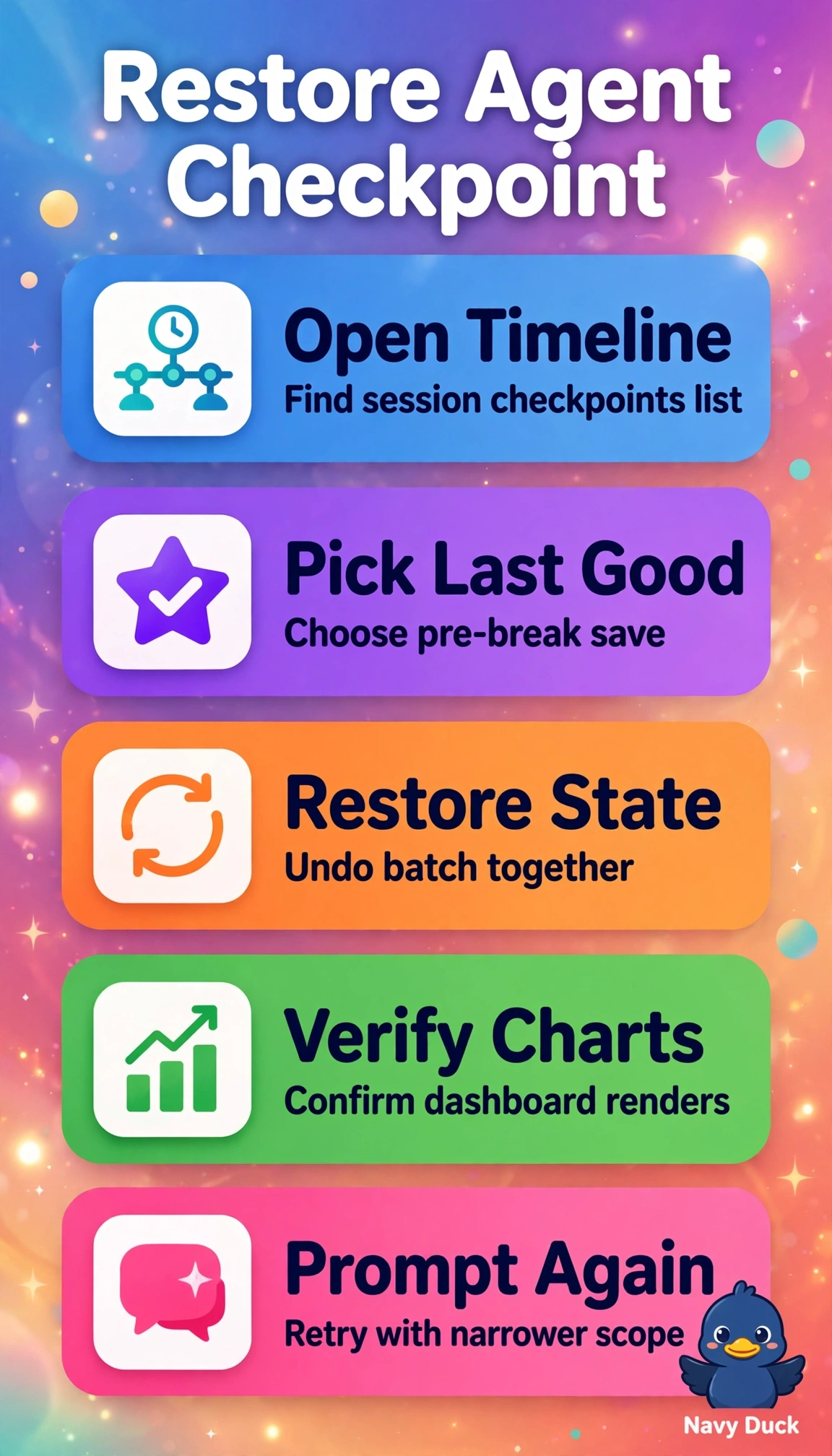
Checkpoints in agent mode capture workspace state across files after each accepted step, so opening the session timeline and restoring the checkpoint from just before the breaking edits rolls back all linked layout and chart changes together and returns immediately to the last known working state, which is the fastest path to stability without manual repair. Restoring only the chart file fails on scope because the failure involves both layout breakage and disappeared velocity charts across several edits, so a single-file restore leaves inconsistent layout dependencies in place and does not re-establish the verified combined state. Comparing checkpoint diffs to manually reapply good edits fails on speed because while diff review is a sound quality practice for selective reuse, it replaces one-click atomic rollback with iterative reconstruction that delays recovery when the stated priority is quick restoration. Restoring the latest checkpoint created after the break fails on target state because that checkpoint preserves the broken layout for in-place diagnosis, which is useful for root-cause analysis but directly contradicts the requirement to return to the last working state. For exam purposes, remember that checkpoint restore is about temporal scope and atomic undo, not Git commits or chat history, and questions emphasizing fastest stability favor the pre-break collective restore over precise or diagnostic work. As a practical check, verify the timeline timestamp and file list for the chosen checkpoint, confirm charts and layout render, then create a fresh checkpoint before retrying the refactor in smaller steps.