
A product manager must choose a model for two Copilot tasks: rapid first-draft summaries of 200 daily support threads, and deep multi-file reasoning to explain a complex checkout failure. Which statement correctly recognizes considerations for choosing between models, including the unique strengths of each model?
Select an answer to reveal the explanation.
Short Explanation
You would not use a race car to haul furniture. Matching speed to summaries and depth to debugging honors each model’s superpower and model selection saves you time without sacrificing insight.
Full Explanation
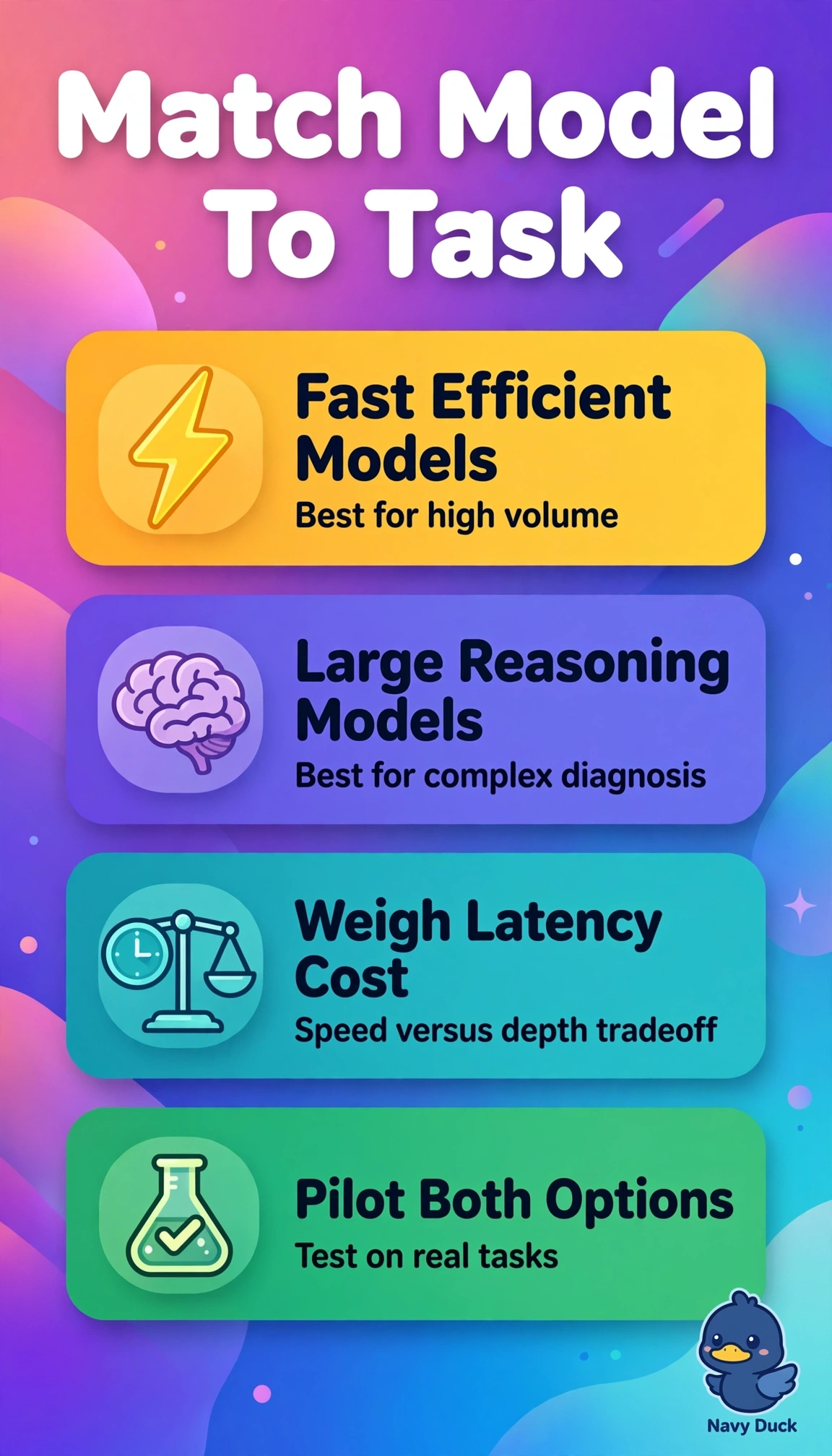
The correct pairing aligns model strengths to task demands, using a fast efficient model where throughput, low latency and cost per request dominate across 200 daily summaries, while reserving a larger reasoning model where multi-step inference across multiple files is needed to explain a checkout failure. The reversed assignment fails on fit despite using both model classes, because it spends expensive reasoning cycles on routine drafts while leaving complex diagnosis to a model optimized for speed over depth, increasing cost and reducing diagnostic quality. Reusing only the efficient model even with a larger context window fails on reasoning depth, because expanded input capacity does not add the sustained chain-of-thought and cross-file correlation needed for root-cause explanation. Reusing only the large reasoning model for everything fails on operational efficiency, because applying high-latency, higher-cost inference to high-volume drafts creates queueing and budget pressure without meaningful quality gain for first drafts. As an exam caveat, avoid equating context window with reasoning ability, since questions often test whether you distinguish retrieval capacity from inference quality. As a practical check, pilot both tasks with production-like volume and measure summary turnaround and cost per hundred threads alongside diagnostic accuracy on a known failure, then route traffic accordingly.