
A business analyst uses Copilot to summarize fifty customer interviews for executives who will only read a one-page brief, requiring comparable themes and a strict limit to prevent overflow into chatty prose. Which prompt structure specifying the response format produces the most reliable executive-ready output?
Select an answer to reveal the explanation.
Short Explanation
You'll get a crisp one-page brief when you lock in your columns and cap the summary at 80 words. It's like handing Copilot a lunchbox with dividers so every theme stays tidy and comparable instead of spilling into chatty prose.
Full Explanation
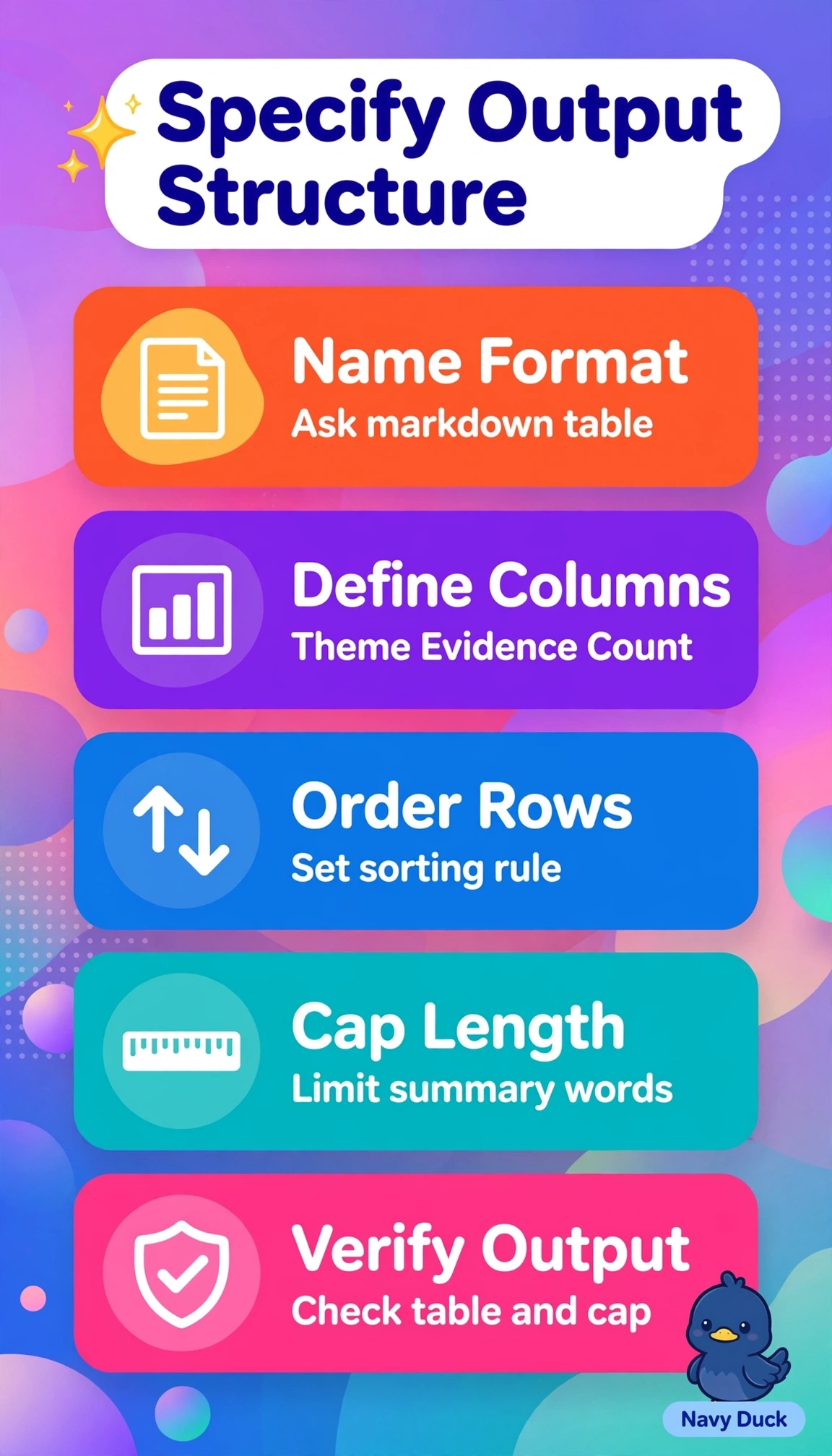
The correct structure works because it enforces both comparability and brevity for an executive audience faced with fifty interviews, with the Theme column normalizing findings, the Evidence column grounding each theme in representative quotes, the Count column quantifying prevalence to allow prioritization, the markdown table ensuring scannable one-page density, and the 80-word capped summary forcing a disciplined takeaway that resists chatty prose. The per-customer table with Customer, Quote, and Sentiment fails on aggregation logic because fifty individual rows cannot be compared at a glance and will overflow a one-page brief even with a capped summary, reflecting interview logging rather than synthesis. The version retaining the Theme, Evidence, and Count table but allowing flexible-length recommendations fails on constraint control because without an explicit word cap Copilot defaults to verbose elaboration that undermines executive readiness. The Theme, Priority, and Owner variant fails on analytical purpose because it reframes discovery as project management, substituting accountability fields for evidentiary support and frequency, so leaders see who does what rather than what customers said and how often. As an exam caveat, prioritize prompts where format and length constraint jointly satisfy every stem requirement rather than selecting a familiar business table that meets only one. As a practical check, render the output, confirm it fits one page, verify the summary is truly under 80 words, and spot-check that every theme links to evidence and counts sum plausibly to the interview base.