
A business analyst owns a nightly agentic workflow that categorizes support tickets. It failed with a missing label error, the run log names the step, and policy requires the fix to be reviewed. Which interaction to resolve the agentic workflow failure best satisfies audit and recovery needs?
Select an answer to reveal the explanation.
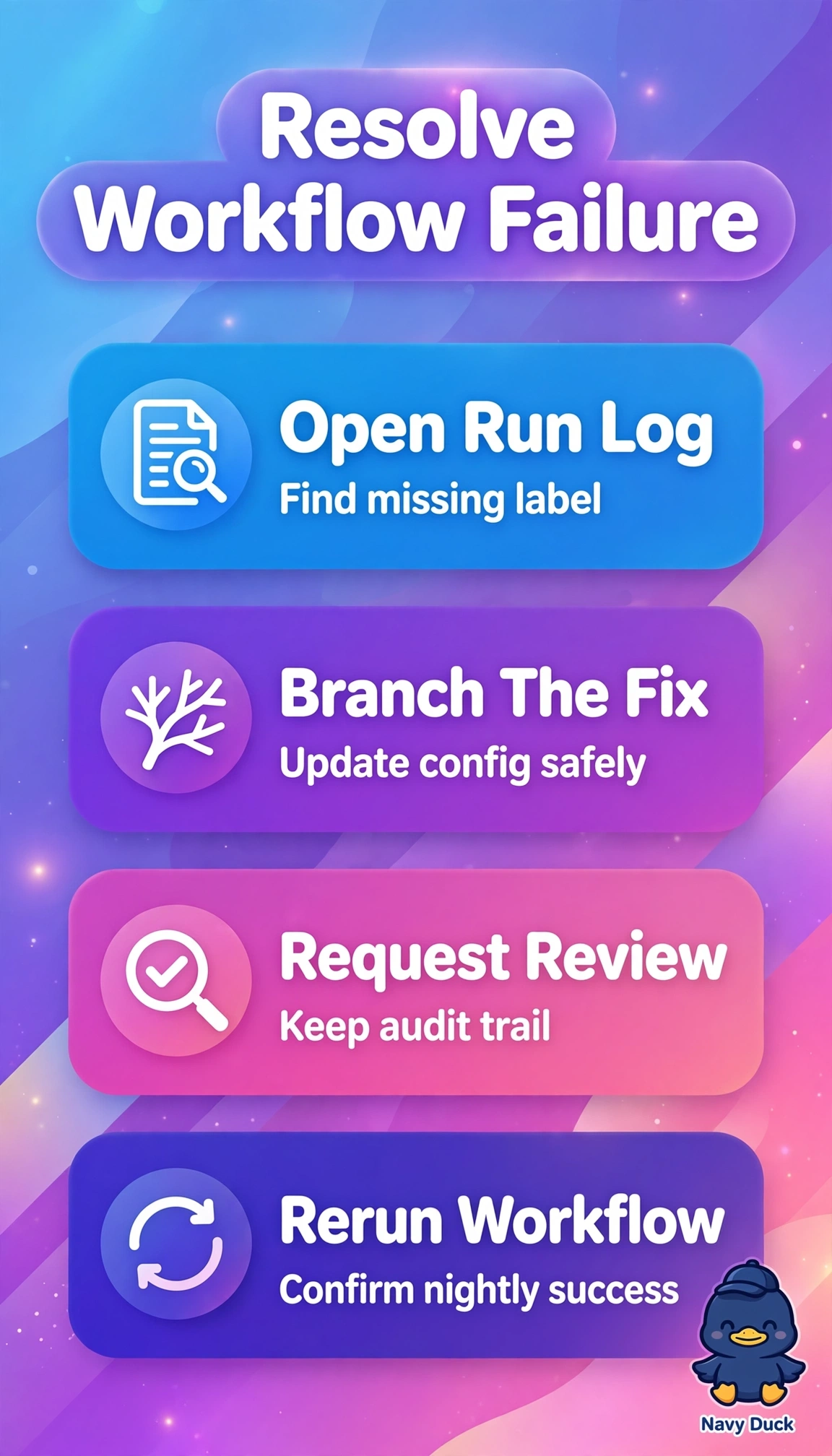
Short Explanation
Failures feel stressful, but logs are your clues. Using the log plus a reviewed fix gives you recoverability like following breadcrumbs home. You'll restore the nightly run with proof.
Full Explanation
The correct approach succeeds because it connects diagnosis, controlled change, and governed recovery in one auditable sequence: consulting the failed run log identifies the exact step behind the missing label error, fixing the label config in a branch preserves history and isolation, and rerunning via pull request enforces required review while documenting recovery of the nightly categorization workflow. Correcting the config directly on the main branch and rerunning immediately reflects common hotfix practice and restores operation quickly, yet it fails governance because it bypasses mandated review and reduces traceability despite good diagnosis and recovery. Fixing in a branch and rerunning via pull request without consulting the log follows solid version control, yet it fails diagnosis because it discards the authoritative step-level evidence and risks fixing the wrong label mapping. Reviewing the log and merging a branched fix via pull request without rerunning meets diagnosis and control needs, yet it fails recovery because tickets remain uncategorized until re-execution proves the fix. An exam caveat is to honor every constraint when distractors appear professionally plausible, favoring full compliance over speed or familiarity. A practical check is to verify the pull request references the failed run ID, shows the label diff, and links a successful rerun before closure.