
A program manager at a 200-person SaaS firm wants backlog triage to run overnight without assigned seats, while her product analysts want reusable in-editor assistants tuned with team instructions for drafting specs. Which agent distinction should she apply to assign cloud agents versus custom agents correctly?
Select an answer to reveal the explanation.
Short Explanation
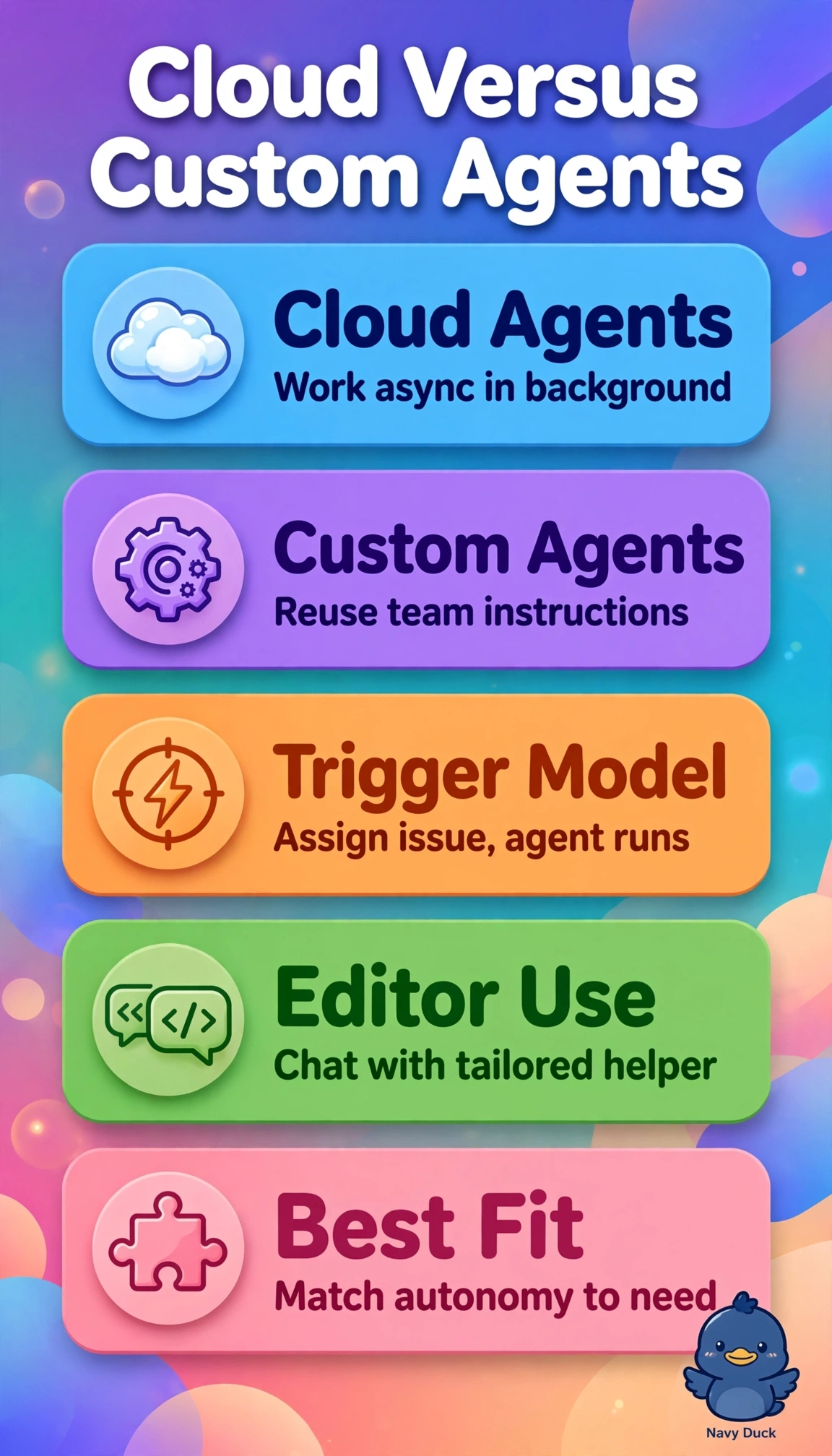
You've got two different jobs here, and they need different workers. Cloud agents run on their own in the background, while custom agents bring your team's instructions into the editor with you.
Full Explanation
The correct response aligns two distinct agent patterns to the stated needs: cloud agents run as autonomous background workers that can triage the backlog overnight without consuming assigned seats, while custom agents persist as reusable in-editor assistants configured with team instructions for drafting specs. The distractor describing one-time spec prompts captures the cloud pattern correctly but fails on customization concept because ephemeral prompts lack persistence, shareability, and governed instructions that define custom agents for repeatable spec work. The distractor describing seat-based co-piloted triage captures the custom pattern correctly but fails on autonomy concept because tying triage to analyst seats and interactive supervision reintroduces capacity limits and daytime blocking that cloud execution is meant to remove. The distractor that reverses the assignment describes two valid real-world uses but fails on placement concept because background seatless execution belongs to cloud infrastructure and persistent tailored in-editor help belongs to customization, so swapping them misallocates cost, access, and lifecycle. As an exam caveat, focus on lifecycle and seat language rather than tool names alone, since questions often test whether assistance is autonomous and seatless versus interactive and personalized. As a practical check, verify in the admin console that overnight triage runs show cloud execution history with no seat consumption and that analysts invoke the same named custom assistant with shared instructions across spec drafts.