
A retail operations lead inherits a legacy discount-calculation script, must brief non-technical stakeholders on what the selected logic does, and will later add documentation and automated checks in Copilot Chat. Which slash command should the lead use in Copilot Chat to obtain that stakeholder-friendly explanation of the selected code?
Select an answer to reveal the explanation.
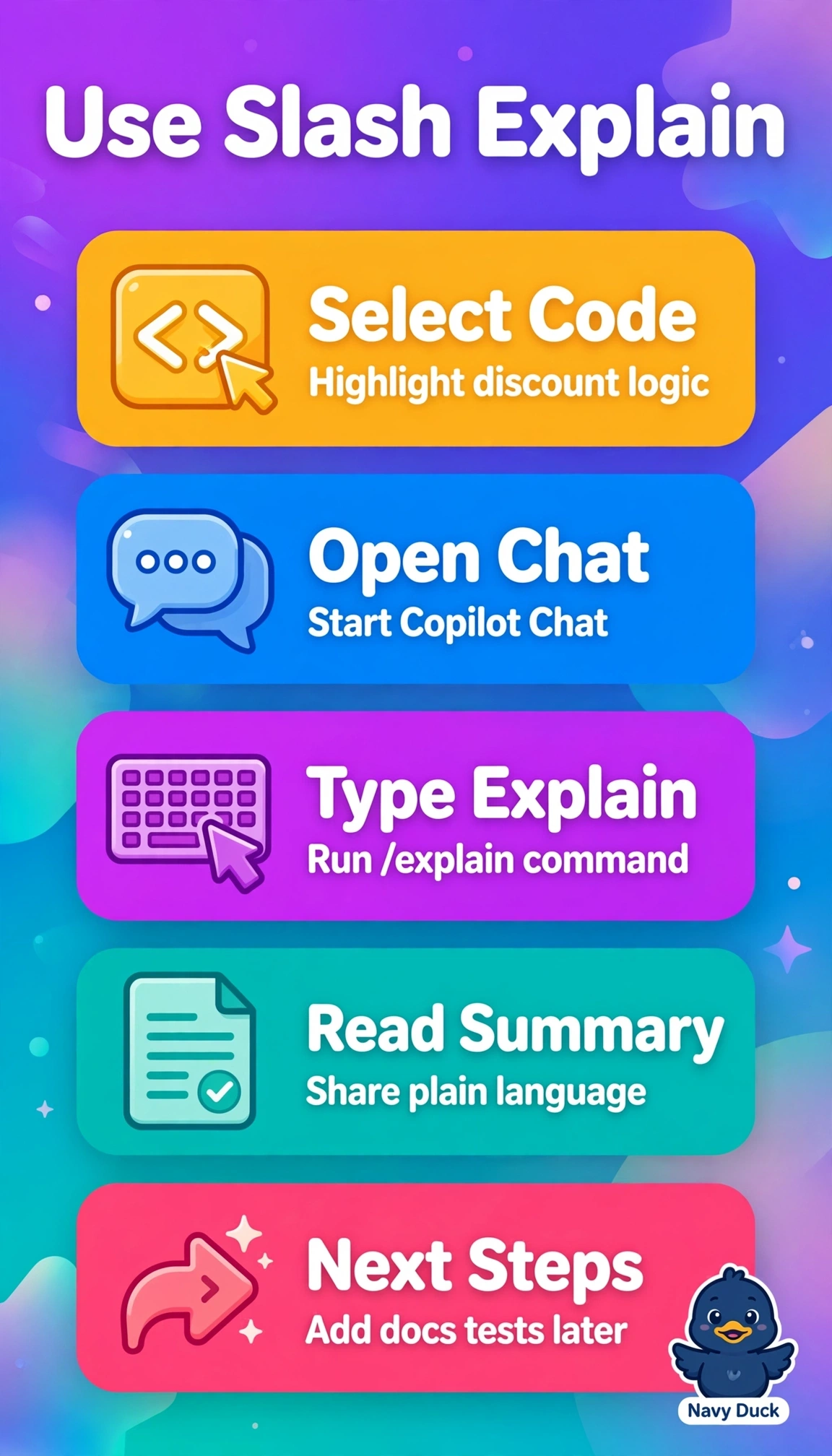
Short Explanation
You're translating geek to plain English for stakeholders before you fix or document anything. The /explain command is your translator here, summarizing what selected code does without changing it.
Full Explanation
The correct command is /explain because it is purpose-built in Copilot Chat to translate selected code into a plain-language summary of what the code does and why, which directly matches the immediate requirement to brief non-technical stakeholders on inherited discount logic without requiring them to read code. The /doc approach fails by timing and audience because it produces formal code comments and structured documentation for developers, which is valuable for the explicitly deferred later handover phase but does not deliver the accessible business-level narrative needed now. The /fix approach fails by goal because it analyzes the selection for bugs and risky patterns and proposes corrections, which is useful maintenance for a legacy script yet skips the requested comprehension step and would present stakeholders with proposed changes rather than an explanation of current behavior. The /tests approach fails by output type because it generates unit tests and validation checks to prove expected behavior, which aligns with the planned later quality work but does not itself describe the logic in stakeholder-friendly terms. An exam caveat is to anchor on the verbs in the stem: when the question asks to obtain an explanation now and says documentation and checks come later, do not select a command that matches a future step. As a practical check in Copilot Chat, select only the discount-calculation block, run the explanation command, and verify the result can be read aloud to operations staff without defining code constructs.