
A support lead deploys an agent with rights to search orders, issue refunds, and email customers. A misconfigured tool once refunded the wrong account. Which escalation path based on tool usage should be designed for safe validation?
Select an answer to reveal the explanation.
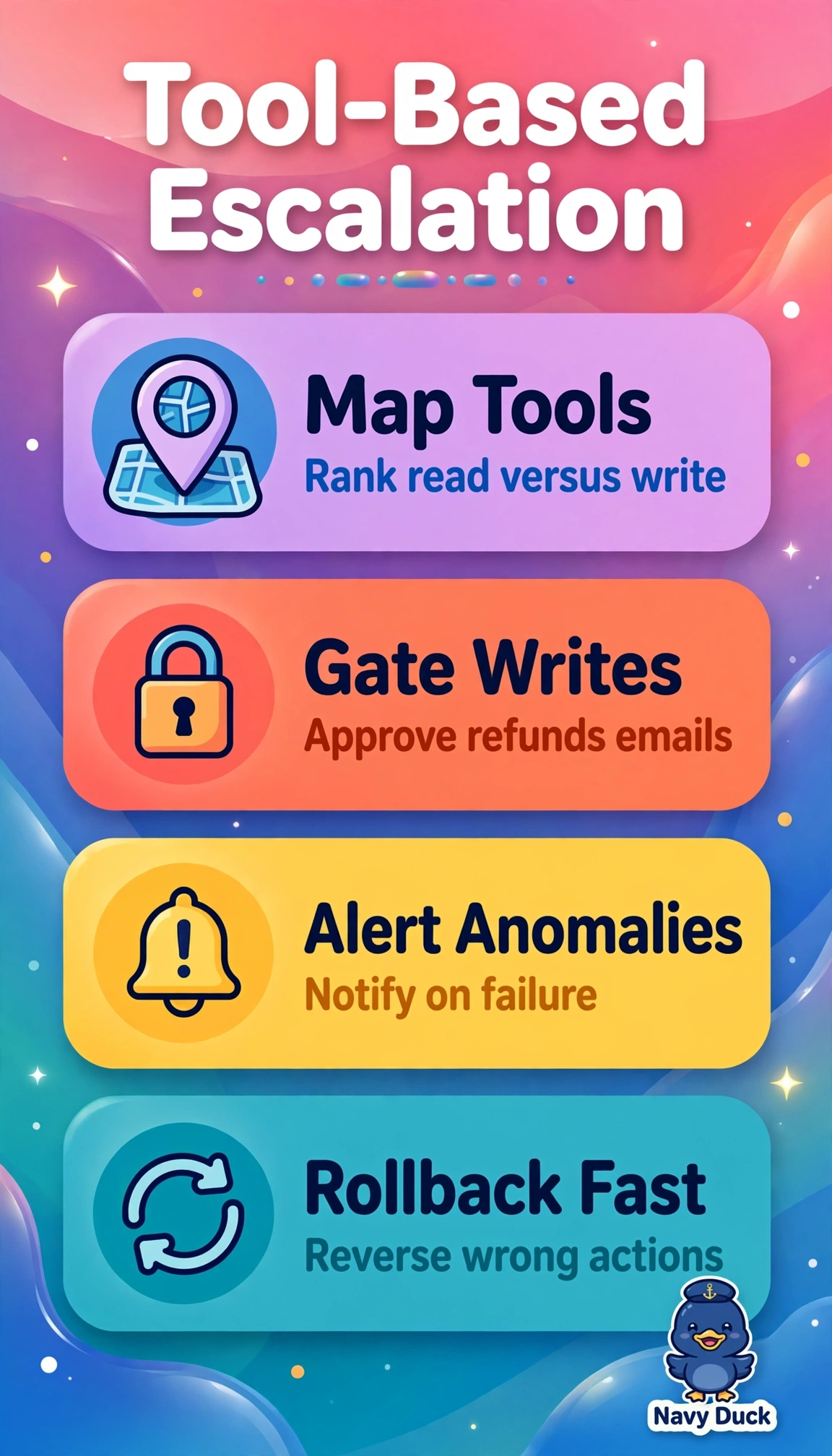
Short Explanation
You put a lock on the powerful buttons, not the windows. Tool-based escalation is like needing two keys to launch anything risky.
Full Explanation
The correct path is right because it tiers control by tool consequence, requiring human approval before irreversible customer-impacting actions like refunds and outbound emails while letting low-risk order search proceed, and it combines prevention with detection and correction through alerts and rollback, which directly answers the prior wrong-account refund where both mistaken execution and difficult recovery matter. The manual-correction variant fails on recoverability because keeping approval and alerts but relying on slow human cleanup instead of automated rollback leaves money misdirected and customers misinformed longer, a widely used support workflow that is insufficient after a proven tool misconfiguration. The search-gated variant fails on scope because gating refunds and harmless read-only search with full alerts and rollback looks disciplined but leaves email unprotected, missing that externally visible communication carries similar irreversibility and trust risk as money movement. The automated-checks-only variant fails on oversight because rule-based validation plus alerts and rollback handles known patterns efficiently yet cannot replace human judgment for ambiguous refund cases where the tool previously failed. As an exam caveat, logging and automation never equal approval for financial or external actions, so prioritize prevention over visibility. As a practical check, classify each tool by reversibility and external impact, enforce sign-off for refunds and emails, and drill alerts with rollback using a simulated misdirected refund.