
A business analyst asks Copilot to summarize 200 customer interviews into a three-bullet executive update that is neutral, clear, and inventive in framing opportunities. Which instruction best defines the information to include in the response for sentiment, coherence, and creativity?
Select an answer to reveal the explanation.
Short Explanation
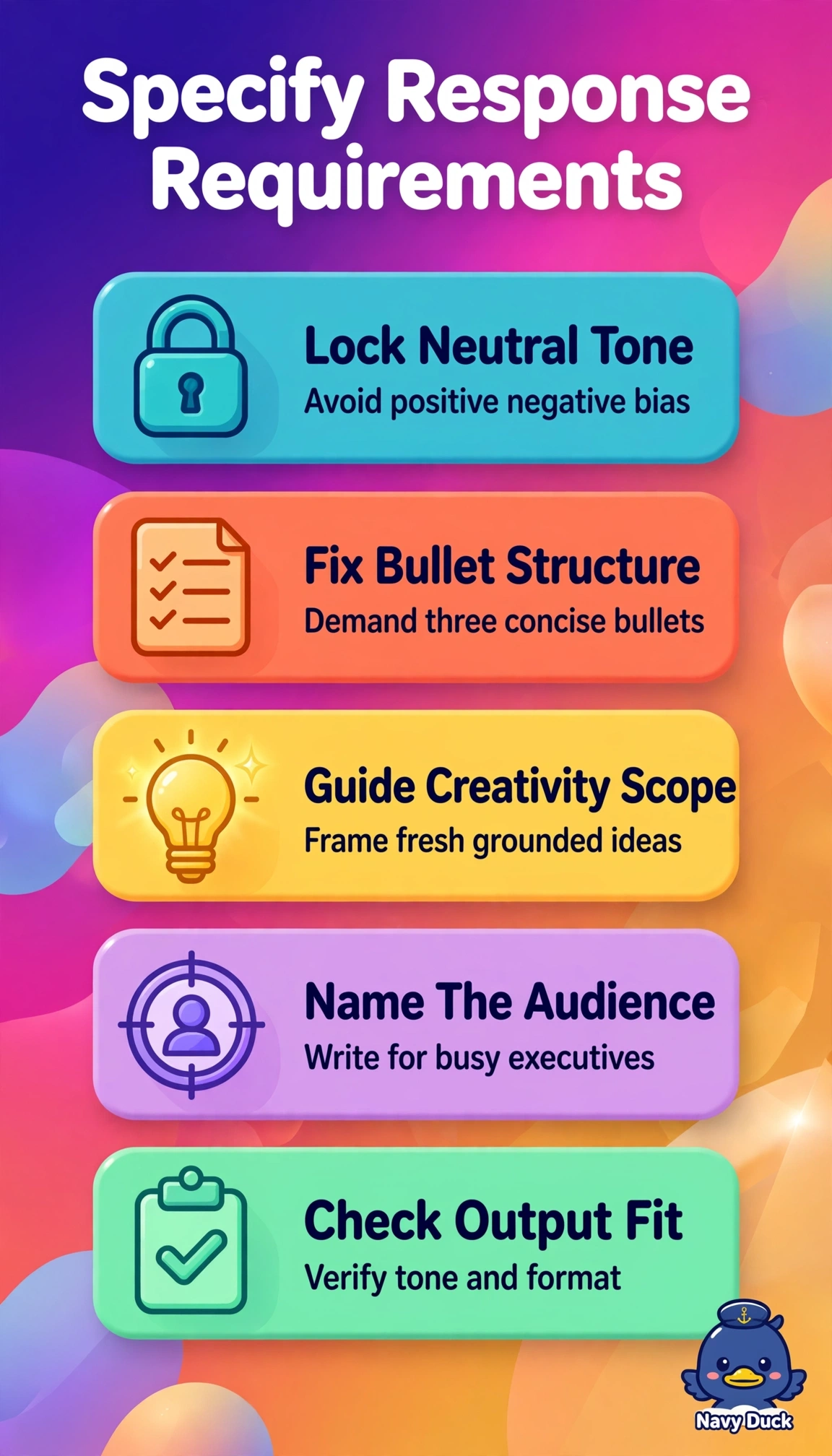
Vague asks breed rambling recaps that executives skim and skip. Tight output specs give you a spotlight, only neutral, crisp bullets hit the stage and inspire action planning.
Full Explanation
The correct instruction succeeds because it aligns all three requested dimensions for the executive summary of 200 interviews: neutral sentiment prevents bias, explicit three-bullet structure enforces coherence and brevity for executive consumption, and inventive but grounded framing satisfies the creativity requirement without hallucinating opportunities. The flowing narrative paragraph alternative fails on coherence and structure because while neutral and creative, an unconstrained paragraph violates the explicit three-bullet executive update format and reduces scannability under time pressure. The upbeat persuasive alternative fails on sentiment control because enthusiasm and persuasion replace required neutrality, risking skewed interpretation of customer feedback even though structure and creativity appear satisfied. The strictly factual summary alternative fails on creativity because deliberately avoiding opportunity framing omits the inventive reframing task, delivering accurate condensation but no forward-looking value. An exam caveat is to read whether the stem asks for content definition versus process or tool steps, since sentiment, structure, and creativity cues signal what to include rather than how to prompt iteratively. A practical check before finalizing is to verify output has exactly three bullets, neutral language with no positive or negative loading, and each bullet pairs an observed theme with a clearly labeled grounded opportunity.