
A support operations team runs an agent that can search help articles, update tickets, and issue refunds through connected tools. Policy requires human approval for refunds over $50 and review when external actions occur. Which escalation path based on tool usage best satisfies the review policy?
Select an answer to reveal the explanation.
Short Explanation
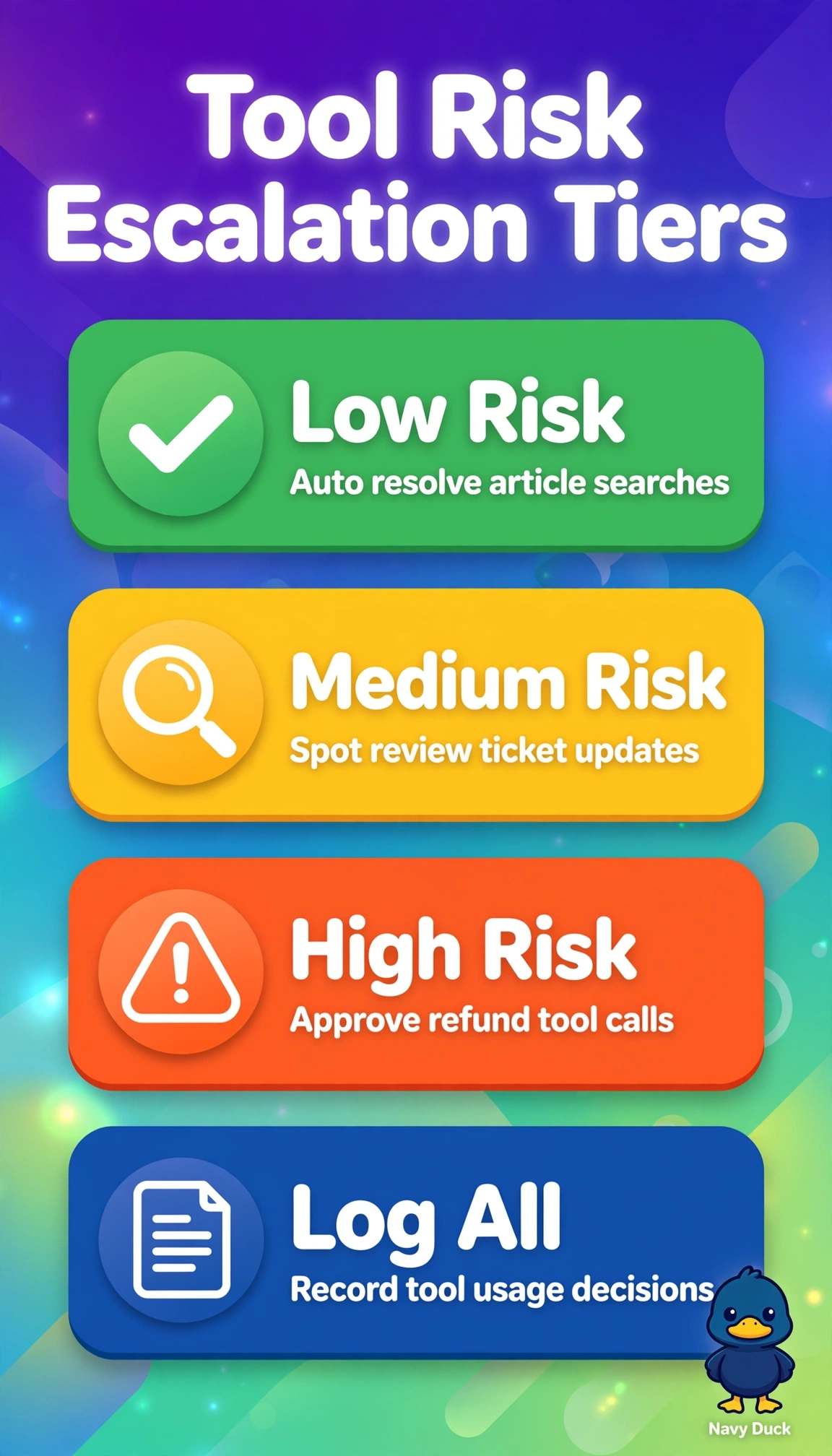
Different tools carry different stakes, so your guardrails should too. Tiered escalation by tool risk gives low-risk searches a faster lane while keeping human review for actions that change records or move money.
Full Explanation
The escalation path that auto-resolves article searches, sends ticket updates for spot review, and requires approval for refund tool calls applies risk-tiered tool governance: searches have no external side effects, ticket updates change persistent external state and warrant review, and refunds need a preventive human gate to satisfy the over-$50 rule and the review duty for external actions. Auto-resolving both article searches and ticket updates while requiring approval only for refunds over $50 respects the refund threshold but fails to review ticket updates, treating a state-changing action like retrieval. Auto-resolving searches and reviewing ticket updates while approving refunds under $200 violates the explicit $50 boundary and allows noncompliant payouts between those amounts. Auto-resolving searches, reviewing ticket updates, and logging refunds only for post-hoc audit provides detectability but not prevention before money moves. Exam caveat: read approval as a pre-execution gate and apply stated thresholds literally; audit trails and higher limits may appear compliant while missing the requirement. Practical check: verify that the router reviews ticket writes, checks refund amounts before calling the tool, queues refunds for the required human decision, and records the tool name, arguments, approver, and outcome for audit.