
A product operations team uses an agent to draft customer release notes from merged pull requests. Outputs must stay concise, match a tone checklist, and improve without constant human edits. The team wants the agent to check its own work first. Which self-critique loop configuration best ensures reliable drafts?
Select an answer to reveal the explanation.
Short Explanation
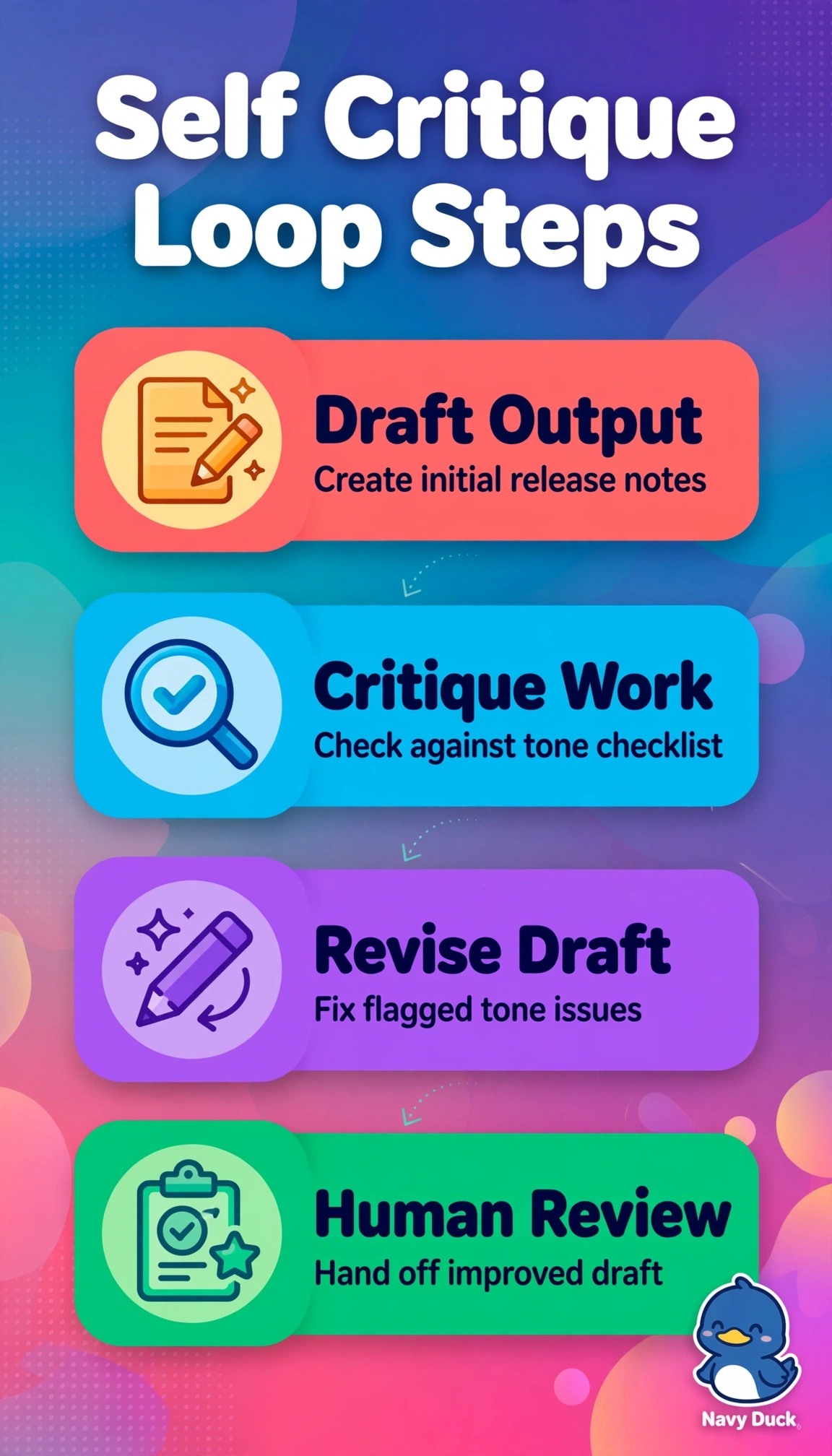
You're building an editor right into the workflow, not just a writer. A draft-critique-revise cycle enforces your checklist like a spell-check for tone and accuracy.
Full Explanation
The correct configuration works because it closes the loop around the stated constraints in the right order: drafting from merged pull requests creates coverage, self-critique grounded in the explicit tone checklist enforces both conciseness and voice without relying on tacit model judgment, and mandatory self-revision before human review delivers improvement without constant human edits while preserving human oversight for reliability. The human-critique variant fails on autonomy and self-first control by making an editor the critic, which is a sound human-in-the-loop pattern for high-risk content but reintroduces a human bottleneck on every draft and does not satisfy the requirement to check its own work first. The general-clarity variant fails on specification grounding by substituting generic readability for checklist-driven critique, which often improves fluency yet allows tone drift because conciseness and voice rules are never explicitly verified. The send-without-revision variant fails on loop closure by performing self-assessment but skipping the autonomous fix step, so identified checklist violations still burden reviewers and reliability does not improve. As an exam caveat, distinguish who critiques from what is checked and whether revision is autonomous, since stems often keep drafting and review language identical and change only the critic or the standard. As a practical check, require the agent to log checklist scores with brief justifications and diff the revised draft so teams can audit that tone failures actually decreased before human time was spent.