
A Copilot agent with production deployment access is about to delete a database table as part of a cleanup task. This action cannot be reversed without a backup restore. What authorization model best governs this specific action?
Select an answer to reveal the explanation.
Short Explanation
General production access doesn't authorize an irreversible table delete. The more irreversible the action, the more specific the authorization needs to be. You need a named human to approve this exact deletion with an expiration, so the agent can't proceed without that approval token.
Full Explanation
Irreversible actions require task-specific, time-bound authorization rather than relying on general access permissions.
Why general production access permissions are insufficient: Having production access means the agent is trusted to perform routine production operations. It does not mean the agent is authorized for every destructive action within that production environment. Authorization must be proportional to the irreversibility and risk of each specific action.
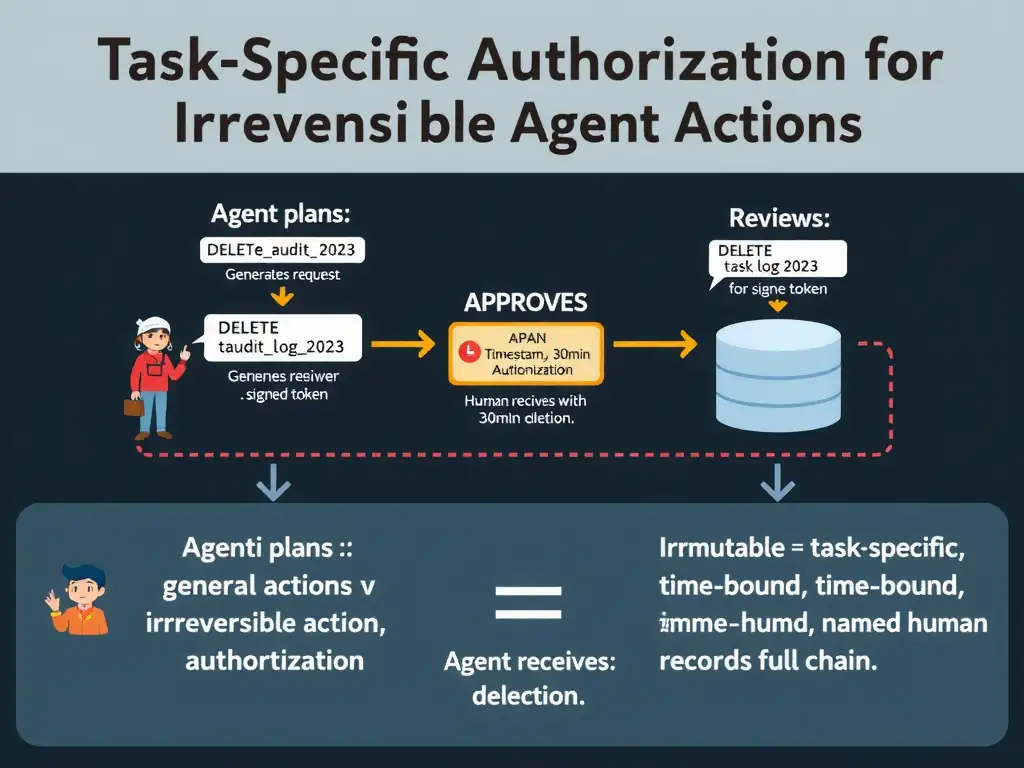
Time-bound, task-specific authorization pattern: 1. Before executing, the agent generates an authorization request: 'I am about to delete table audit_log_2023 as part of cleanup task #482. This cannot be reversed. Please approve.' 2. A named human reviewer receives the request, reviews what will be deleted, and approves with a signed token. 3. The token includes: approver identity, timestamp, expiration (e.g., 30 minutes), and the specific action scope. 4. The agent proceeds only if it receives a valid, unexpired token matching the planned action. 5. The token and approval are recorded in the immutable audit log.
Why the time-bound, task-specific authorization choice is correct: This pattern ensures human accountability for irreversible actions while maintaining operational efficiency — the agent can proceed once approved without ongoing human monitoring.
Why the general production access permissions choice is wrong: General access permissions authorize routine operations, not destructive operations. Conflating the two removes the opportunity for human review of high-impact actions.
Why the audit-trail-plus-5-minute-delay choice is wrong: A 5-minute delay with no human review is not authorization — it is merely deferred autonomous action. If no human sees or approves the action during those 5 minutes, the delay provides no safety benefit.
Why the blanket prohibition on all delete operations choice is wrong: Blanket prohibition on all delete operations is too restrictive. Legitimate cleanup and data management tasks require delete operations. The solution is appropriate authorization, not prohibition.