
A compliance officer is reviewing an agent's workflow for processing employee termination requests. The workflow includes: (1) receiving the termination request from HR, (2) disabling the employee's SSO account, (3) revoking all active OAuth tokens, (4) archiving the employee's email to a compliance mailbox, (5) removing the employee from all GitHub teams and organizations, (6) transferring repository ownership for any repos the employee owns, and (7) deleting the employee's corporate laptop MDM enrollment. Which steps in this workflow MOST require mandatory human judgment gates, and why?
Select an answer to reveal the explanation.
Short Explanation
Most termination steps are mechanical follow-throughs on a decision HR already made. You need human judgment where the agent has to choose the right repository owner and coordinate secure device handling. That's why transferring repository ownership and deleting MDM enrollment need mandatory gates.
Full Explanation
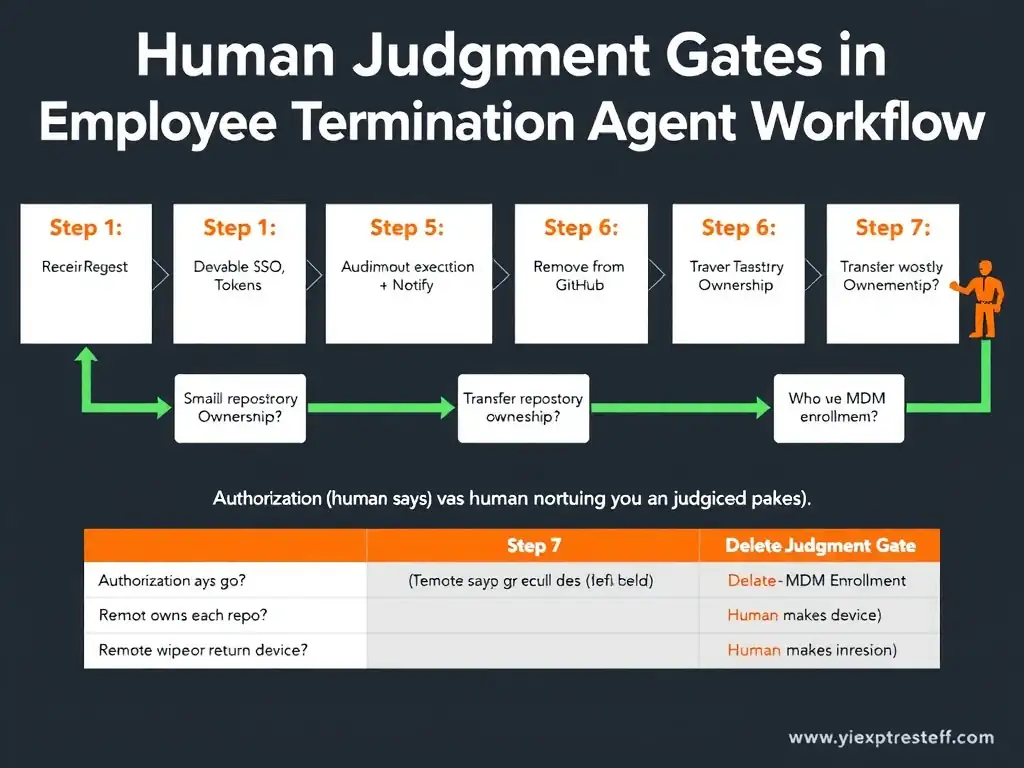
The key distinction is between human authorization, which confirms a predetermined action, and human judgment, which makes a decision the agent cannot make. Steps 1-5 — receiving the termination request, disabling SSO, revoking tokens, archiving email, and removing the employee from GitHub teams — are mechanical executions of a pre-decided termination. The decision to terminate has already been made by HR. Each action has a clear, deterministic execution path and can proceed autonomously with post-execution notification. Step 6 — transferring repository ownership — requires genuine judgment the agent cannot make autonomously. Questions include: Which team or person should own each repository? Are there repositories containing sensitive intellectual property that require a specific custodian? Are there repositories that should be archived rather than transferred? Does the repository serve an active project with a designated successor? The agent cannot determine the correct new owner without organizational context that exists only in human relationships. Step 7 — deleting MDM enrollment — also requires human coordination. MDM unenrollment can remotely wipe corporate data from the device. Coordination with IT is required to determine whether a remote wipe should be triggered if the device is not being returned, or whether enrollment should be removed without a wipe if the device is being returned for re-imaging, and to ensure the physical device chain of custody is handled. The agent cannot determine the device's physical status or return process. The choice that selects only disabling accounts and revoking tokens is wrong because those actions are mechanical, deterministic, high-speed, and easily reversible if the termination was an error. The choice that requires human sign-off for all 7 steps over-gates the process because most steps are standard, deterministic executions that do not require judgment. The choice that selects only archiving email to a compliance mailbox is wrong because it underestimates the judgment required for transferring repository ownership and handling MDM enrollment; archiving email is part of the deterministic compliance workflow once the termination decision exists.