
A platform architect is designing guardrails for an agent that spans the full SDLC pipeline: planning, implementation, testing, code review, and deployment. The team wants to minimize unnecessary human interruptions while maintaining safety. Which guardrail placement strategy is MOST appropriate?
Select an answer to reveal the explanation.
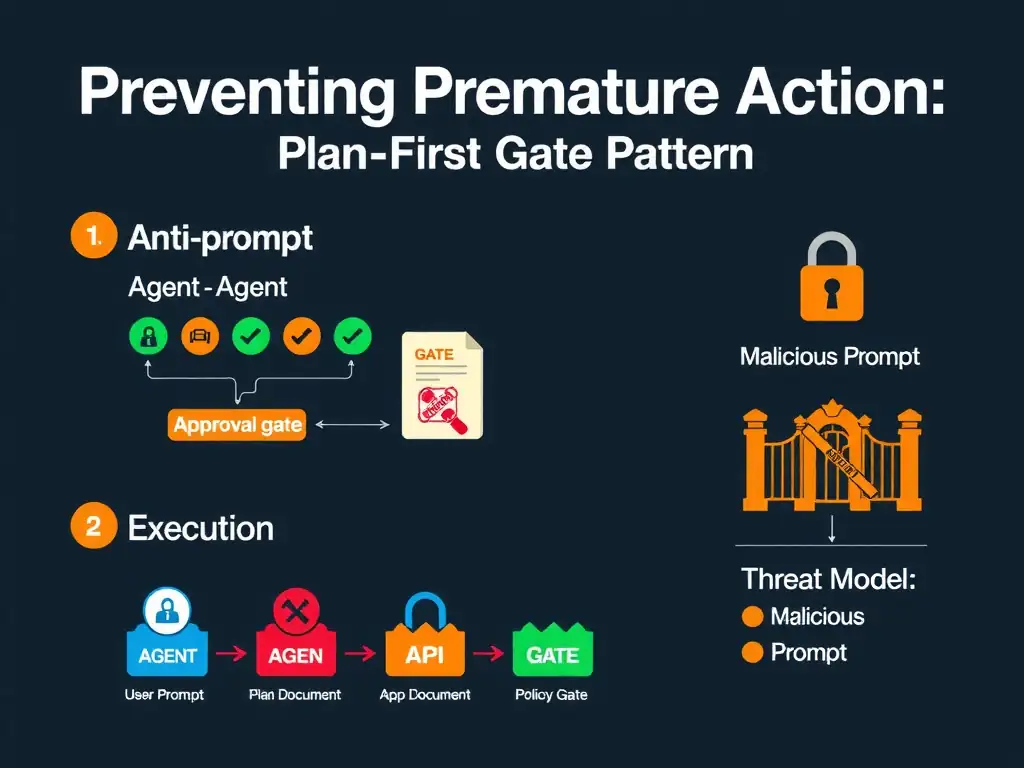
Short Explanation
Think of guardrails like a staircase with a railing — you don't need someone holding your hand on every step, but you want the railing at the edge of the balcony. Use automated checks for reversible transitions, like failing a test or blocking a merge, because no lasting harm happens. Save human judgment for irreversible actions, like deploying to production, where 'undo' means an incident, rollback, and customer impact.
Full Explanation
Guardrail design in SDLC pipelines must balance safety with throughput. Over-gating kills adoption; under-gating enables runaway agents. The key principle is matching the gate type to the reversibility of the transition. Placing human approval gates only at irreversibility boundaries — specifically the transition from 'review approved' to 'deploy to production' — and using automated checks such as test pass, lint, and security scan for earlier transitions is correct because it applies the irreversibility principle. Transitions that can be reversed automatically, such as a failed test blocking a merge, cause no lasting harm and should use automated gates. The only transition that warrants human approval is the one where the action becomes difficult to reverse: deploying to production. A production deployment affects real users, may require coordinated rollback, and creates customer-visible incidents. Automated checks at earlier stages are not 'less rigorous' — they are frequently more consistent than human review for mechanical checks, such as test coverage thresholds and security scan findings. Requiring human approval at every stage transition creates pipeline paralysis. If humans must approve plan to implement, implement to test, test to review, and review to deploy, the agent becomes an expensive typing assistant. Engineers spend more time approving than reviewing, and the human cognitive load is indistinguishable from manual work. Eliminating all human approval gates and relying on automated rollback conflates the ability to roll back with the acceptability of needing to roll back. Production incidents cause customer impact, SLA violations, on-call pages, and reputational damage even when rollback is fast. Automated rollback is a recovery mechanism, not a substitute for a deployment approval gate. Placing human approval gates only at the start of the pipeline, in the planning phase, misidentifies where the highest-stakes irreversibility occurs. Planning decisions can be revised cheaply. Production deployments cannot. Early-stage gating with no late-stage gating is inverted risk management.