
An engineering director wants to present agent ROI to the executive team. She has the following data after 90 days: story-point velocity increased 22%, review turnaround time dropped from 4.2 hours to 1.1 hours, defect escape rate decreased 15%, and agent infrastructure costs $8,000/month. Which metric combination MOST convincingly demonstrates ROI to a business audience?
Select an answer to reveal the explanation.
Short Explanation
You don't need to explain what a story point is to an executive — they shouldn't need to know. The ROI argument that lands is one expressed in dollars and time: 'We freed up engineer-hours per month previously spent waiting on reviews, and we're shipping 15% fewer bugs that used to cost us dollars per incident to fix.' Translate technical metrics into business language and then anchor the cost against it.
Full Explanation
Executive ROI presentations require translating technical improvements into financial and strategic outcomes. Raw engineering metrics without business translation are unconvincing to non-technical leadership.
The velocity-and-cost-per-story-point framing fails because story points are an internal planning unit with no meaning to a business audience. Even framed as 'cost per story point,' the executive must then translate that back into business value — and most cannot do so reliably. Additionally, presenting cost without benefit context just highlights the expense.
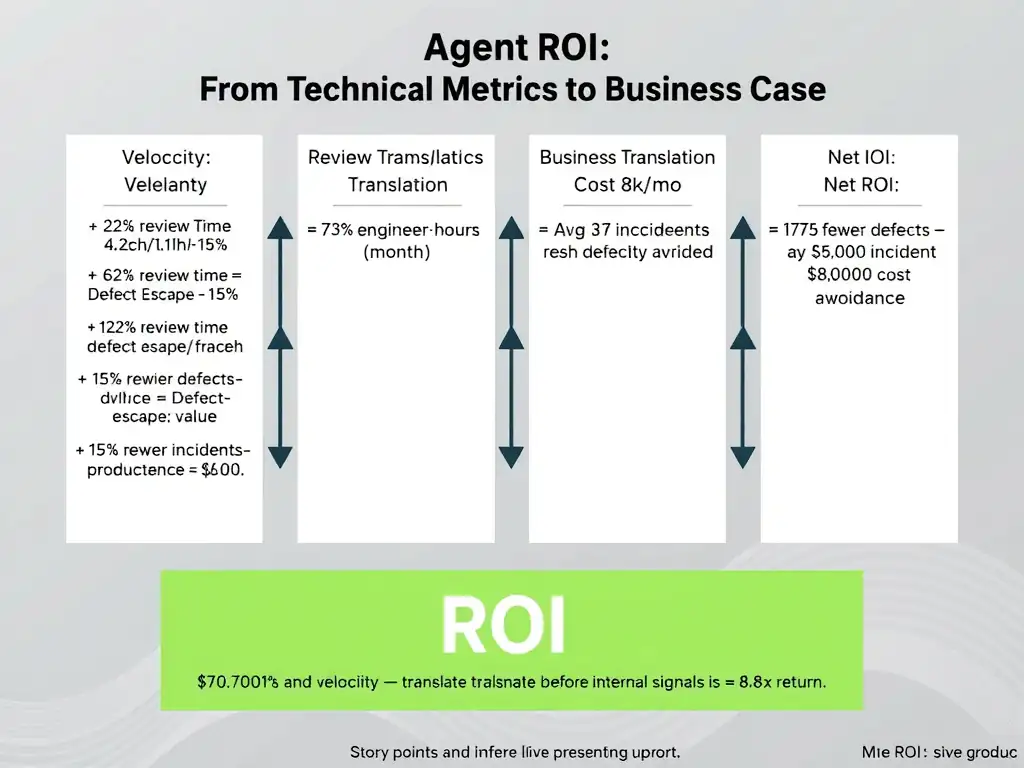
The review turnaround and defect escape framing is correct. Review turnaround reduction from 4.2h to 1.1h is a 73% improvement — and this can be translated directly: if engineers were waiting 3.1h per PR and the team submits 200 PRs/month, that is 620 engineer-hours per month recovered (at, say, $85/hr burdened cost = $52,700/month in productivity). Defect escape reduction of 15% translates to fewer production incidents, lower mean time to repair costs, reduced on-call burden, and incident cost avoidance — all directly expressible in dollars. These two numbers, expressed in business currency, dwarf the $8,000/month infrastructure cost and make the ROI case compellingly.
The equal-weighted balanced scorecard fails as an executive communication strategy. Presenting four metrics without prioritization creates cognitive load and dilutes the most powerful numbers. Executives need a clear headline.
The infrastructure-cost-alone framing argues only that the cost is reasonable, not that it produces a return. This is the weakest possible ROI argument — it justifies cost but establishes no benefit.