
A customer support agent stores conversation context in session memory to handle multi-turn interactions. A privacy audit reveals that PII (customer names, email addresses, case numbers) is being retained in memory and included in logged context artifacts. The organization must remediate this before the next compliance review. Which approach BEST addresses both the data minimization and audit logging concerns?
Select an answer to reveal the explanation.
Short Explanation
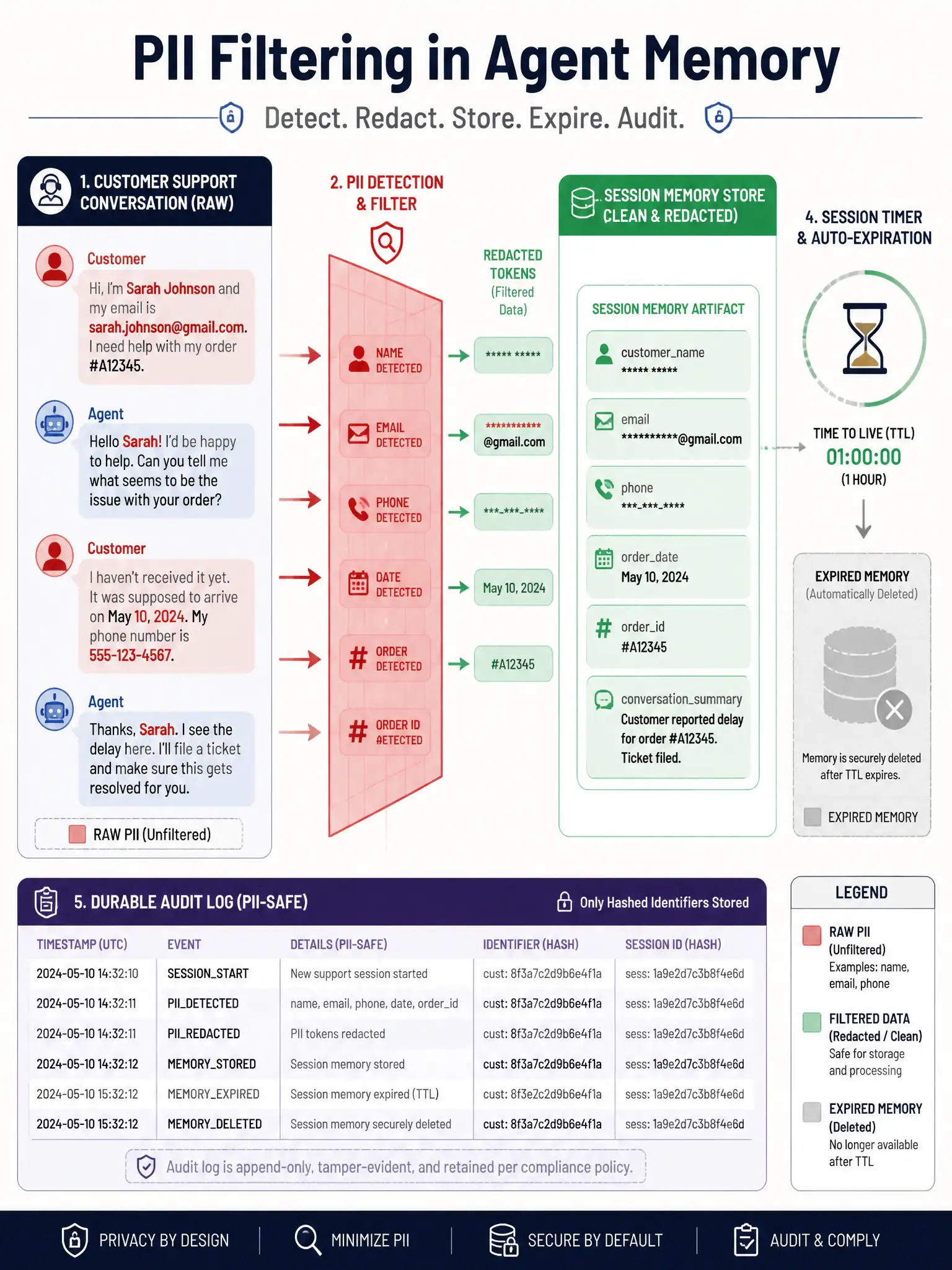
Think of PII in memory like mud on your boots — don't track it into the house in the first place. Use session-scoped memory with automatic expiration and filter PII before it enters memory or logs. You solve retention and artifact contamination at the source.
Full Explanation
The correct approach is session-scoped memory with automatic expiration (no persistence beyond the session) plus a PII filter before any memory content is logged or stored to durable artifacts, with redaction or hashing of PII values before they enter the memory store. The audit revealed two distinct problems: (1) PII is being retained beyond its useful life, and (2) PII is leaking into logged artifacts. This approach addresses both at the architectural level. Session-scoped memory with automatic expiration ensures that customer PII is not carried forward to subsequent sessions — it exists only for the duration of the interaction that needs it. The PII filter applied before any memory content reaches durable artifacts (logs, audit trails, knowledge bases) ensures the second problem is solved at the write path. Redacting or hashing values like email addresses and case numbers allows logs to remain useful for debugging without containing raw PII.
Disabling the agent's memory entirely so that no context is retained between turns is wrong because it breaks the agent's core function — it cannot handle multi-turn conversations without context. Trading compliance for capability is not a valid remediation strategy when targeted controls exist.
Encrypting all memory at rest using AES-256 so that PII stored in memory is protected from unauthorized access is wrong because encryption at rest protects against unauthorized access but does not address the retention violation. If PII is stored longer than permitted by data minimization principles or a deletion obligation (such as GDPR right to erasure), it is still non-compliant regardless of whether it is encrypted. Encryption and data minimization are orthogonal controls.
Requiring human approval before any memory value is logged to artifacts, so a reviewer can manually redact PII before it is persisted, is wrong because human-in-the-loop approval for every memory log entry is operationally unscalable for a high-volume customer support agent. More importantly, it shifts the compliance burden to a human reviewer rather than engineering the PII problem out at the system level. Humans are also error-prone and will miss PII under time pressure — automated filtering is more reliable.