
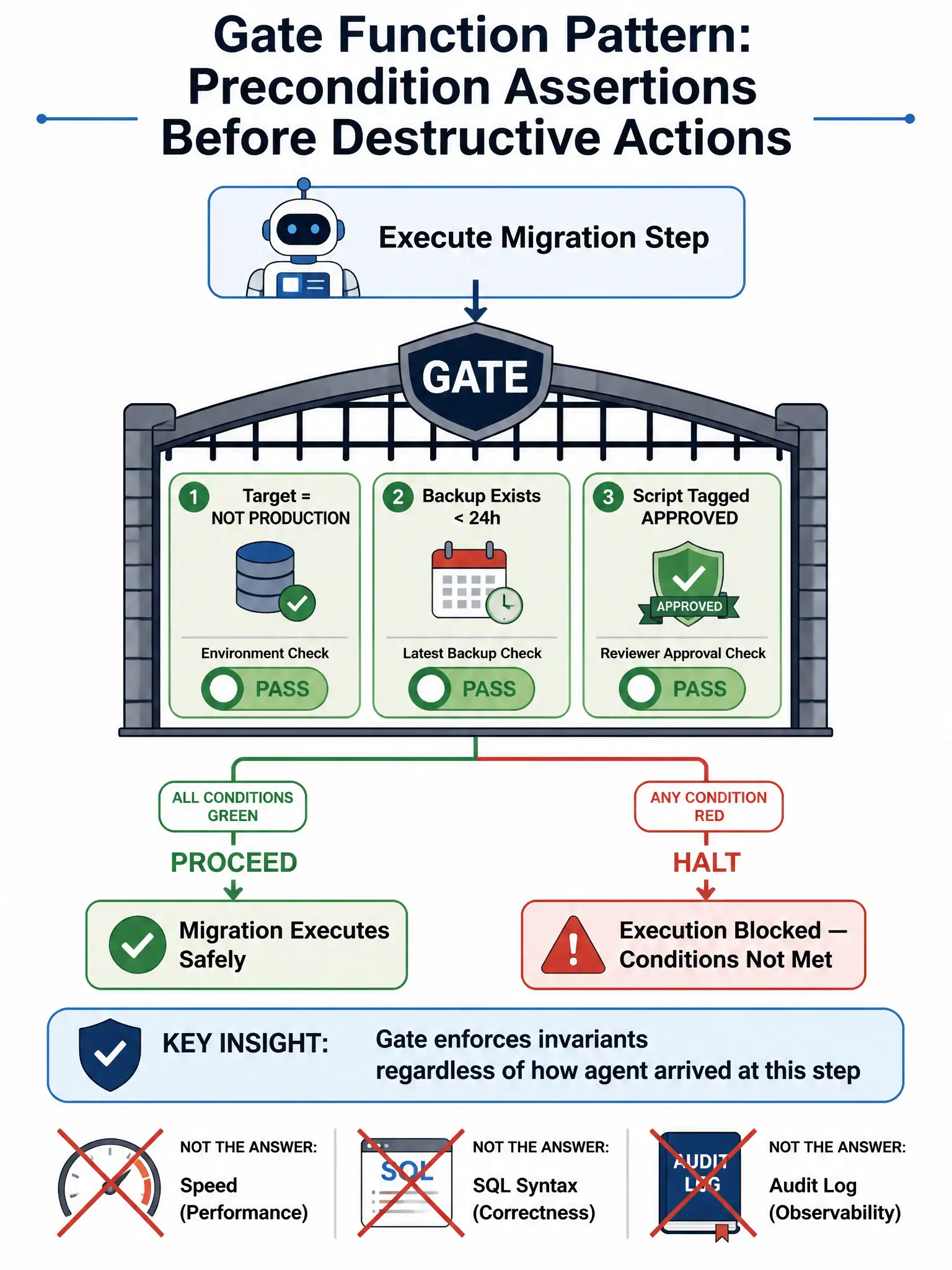
An agent that performs database schema migrations uses a gate function before each migration step. The gate checks three conditions: (1) the target database is not a production instance, (2) a backup exists from within the last 24 hours, and (3) the migration script has been tagged 'approved' by a reviewer. What is the primary security benefit of this gate pattern?
Select an answer to reveal the explanation.
Short Explanation
The gate function is a bouncer who checks the facts before letting anything through, no matter how confident the agent looks. You stop the migration when the environment, backup, or approval isn't right, regardless of how the agent got there. Speed, syntax validation, and audit logs are side effects, not the main security win.
Full Explanation
Gate functions embody the 'trust but verify' principle in agentic systems. Even an agent following a well-designed workflow can encounter unexpected state — a prompt injection in a migration script name, a previous step that failed silently, or a tool call that returned a wrong environment identifier. The gate's job is to assert environmental and procedural invariants immediately before executing a destructive action, making the check independent of the agent's prior reasoning chain. Why the precondition-assertion answer is correct: The primary security benefit of precondition gates is environment and safety-net invariant enforcement regardless of execution path. This is sometimes called 'defense in depth at the action boundary.' The check that the target database is not a production instance prevents the agent from running a destructive migration on a live system even if earlier steps in the workflow failed to correctly identify the target — perhaps because a connection string was misconfigured or an environment variable was wrong. The check that a backup exists from within the last 24 hours ensures a recovery option exists before data is mutated. The check that the migration script has been tagged 'approved' by a reviewer enforces the human review requirement even if the agent was invoked in a non-standard way. Together, these checks create a safety perimeter at the action boundary that holds independently of how the agent navigated there. Why the speed answer is wrong: Pre-validating conditions does not make the migration faster in any meaningful sense — the conditions must still be evaluated at runtime (the backup check requires querying backup timestamps, the database type check requires an API call, etc.). There is no computational shortcut here. The gate adds latency, not removes it. Speed is irrelevant to the security function being described. Why the SQL-syntax answer is wrong: SQL syntax validation is a separate concern handled by SQL parsers or dry-run execution modes — not by a gate that checks backup existence and environment type. The gate conditions described are operational and procedural, not syntactic. Even syntactically perfect migration scripts can still drop the wrong table in the wrong environment. Why the audit-trail answer is wrong: While the gate implicitly records that the 'approved' tag was verified (and this could be logged as a side effect), creating an audit trail is not the primary security benefit. The audit trail benefit is a consequence of running the check — the primary benefit is preventing execution when conditions are not met. An audit trail of a migration that ran on production without a backup is a record of a disaster, not a security control.