
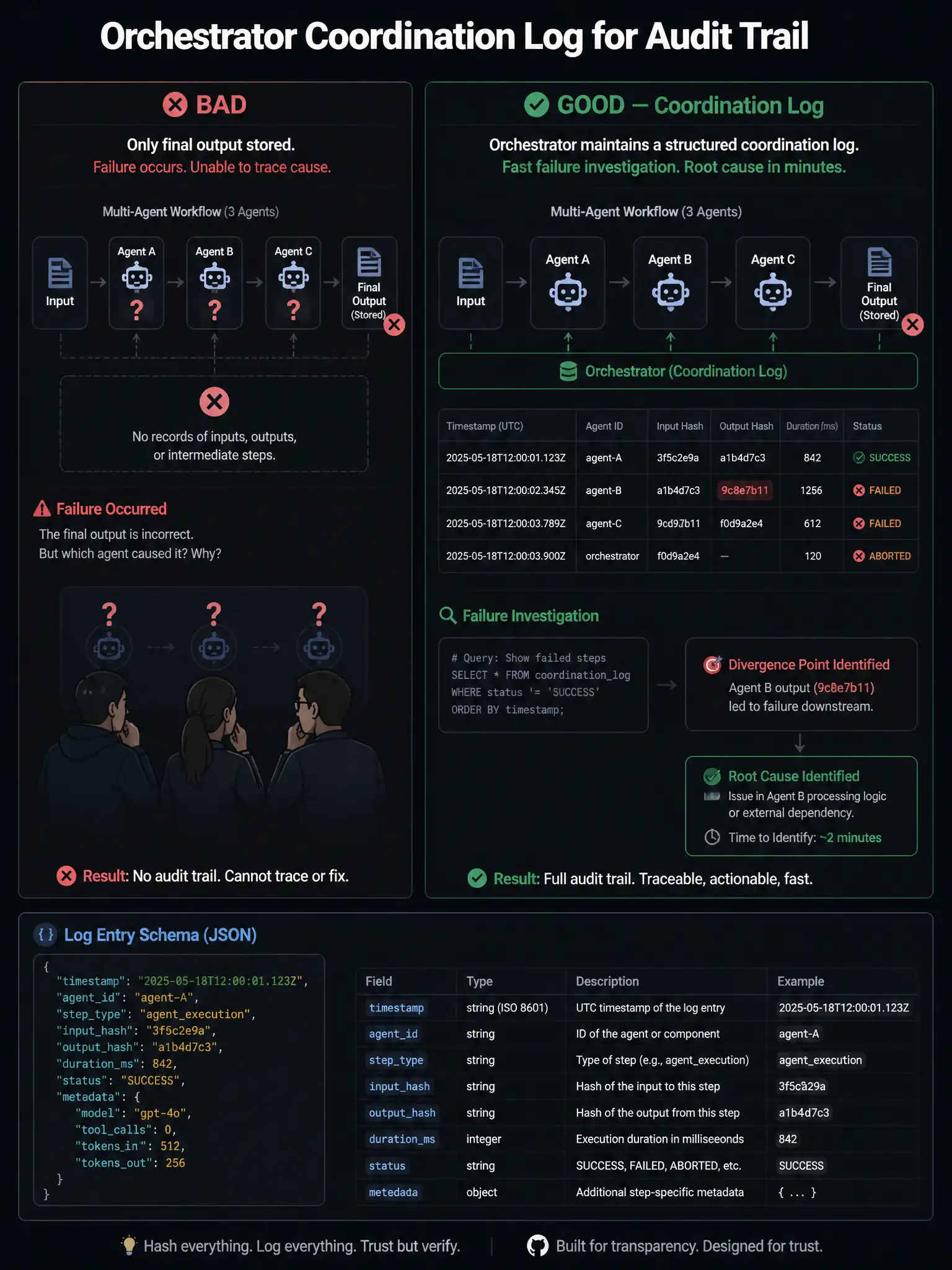
After a multi-agent workflow produces an incorrect output, the engineering team tries to reconstruct which agents ran, in what order, what each agent decided, and why. The orchestrator has no coordination log — only the final output exists. The team cannot determine whether the failure originated in Agent A's analysis, Agent B's transformation, or the orchestrator's routing. What should have been built into the orchestrator?
Select an answer to reveal the explanation.
Short Explanation
You should have built a structured coordination log into the orchestrator. It records every agent invocation, inputs, outputs, timing, and routing decision, so you can reconstruct the workflow after a failure. Without that audit trail, you're left guessing.
Full Explanation
The structured coordination log is the orchestrator's equivalent of an application transaction log. It records the complete sequence of events in a workflow execution, enabling post-hoc reconstruction of what happened at each step.
Comprehensive coordination logs include: - Workflow ID and start time - For each agent invocation: agent ID, invocation timestamp, inputs provided, outputs received, duration, status (success/failure/timeout) - Routing decisions: which agent was selected for each step and why (if rule-based or model-driven) - Handoff context passed between agents - Any exceptions, retries, or fallback activations
This log enables the team to answer: where in the workflow did the data first diverge from the expected path? Which agent received what input and produced what output? Was the failure in an agent's processing or in the orchestrator's routing logic?
The separate output files approach captures final outputs but not inputs, not timing, not routing decisions, and not intermediate state within each agent. Output files alone are insufficient for root cause analysis.
The debug-mode-by-default approach produces verbose output within each agent's execution but does not solve the orchestrator-level visibility problem. The orchestrator's own coordination decisions and the sequence of agent invocations remain unlogged.
The human-reviewer-between-stages approach reintroduces human bottlenecks into an automated workflow, defeats the efficiency purpose of multi-agent orchestration, and is not scalable. The humans would be performing the role of the coordination log, at great cost.