
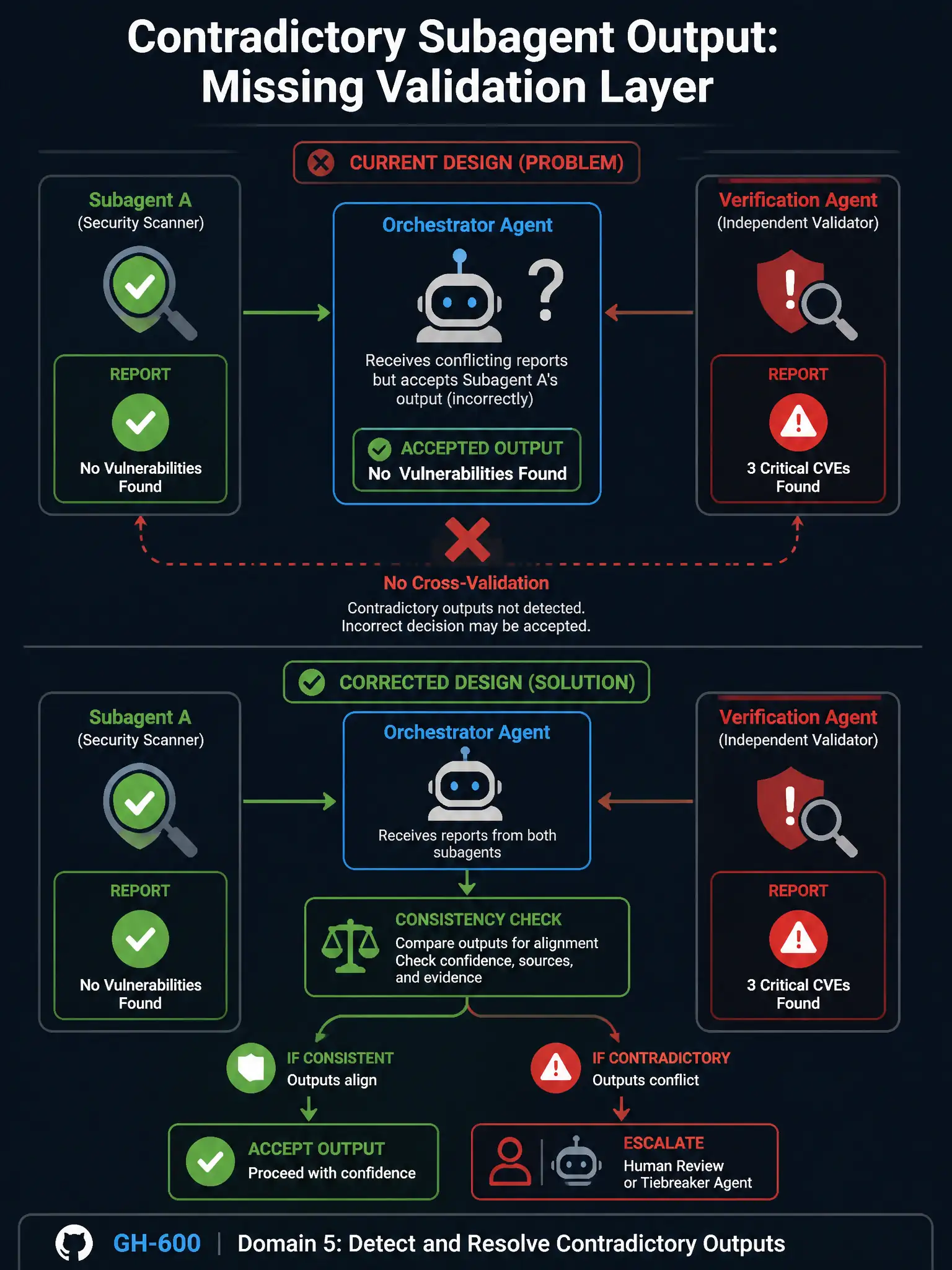
An orchestrator agent delegates a security assessment task to a subagent. The subagent returns a report stating 'No vulnerabilities found,' but a separate verification agent had already flagged three critical CVEs in the same codebase. The orchestrator accepts the subagent's report and marks the task complete. Which control is MISSING that allowed this contradictory output to be accepted?
Select an answer to reveal the explanation.
Short Explanation
You need a cross-validation step that checks subagent outputs against prior agent findings before accepting results as authoritative. If one agent says clean and another flags three CVEs, the orchestrator must catch the contradiction instead of marking the task done.
Full Explanation
In a well-designed multi-agent system, the orchestrator is responsible for more than routing tasks — it must also validate that the outputs it receives are internally consistent. When two agents produce contradictory findings on the same artifact, accepting one without surfacing the conflict is a critical design failure.
Why the cross-validation control is correct: The missing control is output cross-validation at the orchestration layer. Before marking a task complete, the orchestrator should compare the subagent's output against any prior or parallel agent findings on the same subject. When contradictions appear (for example, one agent finds clean, another finds three CVEs), the orchestrator must escalate — either triggering a human-in-the-loop review, requesting a tiebreaker from a third agent, or failing the task with a conflict report. Without this step, contradictory outputs from lower-confidence agents can silently override correct findings from higher-confidence agents.
Why the longer timeout proposal is wrong: Timeout duration affects how much work an agent can do, not whether the orchestrator validates the result. Extending the timeout does not add consistency checking between multiple agents' findings.
Why the high model temperature proposal is wrong: While high temperature can increase variability in model outputs, assigning blame to temperature does not fix the architectural gap. Even with temperature = 0, the orchestrator still needs to check cross-agent consistency, because deterministic wrong answers are still wrong.
Why the retry-three-times proposal is wrong: Retrying a subagent tests for reproducibility of that agent's output, not for consistency with other agents' outputs. If the subagent consistently returns 'No vulnerabilities found' (perhaps because it lacks access to the full codebase), retrying it three times just confirms the same incorrect result three times.
Exam takeaway: orchestrators must implement cross-agent consistency checks. Contradictory outputs between agents must be surfaced, not silently resolved by accepting the most recent or most convenient result.