
A team building a multi-agent research pipeline reports that downstream agents are producing irrelevant outputs. After investigation, you discover that each agent only receives the raw task description but not the decisions, reasoning, or intermediate results from previous agents. Which practice BEST addresses this handoff documentation failure?
Select an answer to reveal the explanation.
Short Explanation
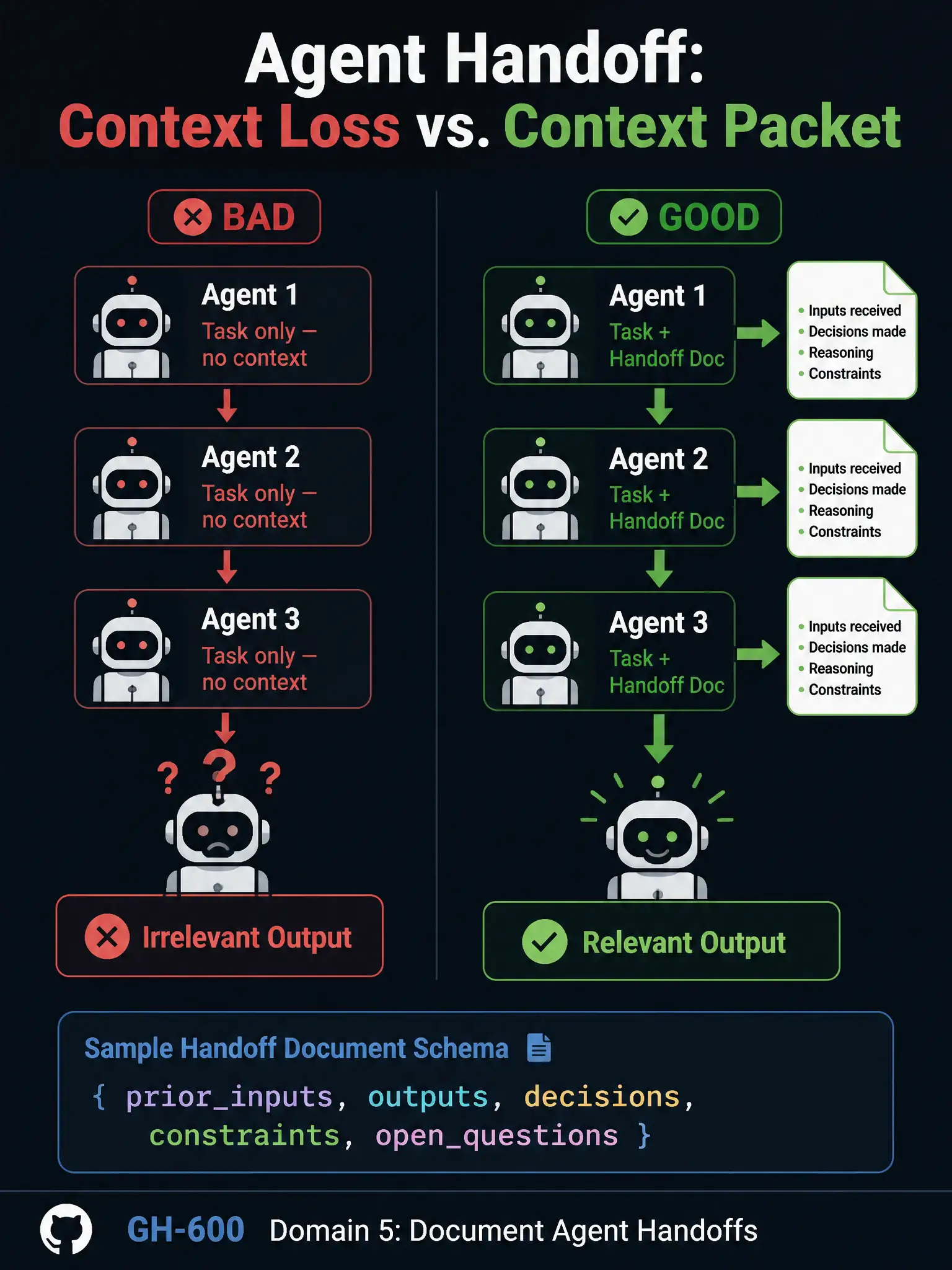
Think of it like a relay race where each runner gets the baton but not the race plan. You fix that by passing a structured handoff document with prior inputs, outputs, decisions, and reasoning, so each downstream agent starts with full situational context.
Full Explanation
Context loss between agent steps is one of the most common reasons multi-agent pipelines produce poor-quality outputs. Each agent in isolation may perform perfectly on its narrow task, but without understanding what the previous agent decided and why, downstream agents lack the situational awareness needed to produce relevant, coherent work.
Why the structured handoff document practice is correct: Structured handoff documents, sometimes called 'context packets', 'chain-of-thought summaries', or 'agent memos', solve this by explicitly encoding what each agent received as input, what it produced, what decisions it made, and any constraints or caveats it discovered. This document is passed as structured input to the next agent, so the downstream agent's first action is reading the full context rather than starting from the raw task description alone. Formats can range from JSON metadata blobs to structured Markdown summaries appended to the task prompt.
Why increasing the token limit for each agent's context window practice is wrong: Increasing context window size addresses the capacity to receive context, not the absence of context being passed. If the handoff doesn't include the prior agent's reasoning, a larger context window just means the agent can hold more empty space. The root cause is the handoff design, not the window size.
Why replacing the multi-agent pipeline with a single monolithic agent practice is wrong: Replacing a multi-agent pipeline with a monolithic agent trades scalability, parallelism, and modularity for simplicity. It may fix the context problem in a small use case, but it is not the correct architectural answer; it eliminates the design entirely rather than fixing the handoff mechanism.
Why adding a human review checkpoint between every agent step practice is wrong: Human review at every step eliminates the efficiency and scalability benefits of automation and does not scale. It is a recovery pattern for exceptional cases, not the primary fix for a structural design flaw.
The exam takeaway: every agent handoff must explicitly transfer context — task inputs, outputs, decisions, and constraints — not just the raw next-step instruction.