
A platform team is deploying agents across three different workflows: (1) auto-formatting code on every commit, (2) proposing architectural refactors for legacy services, and (3) rotating API credentials on a weekly schedule. Which autonomy configuration is MOST appropriate across all three workflows?
Select an answer to reveal the explanation.
Short Explanation
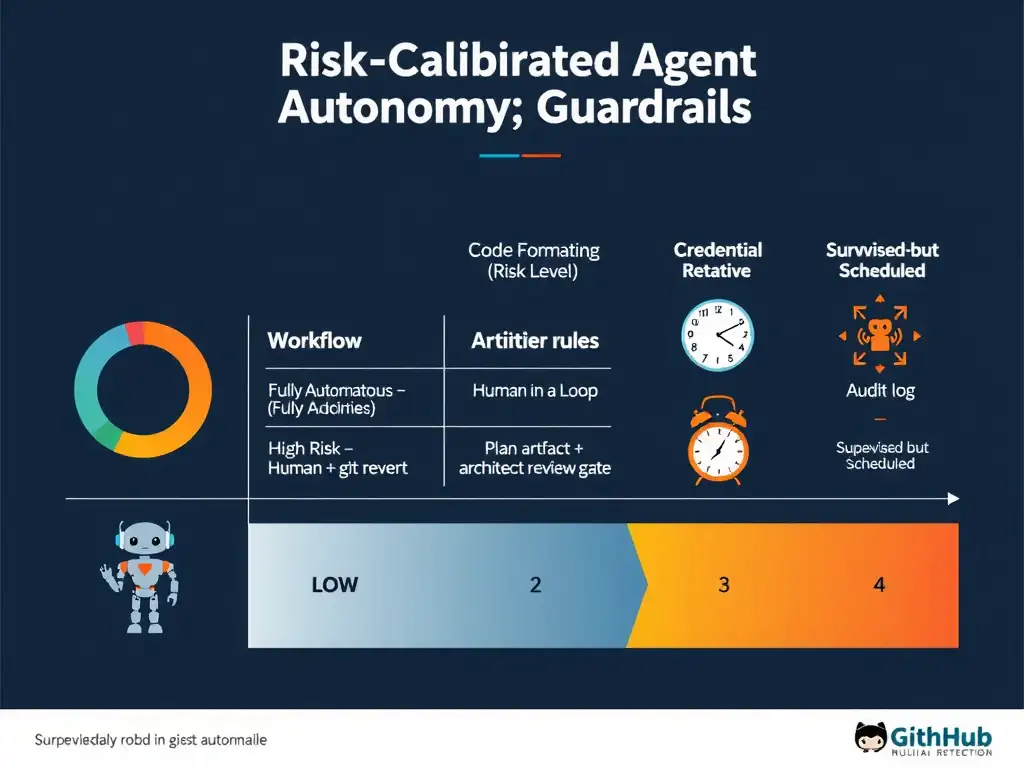
You wouldn't require a surgeon to get approval before washing their hands, but you would before performing a procedure. Autonomy should match the risk and reversibility of the action, not be applied uniformly. Formatting can run fully autonomous, architectural refactors need human plan review, and credential rotation fits supervised-but-scheduled.
Full Explanation
Tuning agent autonomy is about matching the level of human oversight to the risk profile of each task, considering reversibility, judgment requirements, security sensitivity, and blast radius of errors.
The correct approach is to calibrate autonomy per workflow: fully autonomous for formatting because it is low risk, reversible, and rule-based; human-in-the-loop with plan review for architectural refactors because they are high impact and judgment-intensive; and supervised-but-scheduled for credential rotation because it is security-sensitive but follows a predefined procedure.
For auto-formatting, full autonomy is appropriate because code formatting follows deterministic rules, such as Prettier or Black, changes are immediately visible in diffs, easily reverted, and low-consequence. Human review here creates friction without adding safety value.
For architectural refactors, human-in-the-loop with plan review is appropriate because these changes affect system design, may introduce breaking changes across service boundaries, and require judgment about trade-offs that extend beyond the agent's context window. A plan artifact reviewed by a human architect before execution is the appropriate pattern.
For credential rotation, supervised-but-scheduled is appropriate because this is a well-defined procedure: generate a new secret, update the secret manager, deprecate the old key, and verify the result. However, it is security-sensitive. A human should not approve each individual rotation, because that defeats the purpose of automation, but the process should run on a schedule with audit logging, anomaly detection, and an override mechanism if the procedure deviates from the expected path.
The all-autonomous approach is dangerous for architectural refactors and credential rotation. Architectural refactors made autonomously without human review can introduce systemic issues. Credential rotation with full autonomy and no oversight removes the security monitoring layer.
The all-supervised approach eliminates the efficiency gains that make agents valuable for routine tasks like formatting. Requiring human approval for every Prettier run is operationally untenable.
The trial-period approach is not a principled autonomy model. It assumes that absence of reported incidents equals absence of risk, which is not valid. Undiscovered errors in architectural refactors may surface weeks later. The 30-day window is arbitrary, and the batch promotion ignores per-workflow risk differences.
The exam objective is: 'Plan and implement the degree of agent autonomy, including guardrails.' The principle is risk-calibrated autonomy, not uniform autonomy.