
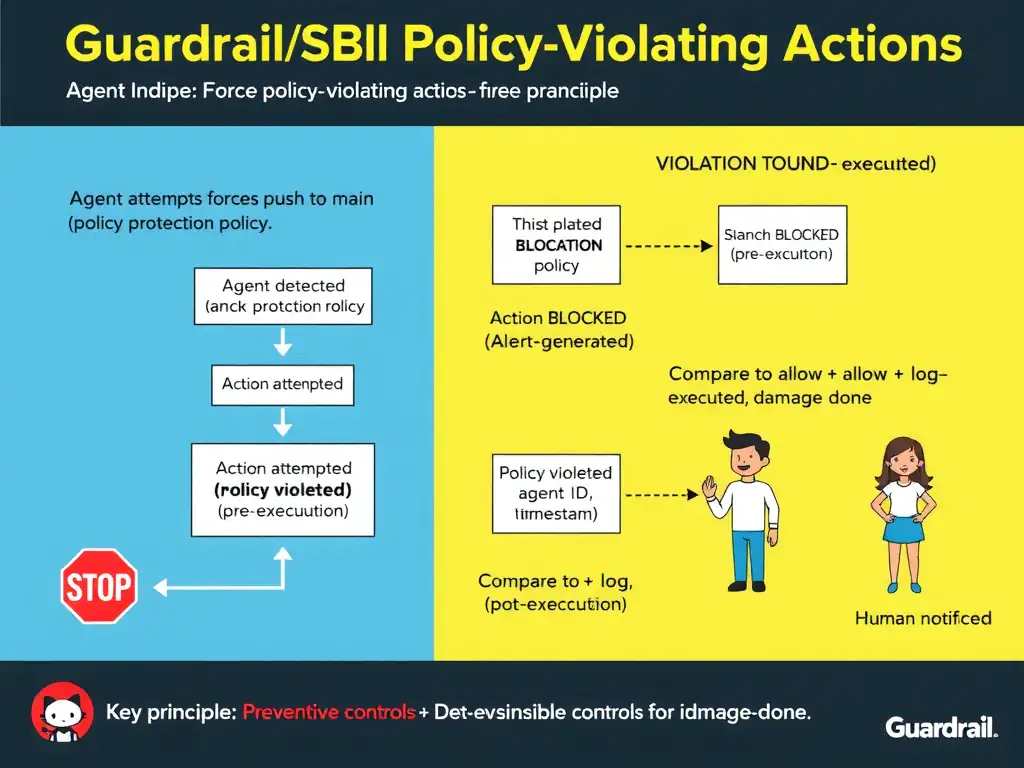
A GitHub Copilot agent is attempting to perform a force push to the main branch, which violates the organization's branch protection policy. How should the guardrail system respond?
Select an answer to reveal the explanation.
Short Explanation
You don't let a policy-violating action slip through. If an agent tries to force push to main, you block it, prevent execution, and alert on the violation.
Full Explanation
Guardrail systems must enforce organizational policies as hard blocks, not soft suggestions. Actions that violate security, compliance, or operational policies must be prevented before they are executed.
Why blocking the action immediately, preventing execution, and generating an alert is right: When the agent attempts a force push to main — an action that violates branch protection policy — the guardrail system should immediately block the execution attempt, prevent any data from being pushed, and generate a structured alert that explains which policy was violated and why. This creates both prevention and accountability.
Why allowing the force push to proceed and logging it for post-hoc review is wrong: Allowing the force push to proceed and logging it afterward means the damage is already done. Post-hoc review is a detective control, not a preventive one. Force pushes to main can rewrite history, lose commits, and affect the entire team — these effects are not easily undone.
Why sending a notification to the team and allowing the agent to retry with different parameters is wrong: Sending a notification and allowing a retry with different parameters does not block the violation — it delays it. If the agent's goal is to force-push, it may find other ways to accomplish this if the notification-based approach doesn't specifically prevent the action.
Why pausing the agent and asking the agent itself to determine whether the force push is appropriate is wrong: Asking the agent to determine whether its own policy violation is appropriate is fundamentally flawed. An agent that has decided to force-push main will likely justify that decision when asked. Policy enforcement must be external to the agent's reasoning.