
A developer wants a Copilot agent to work exclusively on feature branches prefixed with 'agent/' so that it never modifies code on main or release branches. Which configuration approach best enforces this branch-based scope?
Select an answer to reveal the explanation.
Short Explanation
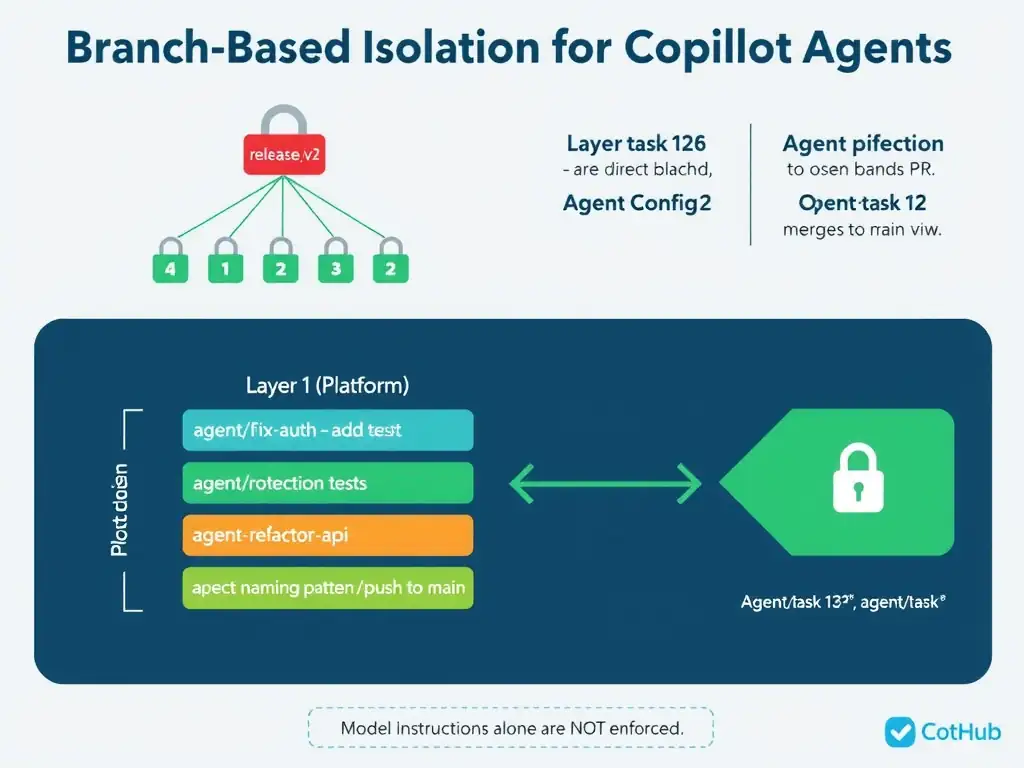
Branch protection rules are the platform-level guardrails that actually enforce what can and can't be pushed. Telling the model in plain language to stick to agent/* branches is like putting up a 'please knock' sign — polite, but not a lock. You need protection rules on main and release branches plus agent configuration that always creates agent/-prefixed branches for its work.
Full Explanation
Branch-based scope isolation ensures an agent's changes are quarantined to purpose-built branches and never land directly on protected branches. This is enforced through a combination of platform-level controls and agent configuration:
1. Branch protection rules on main and release branches (e.g., release/*) block direct pushes, require pull requests, and may require status checks. The agent cannot bypass these rules regardless of what the model attempts — the GitHub API will reject the push with a 403.
2. Agent configuration that specifies the branch naming pattern (e.g., creating branches matching agent/{task-id} or agent/{description}) ensures the agent's working branches are clearly identifiable and isolated.
Together, these controls create a defense-in-depth setup: even if the agent tries to push to main, the branch protection rule prevents it; and the naming convention makes agent branches easy to identify and review.
The instruction-only approach is incorrect because model-level instructions are not access controls. The model may misinterpret context, an adversarial input could override the instruction, and — most importantly — the GitHub API does not check system prompt instructions before accepting a push. Instructions guide behavior probabilistically; they do not enforce it deterministically.
The workflow trigger approach is incorrect because a branch deletion trigger is unrelated to restricting which branches an agent can write to. It would also be counterproductive — triggering the agent when branches are deleted is not a useful CI pattern for this scenario.
The default-branch rename approach is incorrect because renaming the default branch to agent/main would break the entire repository's normal workflow. Team members, other CI pipelines, and integrations all depend on a stable default branch name like main. This is not a scoping strategy; it's a disruptive rename.
The branch protection plus agent branch naming approach is correct. Branch protection rules provide enforceable platform controls, and agent branch naming configuration provides operational isolation.
Prefer to study offline? Printable PDF study book + test engine ($7.50, unofficial). These questions stay free here.