
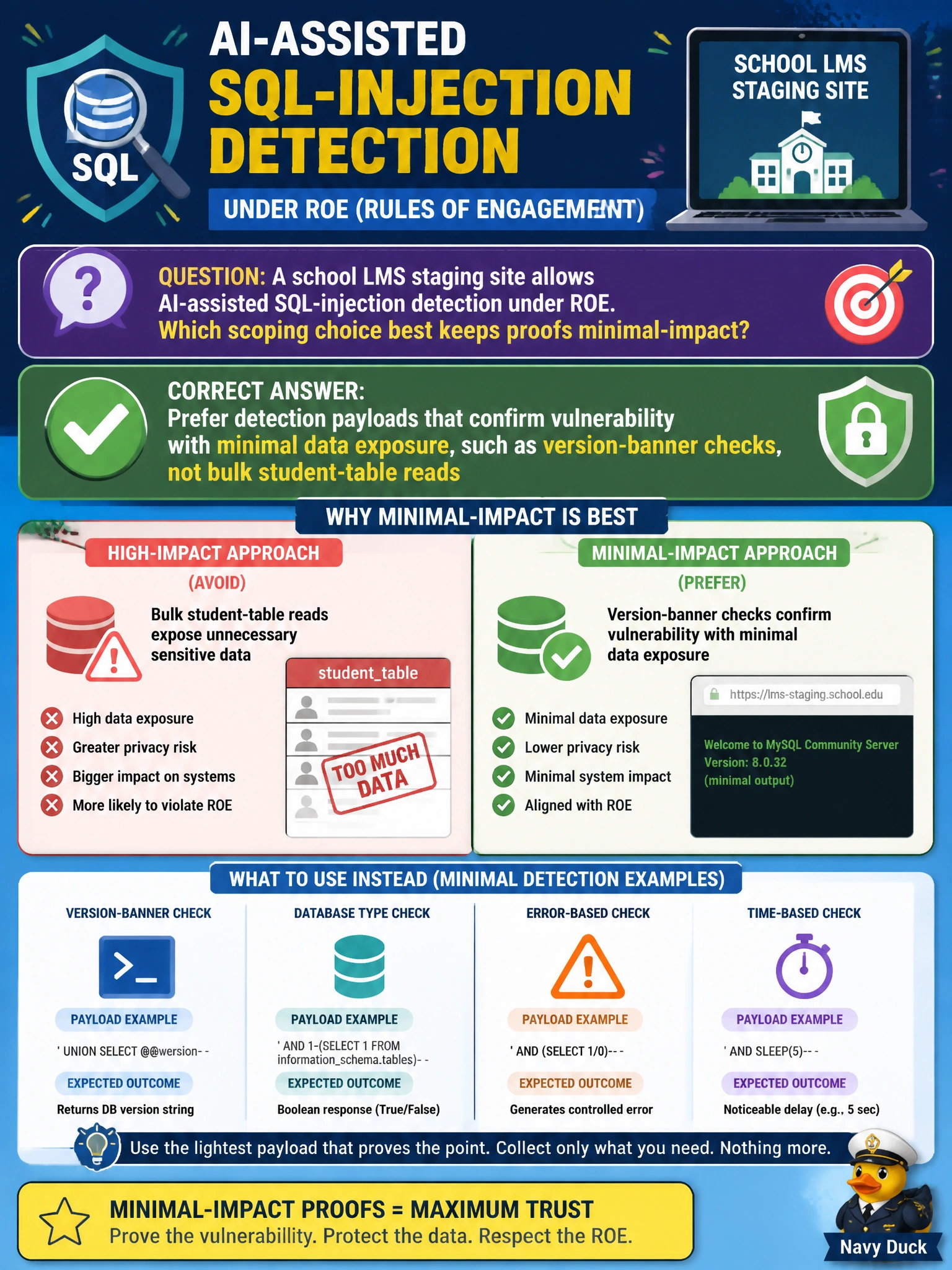
A school LMS staging site allows AI-assisted SQL-injection detection under ROE. Which scoping choice best keeps proofs minimal-impact?
Select an answer to reveal the explanation.
Short Explanation
Prove the door is unlocked without hauling the whole gradebook into the hallway. Banner-style detection beats student-table tourism. Staging still deserves a light touch.
Full Explanation
On a school LMS staging site, authorized SQL-injection detection should prove vulnerability with minimal data exposure. Preferring detection payloads such as version-banner or boolean/time checks that confirm the issue without bulk student-table reads keeps proofs proportional and reduces privacy harm even in staging. Minimal-impact scoping is especially important where education records may appear and where shared staging databases support multiple district teams.
Exfiltrating full student grade tables as the default detection method is excessive and privacy-hostile, even when labeled staging. Overwriting enrollment records for dramatic write-access demos risks integrity and shared staging usefulness for teachers and IT. Mirroring production student PII into a public LLM context for realism violates privacy and often district policy; realism does not require feeding PII to public models.
Exam caveat: minimal-impact SQLi proof questions prefer banner/detection-style confirmation over bulk reads or destructive writes. Operational check: choose the lightest detection that confirms SQLi under ROE, avoid bulk education-data exfil, keep PII out of public LLM contexts, restore any test side effects, and document the minimal proof.