
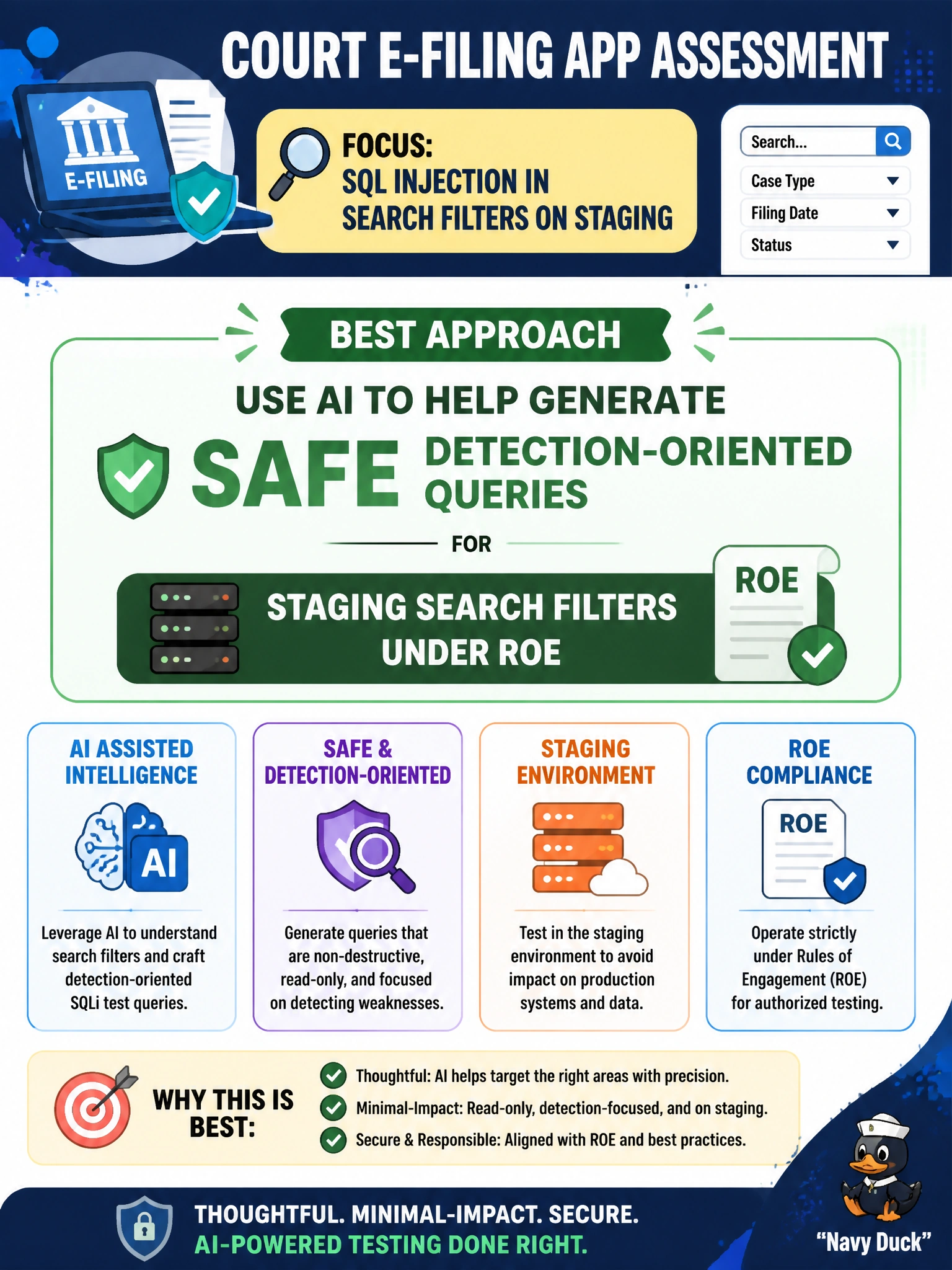
A court e-filing app assessment focuses on SQL injection in search filters on staging. Which AI-assisted approach best stays thoughtful and minimal-impact?
Select an answer to reveal the explanation.
Short Explanation
Justice apps deserve kid gloves: AI can draft gentle detection queries for staging filters, not a smash-and-grab of case tables. Production docket vandalism fails every ethics class.
Full Explanation
Court e-filing applications demand minimal-impact, ROE-bound testing because case data sensitivity and judicial trust are high. The best AI-assisted approach on staging search filters uses AI to help generate safe, detection-oriented queries that confirm SQL-injection conditions without bulk exfiltration or destructive writes. Thoughtful detection on staging aligns with authorized practice and reduces collateral harm while still producing evidence owners can remediate.
Dumping entire case tables to a laptop as the first detection step is excessive data exposure and poor methodology for a justice system app. Running destructive writes against production dockets to prove severity ignores staging, ROE, and judicial operational risk. Skipping staging to inject live filings because 'realism outweighs ROE' explicitly rejects the rules of engagement that make the assessment lawful and ethical.
Exam caveat: justice-system SQLi items prefer safe detection-oriented staging queries with AI assistance under ROE, not production vandalism or bulk dumps. Operational check: stay on staging, craft minimal detection payloads (with AI as a drafting aid), capture evidence, avoid bulk case-record extraction, and escalate only through approved channels.