
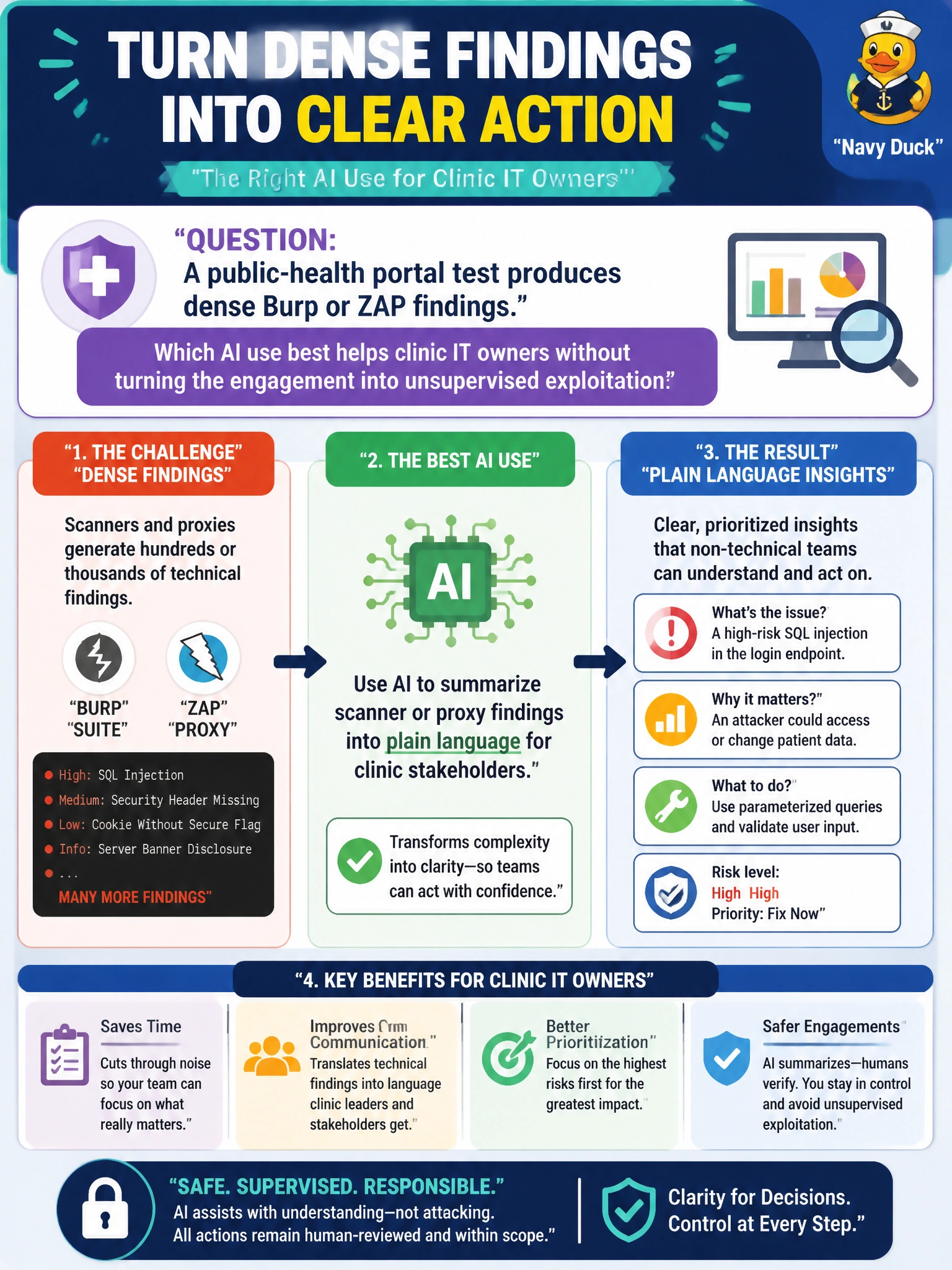
A public-health portal test produces dense Burp or ZAP findings. Which AI use best helps clinic IT owners without turning the engagement into unsupervised exploitation?
Select an answer to reveal the explanation.
Short Explanation
Clinic IT folks need English, not a wall of proxy glyphs. Let AI translate the Burp/ZAP noise into plain language—then keep humans steering what actually gets tested. Auto-exploit agents and social-media dumps fail the public-health sniff test.
Full Explanation
Dense Burp or ZAP output is hard for clinic IT owners to act on. The best AI use in a public-health portal test is summarizing scanner or proxy findings into plain language for stakeholders—translating technical alerts into owned risks, affected components, and next steps—without granting the model unsupervised exploitation authority. That keeps the engagement collaborative and actionable for municipal health operations, where downtime and privacy mistakes have direct resident impact.
Feeding raw tool output into an agent that auto-exploits every alert on production abandons ROE and can harm clinical availability or corrupt health workflows. Deleting medium findings so dashboards look green hides risk and misleads leadership about residual exposure. Translating findings into patient-identifiable narratives on public social media violates privacy and professional ethics regardless of technical accuracy.
Exam caveat: AI-for-findings-communication questions reward plain-language summarization for owners, not auto-exploit agents or public PII storytelling. Operational check: use AI to draft stakeholder-friendly summaries from tool output, keep humans deciding remediation and any follow-on tests, scrub patient identifiers from external communications, and retain the raw tool evidence in a controlled store.