
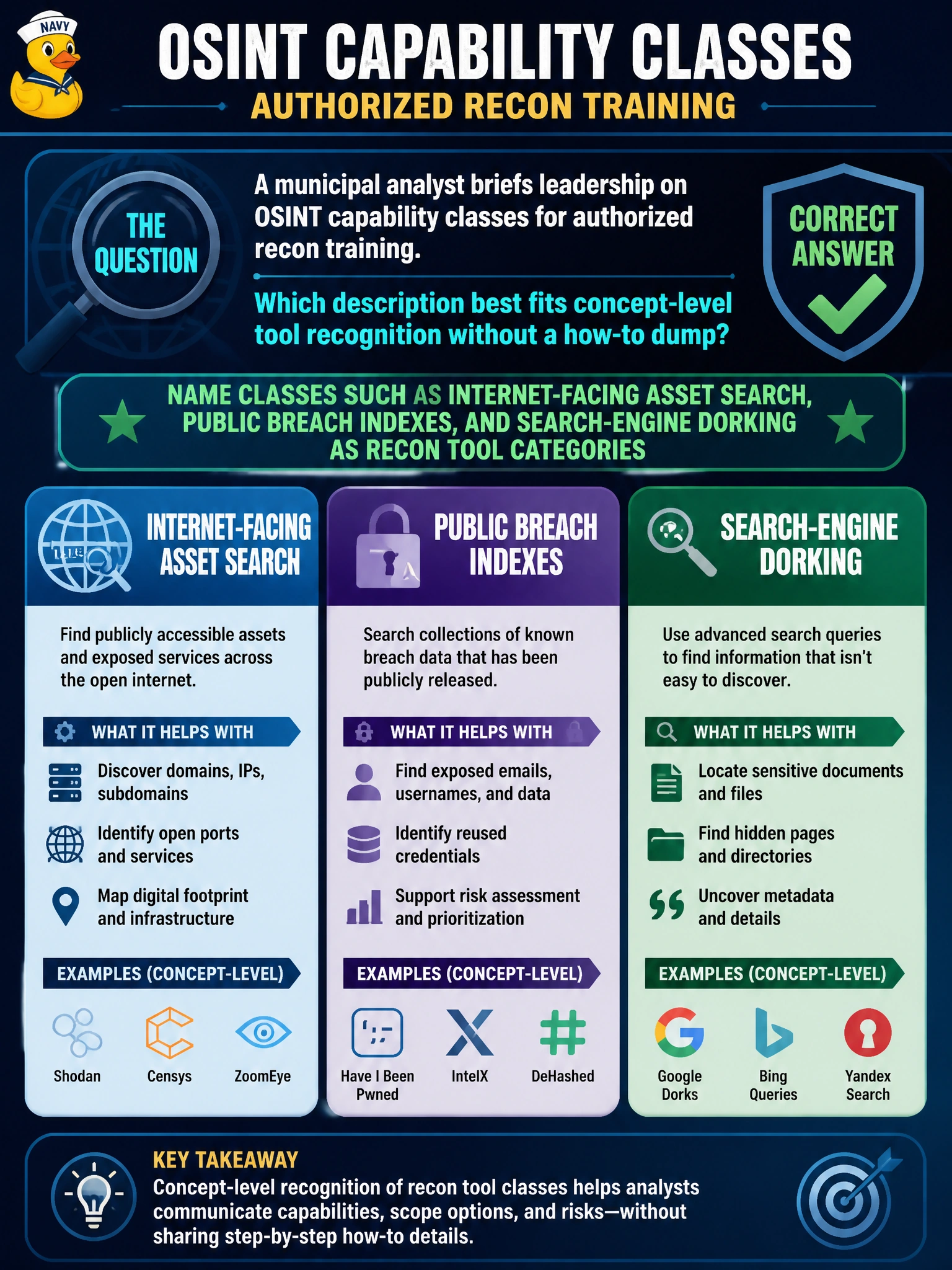
A municipal analyst briefs leadership on OSINT capability classes for authorized recon training. Which description best fits concept-level tool recognition without a how-to dump?
Select an answer to reveal the explanation.
Short Explanation
Brief the toolbox categories—asset search, breach indexes, dorking—not a recipe book of exploits. Leadership needs concept-level map pins, not live credentials taped to the projector.
Full Explanation
Authorized recon training for municipal leadership needs concept-level tool recognition without turning the brief into an exploit cookbook. The best description names capability classes—internet-facing asset search, public breach indexes, and search-engine dorking—as recon tool categories. That framing teaches what kinds of OSINT capabilities exist and why they matter for city defense, while avoiding operational how-to dumps that create misuse risk or unnecessary sensitivity in slide decks.
Pasting full exploit commands and unpaid access credentials into briefing slides fails training hygiene and may circulate illegal or abusive content under the guise of education. Claiming OSINT tools are illegal for any government tester under all circumstances is false and unhelpful: authorized government testing and open-source research have lawful lanes. Recommending only proprietary malware builders as the primary OSINT stack misclassifies malware construction as OSINT and steers the program toward the wrong capability family.
Exam caveat: 'concept-level recognition' stems usually want category naming, not command paste or blanket illegality claims. Operational check: keep leadership briefings at class/category level, ban credential and exploit-recipe dumps from decks, and route deep technique labs to controlled training environments with proper ROE.