
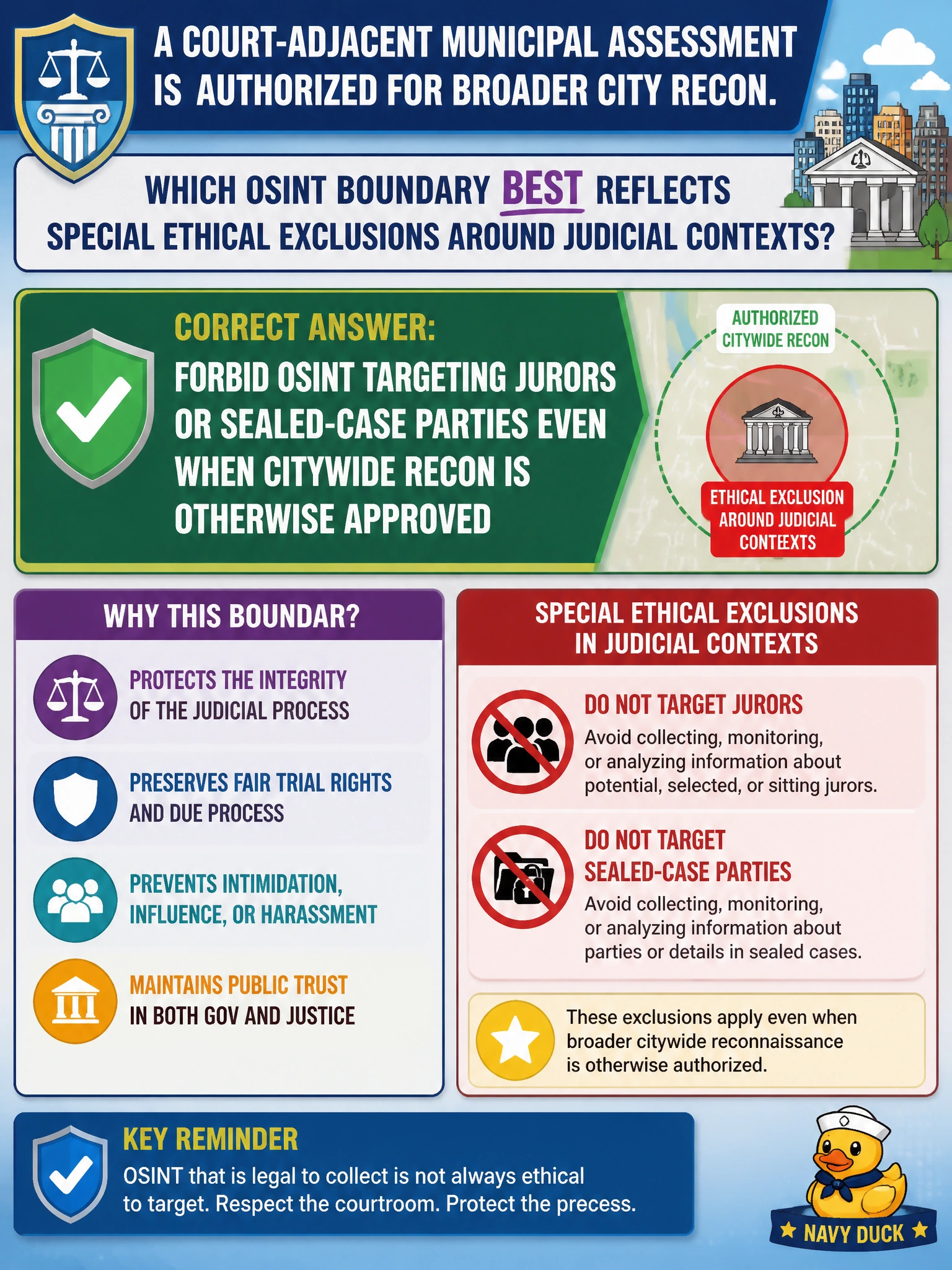
A court-adjacent municipal assessment is authorized for broader city recon. Which OSINT boundary best reflects special ethical exclusions around judicial contexts?
Select an answer to reveal the explanation.
Short Explanation
Courts have bright red lines: jurors and sealed parties are off the recon menu—even if the rest of city hall is in scope. Fake AI juror profiles and sealed-docket gossip are how assessments earn ethics hearings, not gold stars.
Full Explanation
Court-adjacent municipal assessments often receive broader city recon authorization, but judicial contexts carry special ethical and legal exclusions that do not disappear just because the engagement is citywide. The correct boundary forbids OSINT targeting jurors or sealed-case parties even when other municipal assets are in scope. That exclusion protects due process, reduces jury-tampering risk narratives, and keeps purple-team work from contaminating judicial integrity. Ethical exclusions around jurors and sealed matters are bright-line constraints, not optional niceties that yield to phishing realism.
Encouraging OSINT on jurors and sealed-case parties to improve phishing realism fails ethics and can create serious legal exposure; realism never overrides judicial protections. Publishing sealed docket excerpts in purple-team chat for situational awareness fails confidentiality and court-order constraints—sealed material is not training flavor text. Letting AI invent juror social profiles when primary sources are unavailable fabricates people and risks false targeting; invented profiles are not OSINT and are not authorized substitutes for out-of-scope collection.
Exam caveat: when a stem mentions courts, jurors, or sealed cases, prefer the answer that draws a hard exclusion even if other recon is approved. Operational check: write juror and sealed-party prohibitions into ROE and recon playbooks, brief testers before collection starts, and reject any AI-generated stand-in profiles for those excluded parties.