
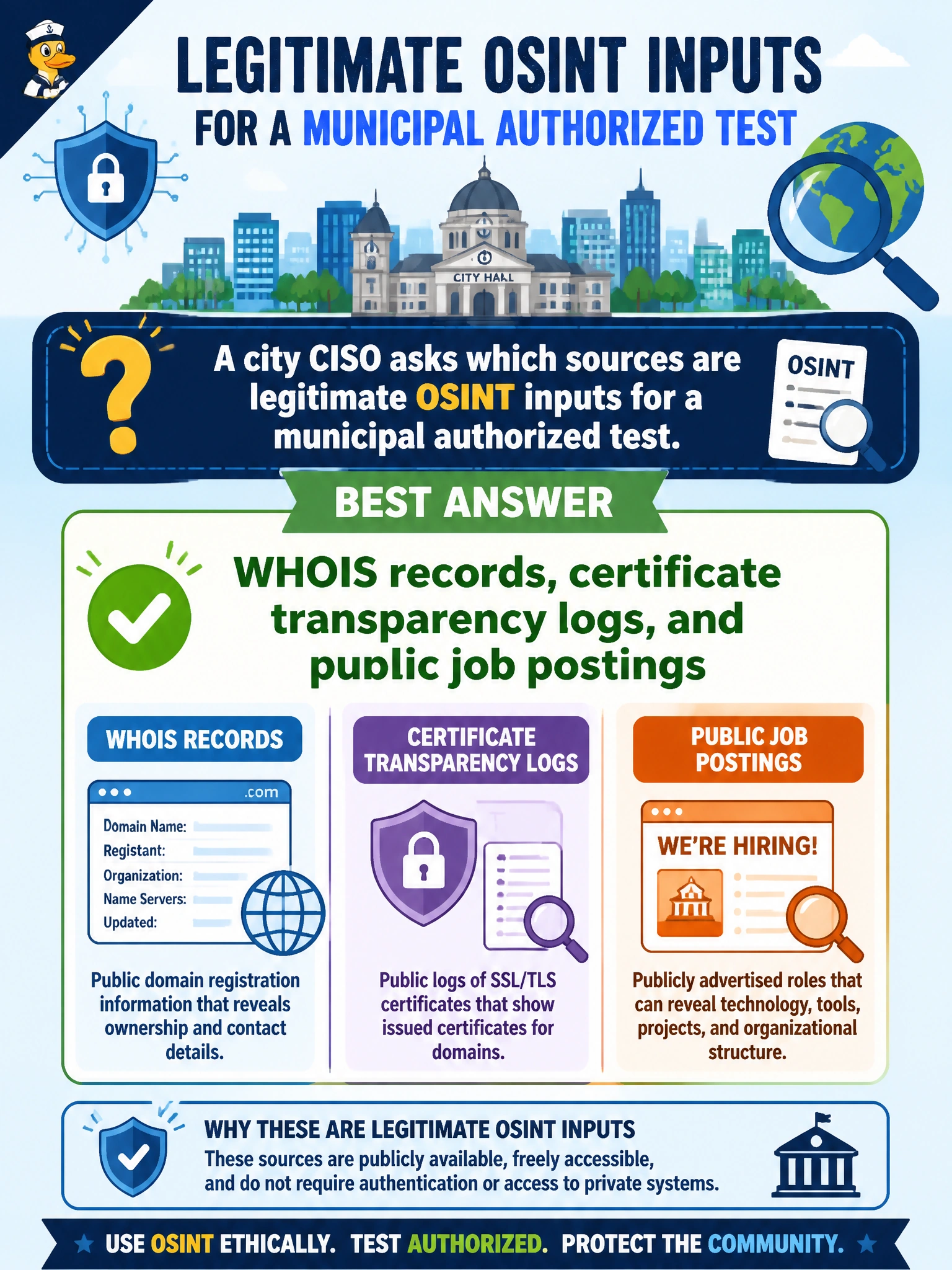
A city CISO asks which sources are legitimate OSINT inputs for a municipal authorized test. Which answer is best?
Select an answer to reveal the explanation.
Short Explanation
WHOIS, cert transparency, and job posts are the public notice board of recon—fair game under typical ROE. Stolen cookies and unauthorized wiretaps are a different universe.
Full Explanation
Legitimate OSINT inputs for a municipal authorized test commonly include public registration and exposure sources such as WHOIS records, certificate transparency logs, and public job postings. Those sources reveal infrastructure ownership clues, issued certificates, and technology or process hints without requiring criminal markets or unlawful interception. City CISOs should recognize these as standard, lawful open-source classes under typical ROE.
Relying only on classified law-enforcement databases accessed without a need-to-know fails by concept: that is not OSINT and may be unauthorized access to sensitive systems. Stolen MFA session cookies purchased from criminal markets are illicit access material, not open-source intelligence. Wiretap feeds collected without judicial or policy authorization are interception, not legitimate OSINT for a municipal test.
Exam caveat: Public source does not mean publish-everything in the customer report—minimize sensitive personal data from job posts or WHOIS privacy contacts when not needed. Some WHOIS data is redacted; absence of a field is not a finding of no exposure. Certificate transparency can include unrelated lookalike domains—validate relevance before alarming operators.
Operational check: Build the recon source list with WHOIS, CT logs, and careers pages explicitly in-scope; prohibit dark-web credential markets and unauthorized intercepts in the same checklist; and require citations to the public primary record for each infrastructure claim in the report.