
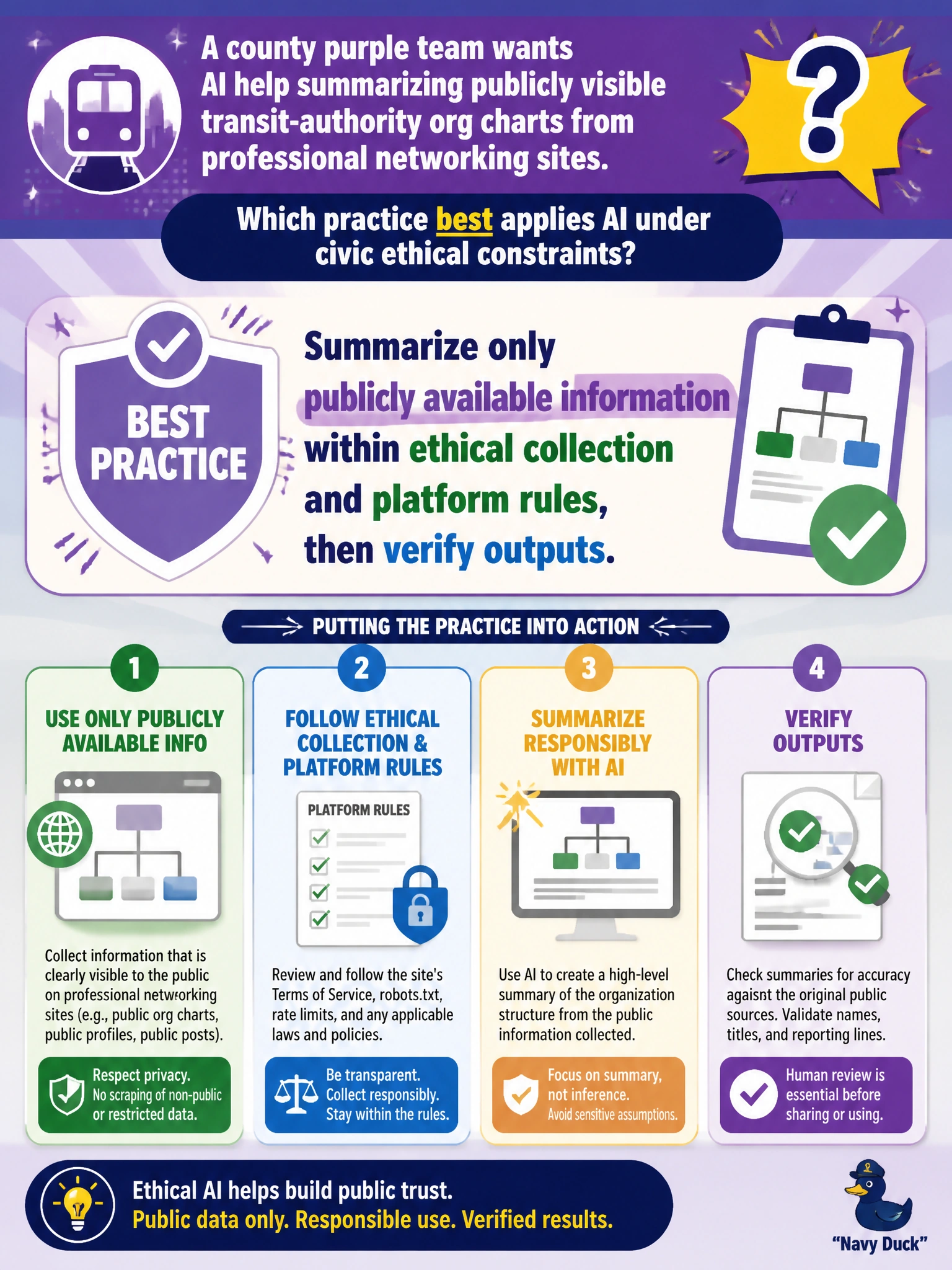
A county purple team wants AI help summarizing publicly visible transit-authority org charts from professional networking sites. Which practice best applies AI under civic ethical constraints?
Select an answer to reveal the explanation.
Short Explanation
You can use AI to summarize public transit-authority org charts, as long as you follow ethical collection and platform rules and verify the results. Treat the summary like a helpful highlighter, not a substitute for checking your sources; restricted profiles and staff home addresses are not fair game.
Full Explanation
For civic OSINT, use AI to summarize only publicly available transit-authority information collected within ethical, legal, and platform rules, then verify the output against its sources. Public professional networking pages and org charts can help map an organization for an authorized assessment, but AI does not grant permission to collect restricted profiles or hidden account details when access controls or platform terms prohibit it. That practice fails because it disregards collection limits. Ignoring collection rules on the assumption that AI summaries are always accurate also fails: models can make mistakes, and accuracy does not remove the obligation to follow rules. Publishing raw staff home addresses found through AI side channels is harmful doxxing, not appropriate municipal reconnaissance. Exam caveat: Public availability is necessary but not always sufficient; some public information, including home addresses and personal phone numbers, may still be sensitive to disseminate. Minimize and redact such details in reports, and follow platform automation limits and anti-bot rules even when AI tools drive collection. Practical check: Restrict the workflow to URLs or exports already confirmed public and in scope, require analysts to cite primary sources for material org-chart claims, and run a redaction pass to remove nonessential personal contact data before the report leaves the purple team.