
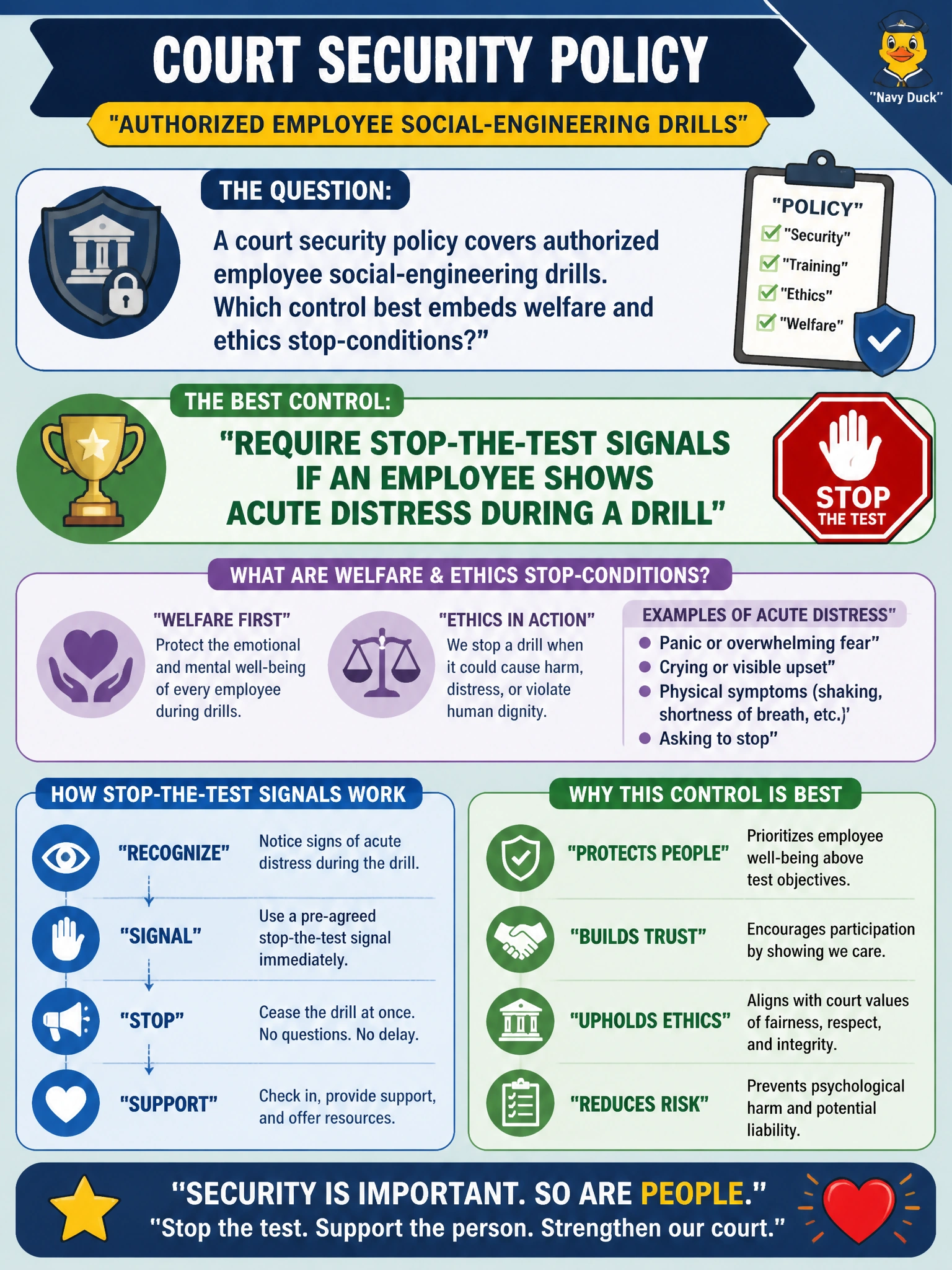
A court security policy covers authorized employee social-engineering drills. Which control best embeds welfare and ethics stop-conditions?
Select an answer to reveal the explanation.
Short Explanation
If someone is melting down on a drill call, you hit the brakes—period. Welfare stop signals are the seatbelt for ethical SE exercises, not a nice-to-have.
Full Explanation
Authorized employee social-engineering drills in court and other municipal workplaces must embed welfare and ethics stop-conditions so duty of care is enforceable during live calls or scenarios. Requiring clear stop-the-test signals when an employee shows acute distress prevents psychological harm, preserves trust in the awareness program, and keeps the engagement aligned with HR and legal expectations. Metrics are subordinate to participant welfare; ethical abort criteria are a control, not a failure of rigor.
Continuing every scenario regardless of distress fails by concept: it treats humans as disposable instrumentation and conflicts with municipal employer responsibilities. Punishing anyone who asks to pause mid-call weaponizes the drill and drives underreporting of harm. Forbidding ethical aborts so metrics stay continuous elevates dashboard continuity over legality and safety and produces culture outcomes that undermine defensive learning.
Exam caveat: Stop-conditions do not mean every mild awkwardness ends the program, nor that results cannot be recorded when a scenario is aborted. Document the abort, protect the employee, and treat the event as a safety and process finding. Court environments may also involve trauma-sensitive roles; pretest ethics review should calibrate scenarios accordingly rather than copying retail phishing scripts wholesale.
Operational check: Before the drill, publish the stop signal and escalation path to facilitators and participants; verify facilitators can immediately terminate a call and open welfare support; and after any abort, confirm HR/ethics notification occurred and that no punitive action was taken for using the stop condition.