
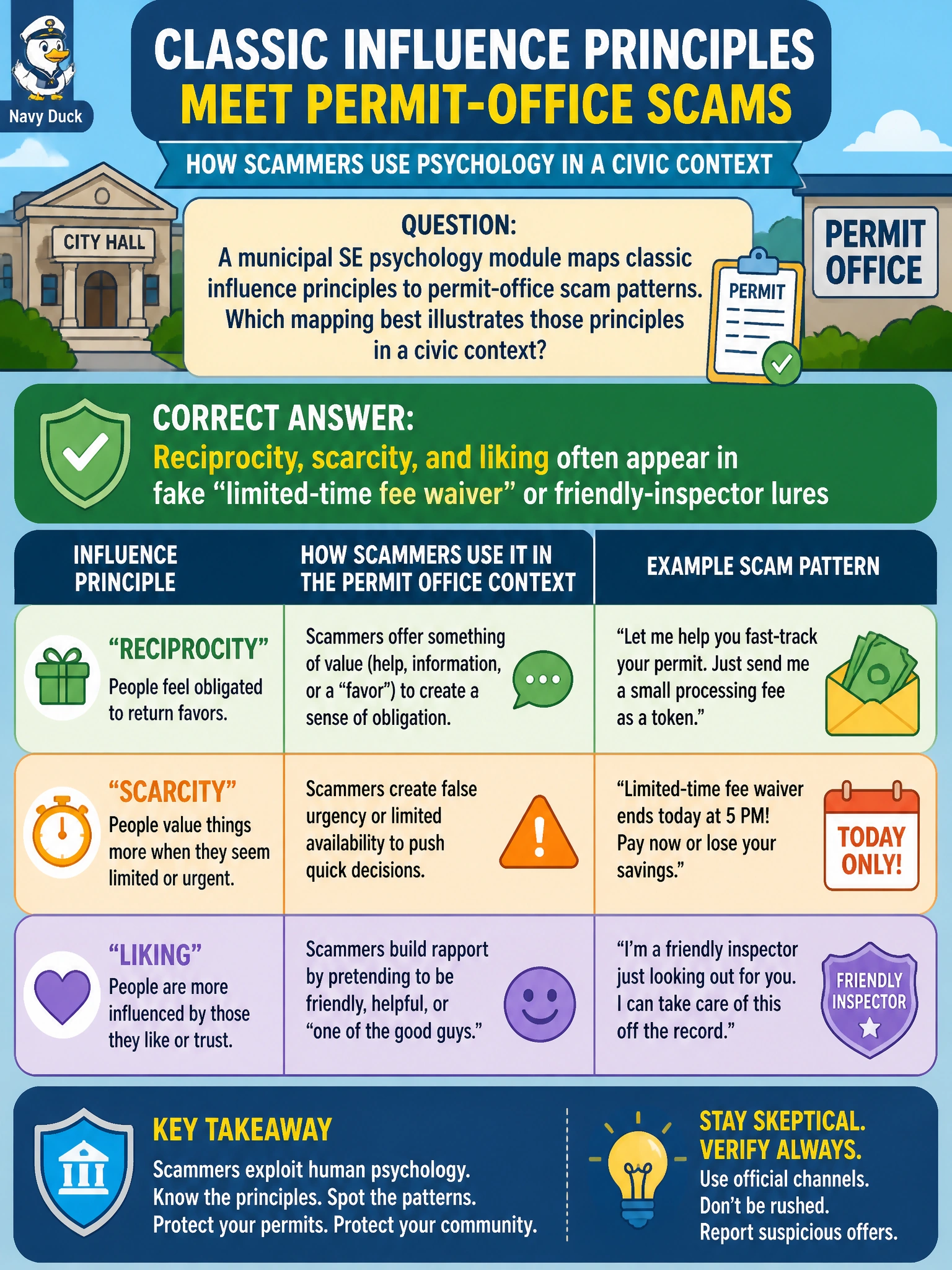
A municipal SE psychology module maps classic influence principles to permit-office scam patterns. Which mapping best illustrates those principles in a civic context?
Select an answer to reveal the explanation.
Short Explanation
Fake 'act now or lose your waiver' notes and overly buddy-buddy inspector chats are just scarcity and liking wearing a city badge. Psychology travels—civic scams use the same levers as any other con.
Full Explanation
Classic social-engineering influence principles—reciprocity, scarcity, liking, authority, consistency, and social proof—map cleanly onto civic scam and awareness patterns. Fake limited-time fee waiver messages exploit scarcity and urgency around municipal fees, while friendly-inspector or helpful-clerk pretexts lean on liking and reciprocity to lower skepticism at a permit office. Mapping those levers in a municipal psychology module helps defenders design realistic authorized drills and help staff recognize pressure tactics without needing to memorize criminal playbooks.
Treating only encryption algorithms as relevant and dismissing human influence fails by concept: SE is primarily a human decision problem that cryptography alone does not solve at the moment of compliance. Claiming scarcity never applies to government services because permits have unlimited supply ignores how adversaries invent artificial deadlines, quota threats, or temporary waivers. Asserting that liking works only in consumer retail ignores municipal contexts where rapport, familiarity, and helpful form-completion language are common and effective.
Exam caveat: Recognizing influence principles is not authorization to deploy manipulative or demeaning pretexts against staff or the public. Civic programs still need ethics review, ROE, and welfare stop-conditions. Also, presence of a principle in a lure does not prove every urgent fee notice is malicious—operational verification against official channels remains required.
Operational check: In training materials, label sample civic lures with the influence principle each uses, then have staff practice an out-of-band verification step (official portal, published phone number, or known supervisor callback) before complying with fee-waiver or inspector requests that invoke scarcity or excessive friendliness.