
A county attack-surface briefing ranks social-engineering targets for an authorized awareness program. Why is the shared help desk often treated as a high-value target?
Select an answer to reveal the explanation.
Short Explanation
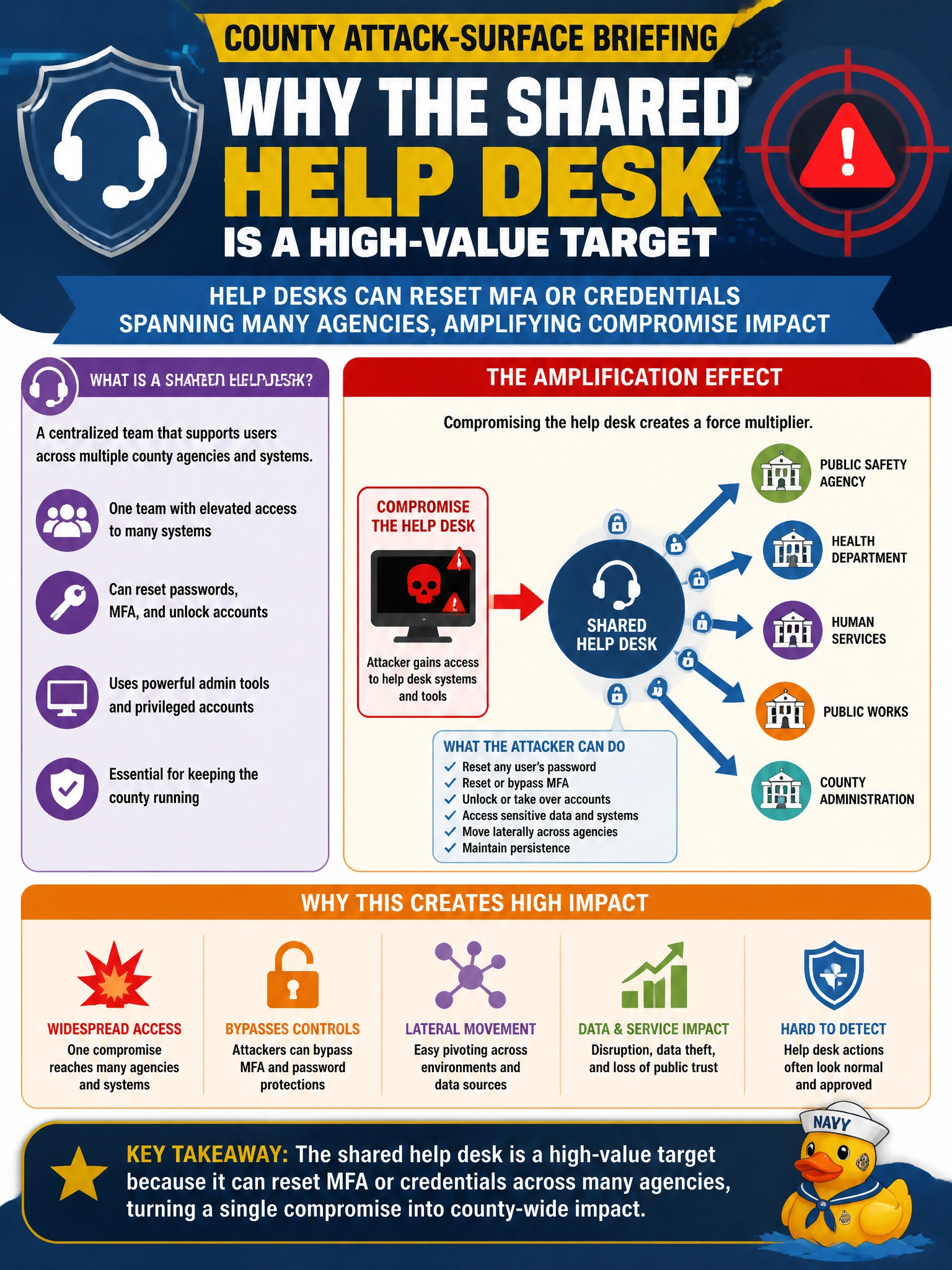
Think of the help desk like the master key to a city hall full of locked doors—one friendly reset and half the building opens. That blast radius is why SE programs treat shared identity desks as high-value targets, not just 'printer ticket' shops.
Full Explanation
In municipal identity operations, a shared help desk is a high-value social-engineering target because it commonly performs MFA resets, password recovery, unlocks, and privilege-adjacent identity workflows that span many agencies from a single trust point. Compromising that desk through pretext, urgency, or authority can yield cascading access far beyond one mailbox or one department. Attack-surface briefings for authorized awareness programs therefore rank the shared desk alongside other blast-radius identity surfaces rather than treating it as low-impact facilities support.
Claims that help desks never hold credentials or cannot affect identity workflows fail by concept: civic service desks routinely touch authentication recovery paths. Framing the desk as only printer tickets understates privilege and ignores MFA and unlock duties. Asserting that MFA resets always require mayor approval invents a universal control that most jurisdictions do not operate and still would not erase help-desk influence on identity tooling when exceptions exist.
Exam caveat: high value does not mean every help-desk agent is malicious or that SE programs should run uncontrolled live tests against them. Ranking for awareness, purple-team scoping, and control hardening is different from authorizing phishing without ROE, HR, and welfare review. Also distinguish shared enterprise desks from siloed departmental support with narrower reset rights—scope the risk to the actual identity privileges in that municipality.
Operational check: Inventory who can reset MFA, unlock accounts, or change authenticators across agencies; map those rights to ticketing workflows and out-of-band verification steps. During an authorized awareness exercise, confirm that help-desk playbooks require callback or secondary identity proof before reset, and that anomalous reset volume is logged and reviewed by identity owners.