
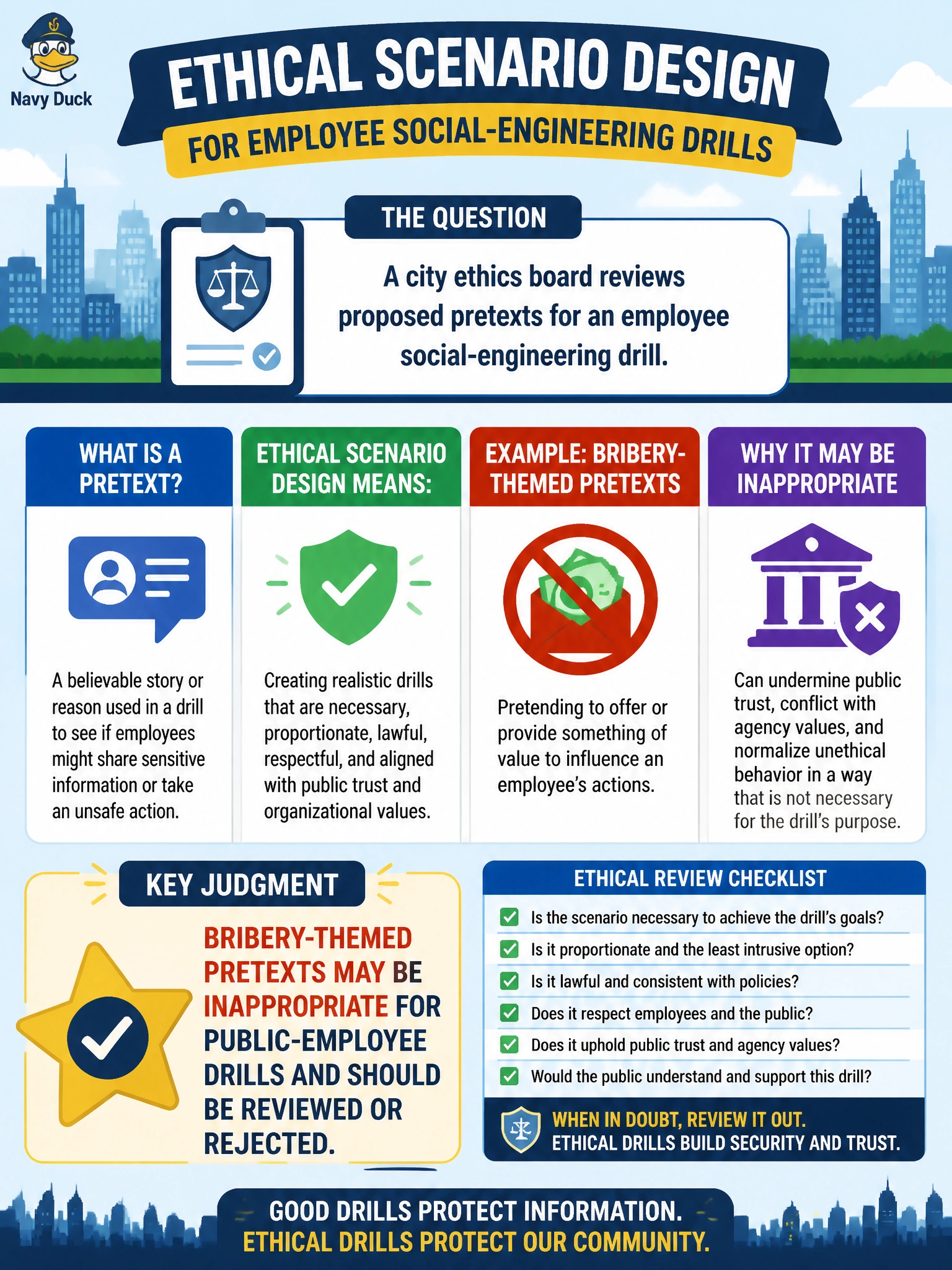
A city ethics board reviews proposed pretexts for an employee social-engineering drill. Which judgment best reflects ethical scenario design?
Select an answer to reveal the explanation.
Short Explanation
Public employees and bribery storylines can be a nasty mix—ethics boards exist to say 'not this one.' Chatbot drafts and click-rate addiction do not replace judgment.
Full Explanation
A city ethics board reviewing proposed pretexts should judge that bribery-themed pretexts may be inappropriate for public-employee drills and should be reviewed or rejected. Public employees operate under ethics, gift, and anti-bribery expectations; simulated bribery storylines can create legal ambiguity, reputational harm, or unfair pressure unrelated to ordinary phishing resilience. Ethics review exists precisely to reject clever-but-harmful scripts even when they might raise click rates.
Claiming bribery-themed pretexts are always required because they maximize realism for all roles ignores role sensitivity and treats ethics as optional. Saying ethics review is unnecessary once a vendor chatbot drafts the scripts substitutes automation for governance. Asserting any pretext is ethical if click rates improve quarter over quarter elevates a vanity metric over legality, fairness, and civic trust.
Exam caveat: ethical scenario design for government workforce SE is not purely about engagement metrics. Boards may reject themes that implicate corruption narratives, protected classes, or medical/HR trauma content.
Operational check: submit pretext themes to the ethics board before use; document approvals/rejections; prefer scenarios aligned to routine civic fraud (fake invoice, fake IT support) unless a specifically approved corruption-resistance program exists with counsel oversight.